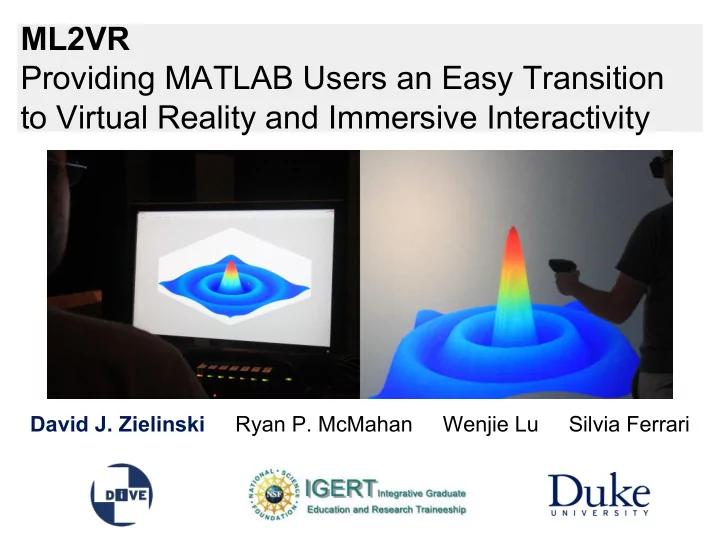
SLIDE 1
ML2VR Providing MATLAB Users an Easy Transition to Virtual Reality and Immersive Interactivity
David J. Zielinski Ryan P. McMahan Wenjie Lu Silvia Ferrari
SLIDE 2 Motivation:
DiVE: Duke Immersive Virtual Environment. 6-Sided CAVE-type Virtual Reality System
Benefits of using Virtual Reality
- Represent models to scale
- Increased spatial understanding
- Advanced interaction techniques
- Collaborative exploration (CAVE-
type systems)
(Open House Every Thursday 4:30pm)
SLIDE 3
Motivation: Engineering Students DiVE ?
SLIDE 4
Question: What software do engineers use for simulation and modeling?
SLIDE 5
Answer: MATLAB
"MATLAB is a numerical computing environment and programming language. Developed by MathWorks, MATLAB allows matrix manipulations, plotting of functions and data, and implementation of algorithms." -Wikipedia
SLIDE 6
Our Goal: MATLAB DiVE
SLIDE 7 Potential Existing Solutions:
Name Features Issues MATLAB Simulink 3D Toolbox
(Commercial Software Module)
Create and modify VRML scenegraphs. Targeted at Desktop display systems. Avizo CalculusMatlab
(Commercial Software Module)
Run MATLAB scripts inside Avizo to process data. Can't utilize user's existing rendering code. Chromium
(open-source project)
Capture and Distributes OpenGL to Render Nodes. No input device abstraction layer. Syzygy
(open-source framework)
Provides input device and display abstraction layer. No way to obtain MATLAB's graphics.
SLIDE 8 Potential Existing Solutions:
Name Features Issues MATLAB Simulink 3D Toolbox
(Commercial Software Module)
Create and modify VRML scenegraphs. Targeted at Desktop display systems. Avizo CalculusMatlab
(Commercial Software Module)
Run MATLAB scripts inside Avizo to process data. Can't utilize user's existing rendering code. Chromium
(open-source project)
Capture and Distributes OpenGL to Render Nodes. No input device abstraction layer. Syzygy
(open-source framework)
Provides input device and display abstraction layer. No way to obtain MATLAB's graphics.
ML2VR MATLAB Syzygy
Our Solution:
SLIDE 9
Let's see ML2VR in action!
SLIDE 10
1 CPU 1 HMD
University of Texas at Dallas
1 CPU 4 Projectors
University of Indiana
1 CPU 1 Projector
Duke University
Common VR System Topologies
SLIDE 11 What is OpenGL?
MATLAB OpenGL Screen fill3([0 0 0],[1 0 0],[1 0 1], glBegin(GL_TRIANGLES) glVertex3f(0,0,0); glVertex3f(1,0,0); glVertex3f(1,0,1); glEnd();
"OpenGL is an API (Application Progamming Interface) for rendering 2D and 3D computer graphics. The API is typically used to interact with a GPU, to achieve hardware-accelerated
- rendering. OpenGL was developed by Silicon Graphics Inc. in
1992." -Wikipedia
vertex = corner
SLIDE 12 What does OpenGL intercept mean?
- 1. We add our replacement opengl32.dll to the MATLAB directory.
- 2. At runtime, MATLAB now loads our replacement opengl32.dll
- 3. When MATLAB calls an opengl function, our function gets called
- 4. After sending out the data, we pass the data onto the real
- pengl32.dll function
SLIDE 13 What does OpenGL intercept mean?
- 1. We add our replacement opengl32.dll to the MATLAB directory.
- 2. At runtime, MATLAB now loads our replacement opengl32.dll
- 3. When MATLAB calls an opengl function, our function gets called
- 4. After sending out the data, we pass the data onto the real
- pengl32.dll function
glVertex3f(...) glVertex3f (...) { // send to GPU } cplxmap(...) MATLAB command normal case
SLIDE 14 What does OpenGL intercept mean?
- 1. We add our replacement opengl32.dll to the MATLAB directory.
- 2. At runtime, MATLAB now loads our replacement opengl32.dll
- 3. When MATLAB calls an opengl function, our function gets called
- 4. After sending out the data, we pass the data onto the real
- pengl32.dll function
glVertex3f(...) glVertex3f (...) { // send to GPU } glVertex3f (...) { send_szg_glVertex3(...); real_opengl.glVertex3f (...); } cplxmap(...) MATLAB command intercept case normal case
SLIDE 15 System Architecture Challenges
- Complicated MATLAB simulations may run at low frame rate.
- Our Syzygy content viewer runs at a higher frame rate.
- Can we utilize this "frame rate mismatch?"
Simulator Sickness Interaction Latency
SLIDE 16 Detailed System Architecture
Graphics content is generated by MATLAB simulation That content is displayed by
SLIDE 17 Detailed System Timeline
- MATLAB simulation generates content
- Syzygy viewer receives a content frame
- While waiting for new content, Syzygy viewer allows user to view content from different
viewpoints (head based rendering).
- Fast head based rendering = reduced simulation sickness
SLIDE 18
- Minimal additions to access data from VR devices
MATLAB Script
vr = vr_interface(ServerIP,ServerPort); while 1 [event,btn,pos]=vr.get_button_event(); if event==1 && btn==0 % modify data here end clf; % clear screen surf(dataX,dataY,dataZ); % render surface drawnow; % flush end
SLIDE 19
Programming API
vr = vr_interface(ServerIP,ServerPort); Parameters: vr.set_return_type(value) vr.set_transform_matrix(value) Events: helps with low frame rate simulations [event, button, pos3]=vr.get_button_event() [event, axis, pos3, val]=vr.get_joystick_event() Polling: [matrix4]=vr.get_sensor_state(sensorID) [val]=vr.get_button_state(buttonID) [val]=vr.get_joystick_state(axisID) Navigation: vr.do_navigation_translate(vec3) vr.do_navigation_rotate(obj, vec3, amount)
SLIDE 20 Case Study: Robot Path Planning
Silvia Ferrari Duke University Wenjie Lu Duke University
- Artificial potential function used to plan the motion of the robot
- Potential function recalculates the best path to the target while
adapting to the dynamic addition and removal of obstacles.
- We added in ML2VR functions to make the simulation interactive.
Key: Robot Obstacle Goal
Original Desktop Simulation Now in VR !
- G. Zhang, and S. Ferrari, “An adaptive artificial potential function approach for geometric
sensing,” in IEEE Decision and Control, 2009, pp. 7903-7910.
SLIDE 21
New Features Robot Demo
Raycasting Move the goal
SLIDE 22
New Sci Vis Examples
coneplot and streamline (complicated 3D visualization) surf demo with parameter modification with joystick x-axis
SLIDE 23
Interaction Examples
01_click 02_joystick 03_touch 04_drag_pos3 05_drag_matrix4 06_virtual_hand_pos3 07_virtual_hand_matrix4 08_raycasting 09_sphere_spawner 10_polling 11_navigation
SLIDE 24 Contributions:
- Open source cross-platform software system.
- MATLAB scripts can easily obtain input device data.
- Decoupled (fast) head based rendering.
- Successful case study of a desktop to VR conversion.
- Suite of Interaction programming examples.
SLIDE 25
March is ML2VR Month!
What Where When Friday Forum Talk Duke University March 8th Poster Session @ FIP Symposium Duke University March 10th-11th Poster @ IEEE VR 2013 Orlando, Florida March 16th-23rd Invited Speaker @ "Immersive Visualization Bootcamp" Indianapolis, Indiana March 25th-27th
SLIDE 26 Software Robustness
- More OpenGL primitives
- Dynamic buffers
- Line rendering issues
- Desktop simulator refinement
Evaluation
- What is the benefit of immersive visualization
and interaction for MATLAB?
Future Work
SLIDE 27
Future Work
Robotics Applications
Quadcopter Simulation Human-Robot Collaboration Simulation
SLIDE 28 Future Work Front + Back Ends
ML2VR MATLAB Syzygy Mathematica
Camille Goudeseune University of Illinois
FreeVR VR Juggler R
Bill Sherman Indiana University Judy Vance Iowa State University
SLIDE 29
Future Work More Collaborators
Michael "Gus" R. Gustafson Teaches EGR 53L, a Computational Methods in Engineering w/ MATLAB course, that is required for all Pratt (Duke Engineering) first-year students. Regis Kopper New director of the DiVE. Ross Tredinnick Living Environments Laboratory (UW Madison CAVE)
SLIDE 30 David J. Zielinski Duke University
Authors
Ryan P. McMahan University of Texas at Dallas
Acknowledgements:
Rachael B. Brady Eric E. Monson Sarah V. Goetz
Support:
National Science Foundation. IGERT Grant No. DGE-1068871.
Silvia Ferrari Duke University Wenjie Lu Duke University
SLIDE 31
Thank You! Questions?
djzielin@duke.edu http://sourceforge.net/projects/ml2vr/