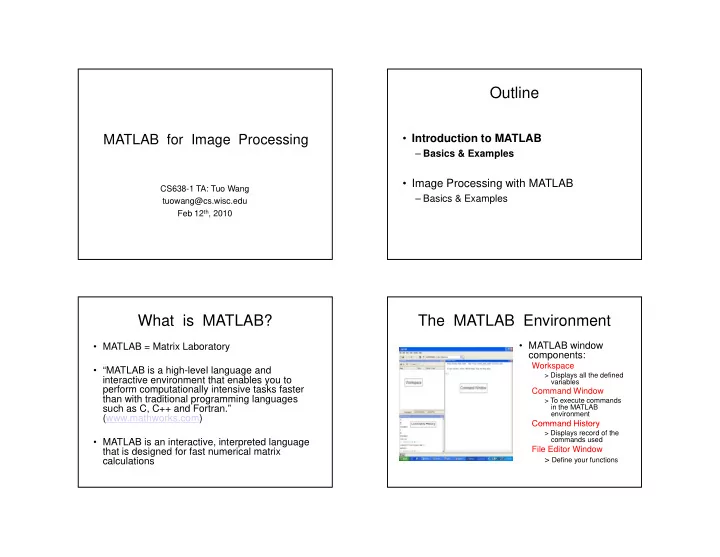
Outline Introduction to MATLAB MATLAB for Image Processing - - PowerPoint PPT Presentation

outline
SMART_READER_LITE
LIVE PREVIEW

Outline Introduction to MATLAB MATLAB for Image Processing - - PowerPoint PPT Presentation

2/12/2010 Outline Introduction to MATLAB MATLAB for Image Processing Basics & Examples Image Processing with MATLAB CS638-1 TA: Tuo Wang Basics & Examples B i & E l tuowang@cs.wisc.edu Feb 12 th , 2010 What


slide-1
SLIDE 1

2/12/2010 1

MATLAB for Image Processing

CS638-1 TA: Tuo Wang tuowang@cs.wisc.edu Feb 12th, 2010

Outline

  • Introduction to MATLAB

– Basics & Examples

  • Image Processing with MATLAB

B i & E l – Basics & Examples

What is MATLAB?

  • MATLAB = Matrix Laboratory
  • “MATLAB is a high-level language and

interactive environment that enables you to perform computationally intensive tasks faster than with traditional programming languages such as C, C++ and Fortran.” (www.mathworks.com)

  • MATLAB is an interactive, interpreted language

that is designed for fast numerical matrix calculations

The MATLAB Environment

  • MATLAB window

components: p

Workspace

> Displays all the defined variables

Command Window

> To execute commands in the MATLAB environment

Command History Command History

> Displays record of the commands used

File Editor Window > Define your functions

slide-2
SLIDE 2

2/12/2010 2

MATLAB Help

  • MATLAB Help is an

extremely powerful y p assistance to learning MATLAB

  • Help not only contains the

theoretical background, but also shows demos for implementation implementation

  • MATLAB Help can be
  • pened by using the

HELP pull-down menu

MATLAB Help (cont.)

  • Any command description

can be found by typing h d i h the command in the search field

  • As shown above, the

command to take square root (sqrt) is searched

  • We can also utilize

MATLAB Help from the command window as shown

More about the Workspace

  • who, whos – current variables in the

k workspace

  • save – save workspace variables to *.mat

file

  • load – load variables from *.mat file
  • l

clear workspace variables

  • clear – clear workspace variables
  • CODE

Matrices in MATLAB

  • Matrix is the main MATLAB data type
  • How to build a matrix?

– A=[1 2 3; 4 5 6; 7 8 9]; – Creates matrix A of size 3 x 3

  • Special matrices:

( ) ( ) ( ) – zeros(n,m), ones(n,m), eye(n,m), rand(), randn()

slide-3
SLIDE 3

2/12/2010 3

Basic Operations on Matrices

  • All operators in MATLAB are defined on

matrices + * / ^ t matrices: +, -, *, /, ^, sqrt, sin, cos, etc.

  • Element-wise operators defined with a

preceding dot: .*, ./, .^

  • size(A) – size vector

size(A) size vector

  • sum(A) – columns sums vector
  • sum(sum(A)) – sum of all the elements
  • CODE

Variable Name in Matlab

  • Variable naming rules
  • must be unique in the first 63 characters
  • must begin with a letter
  • may not contain blank spaces or other types of punctuation
  • may contain any combination of letters, digits, and

underscores

  • are case-sensitive
  • should not use Matlab keyword
  • Pre-defined variable names
  • pi

Logical Operators

  • ==, <, >, (not equal) ~=, (not) ~
  • find(‘condition’) – Returns indexes
  • f A’s elements that satisfy the condition

Logical Operators (cont.)

  • Example:

>>A=[7 3 5; 6 2 1], Idx=find(A<4)

A=

7 3 5 6 2 1

Idx=

3 4 6

slide-4
SLIDE 4

2/12/2010 4

Flow Control

  • MATLAB has five flow control constructs:

– if statement – switch statement – for loop – while loop – break statement break statement

if

  • IF statement condition

– The general form of the IF statement is

IF expression

statements

ELSEIF expression

statements

ELSE ELSE

statements

END

  • CODE

switch

  • SWITCH – Switch among several cases based
  • n expression
  • n expression
  • The general form of SWITCH statement is:

SWITCH switch_expr

CASE case_expr,

statement, …, statement

CASE {case_expr1, case_expr2, case_expr3, …}

statement, …, statement …

OTHERWISE

statement, …, statement

END

switch (cont.)

  • Note:

– Only the statements between the matching CASE and the next CASE, OTHERWISE, or END are executed – Unlike C, the SWITCH statement does not fall through (so BREAKs are unnecessary)

  • CODE
slide-5
SLIDE 5

2/12/2010 5

for

  • FOR repeats statements a specific

b f ti number of times

  • The general form of a FOR statement is:

FOR variable=expr

statements statements

END

  • CODE

while

  • WHILE repeats statements an indefinite

b f ti number of times

  • The general form of a WHILE statement is:

WHILE expression

statements

END

  • CODE

Scripts and Functions

  • There are two kinds of M-files:

– Scripts, which do not accept input arguments

  • r return output arguments. They operate on

data in the workspace – Functions, which can accept input arguments and return output arguments. Internal variables are local to the function

Functions in MATLAB (cont.)

  • Example:

– A file called STAT M: A file called STAT.M: function [mean, stdev]=stat(x) %STAT Interesting statistics. n=length(x); mean=sum(x)/n; stdev=sqrt(sum((x-mean).^2)/n); D fi f ti ll d STAT th t l l t – Defines a new function called STAT that calculates the mean and standard deviation of a vector. Function name and file name should be the SAME!

– CODE

slide-6
SLIDE 6

2/12/2010 6

Visualization and Graphics

  • plot(x,y),plot(x,sin(x)) – plot 1D function
  • figure

figure(k) – open a new figure

  • figure, figure(k) – open a new figure
  • hold on, hold off – refreshing
  • axis([xmin xmax ymin ymax]) – change axes
  • title(‘figure titile’) – add title to figure
  • mesh(x_ax,y_ax,z_mat) – view surface
  • contour(z_mat) – view z as topo map
  • subplot(3,1,2) – locate several plots in figure
  • CODE and Debug CODE

Saving your Work

  • save mysession

% creates mysession.mat with all variables y

  • save mysession a b

% save only variables a and b

  • clear all

% clear all variables

  • clear a b

% clear variables a and b

  • load mysession

% load session

Outline

  • Introduction to MATLAB

– Basics & Examples

  • Image Processing with MATLAB

B i & E l – Basics & Examples

What is the Image Processing Toolbox?

  • The Image Processing Toolbox is a collection of

functions that extend the capabilities of the MATLAB’s functions that extend the capabilities of the MATLAB s numeric computing environment. The toolbox supports a wide range of image processing operations, including:

– Geometric operations – Neighborhood and block operations – Linear filtering and filter design – Transforms – Image analysis and enhancement – Binary image operations – Region of interest operations

slide-7
SLIDE 7

2/12/2010 7

Images in MATLAB

  • MATLAB can import/export

several image formats:

  • Data types in MATLAB

– Double (64-bit double-precision – BMP (Microsoft Windows Bitmap) – GIF (Graphics Interchange Files) – HDF (Hierarchical Data Format) – JPEG (Joint Photographic Experts Group) – PCX (Paintbrush) – PNG (Portable Network Graphics) floating point) – Single (32-bit single-precision floating point) – Int32 (32-bit signed integer) – Int16 (16-bit signed integer) – Int8 (8-bit signed integer) – Uint32 (32-bit unsigned integer) – Uint16 (16-bit unsigned integer) – TIFF (Tagged Image File Format) – XWD (X Window Dump) – raw-data and other types of image data – Uint8 (8-bit unsigned integer)

Images in MATLAB

  • Binary images : {0,1}
  • Intensity images : [0,1] or uint8, double etc.

y g [ ]

  • RGB images : m × n × 3
  • Multidimensional images: m × n × p (p is the number of layers)

Image Import and Export

  • Read and write images in Matlab

img = imread('apple.jpg'); img imread( apple.jpg ); dim = size(img); figure; imshow(img); imwrite(img, 'output.bmp', 'bmp');

  • Alternatives to imshow

Alternatives to imshow imagesc(I) imtool(I) image(I)

Images and Matrices

[0, 0]

How to build a matrix

Row 1 to 256

  • (or image)?

Intensity Image: row = 256; col = 256; img = zeros(row, col); i (100 105 ) 0 5

Column 1 to 256

  • [256, 256]

img(100:105, :) = 0.5; img(:, 100:105) = 1; figure; imshow(img);

slide-8
SLIDE 8

2/12/2010 8

Images and Matrices

Binary Image: row = 256; col = 256; img = rand(row, col); img = round(img); figure; imshow(img);

Image Display

  • image - create and display image object

i l d di l i

  • imagesc - scale and display as image
  • imshow - display image
  • colorbar - display colorbar
  • getimage - get image data from axes
  • truesize - adjust display size of image

j p y g

  • zoom - zoom in and zoom out of 2D plot

Image Conversion

  • gray2ind - intensity image to index image
  • im2bw

image to binary

  • im2bw - image to binary
  • im2double - image to double precision
  • im2uint8 - image to 8-bit unsigned integers
  • im2uint16 - image to 16-bit unsigned integers
  • ind2gray - indexed image to intensity image

t2 t i t i t it i

  • mat2gray - matrix to intensity image
  • rgb2gray - RGB image to grayscale
  • rgb2ind - RGB image to indexed image

Image Operations

  • RGB image to gray image
  • Image resize
  • Image resize
  • Image crop
  • Image rotate
  • Image histogram
  • Image histogram equalization

I DCT/IDCT

  • Image DCT/IDCT
  • Convolution
  • CODE
slide-9
SLIDE 9

2/12/2010 9

Outline

  • Introduction to MATLAB

– Basics & Examples

  • Image Processing with MATLAB

– Basics & Examples

Examples working with Images (1/3)

Create AVI movie with a series images Video

Examples working with Images (2/3)

Blending two images

Examples working with Images (3/3)

Sobel descriptor to detect object edge Sobel descriptor to detect object edge

slide-10
SLIDE 10

2/12/2010 10

Performance Issues

  • The idea: MATLAB is

– very fast on vector and matrix operations – Correspondingly slow with loops

  • Try to avoid loops

T t t i d

  • Try to vectorize your code

http://www.mathworks.com/support/tech- notes/1100/1109.html

Vectorize Loops

  • Example

– Given image matrices, A and B, of the same size (540*380), blend these two images these two images apple = imread(‘apple.jpg');

  • range = imread(‘orange.jpg’);
  • Poor Style

% measure performance using stopwatch timer tic for i = 1 : size(apple, 1) for j = 1 : size(apple, 2) for k = 1 : size(apple, 3)

  • utput(i, j, k) = (apple(i, j, k) + orange(i, j, k))/2;

end end end toc

  • Elapsed time is 0.138116 seconds

Vectorize Loops (cont.)

  • Example

– Given image matrices, A and B, of the same size (600*400), bl d th t i blend these two images apple = imread(‘apple.jpg');

  • range = imread(‘orange.jpg’);
  • Better Style

tic % measure performance using stopwatch timer Output = (apple + orange)/2; toc

  • Elapsed time is 0.099802 seconds
  • Computation is faster!

THE END

  • Thanks for your attention! 
  • Questions?