minutes Our Ref: AAB/090226/M Alumni Advisory Board 5.30pm, - - PDF document

minutes
SMART_READER_LITE
LIVE PREVIEW

minutes Our Ref: AAB/090226/M Alumni Advisory Board 5.30pm, - - PDF document

minutes Our Ref: AAB/090226/M Alumni Advisory Board 5.30pm, Thursday 26 th February Princess Mary Louise Room, The Oxford and Cambridge Club, SW1Y Present: Professor Alison Richard Ms Dina Medland Mr Stuart Laing Dr Simon Singh Sir Paul


slide-1
SLIDE 1

minutes

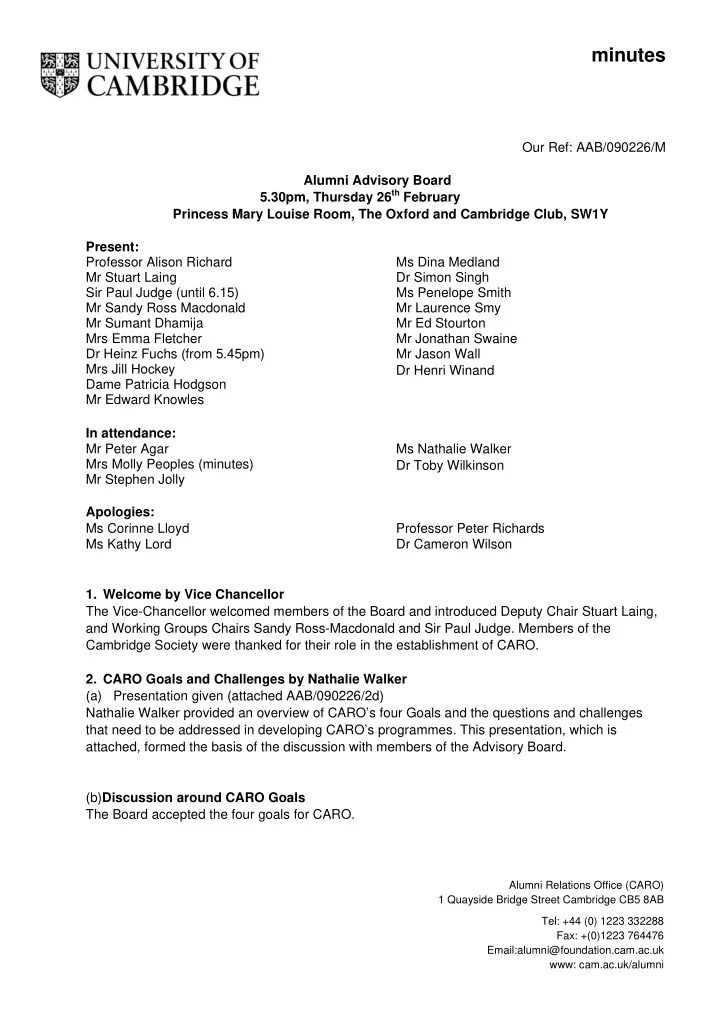
Our Ref: AAB/090226/M Alumni Advisory Board 5.30pm, Thursday 26th February Princess Mary Louise Room, The Oxford and Cambridge Club, SW1Y Present: Professor Alison Richard Mr Stuart Laing Sir Paul Judge (until 6.15) Mr Sandy Ross Macdonald Mr Sumant Dhamija Mrs Emma Fletcher Dr Heinz Fuchs (from 5.45pm) Mrs Jill Hockey Dame Patricia Hodgson Mr Edward Knowles Ms Dina Medland Dr Simon Singh Ms Penelope Smith Mr Laurence Smy Mr Ed Stourton Mr Jonathan Swaine Mr Jason Wall Dr Henri Winand In attendance: Mr Peter Agar Mrs Molly Peoples (minutes) Mr Stephen Jolly Ms Nathalie Walker Dr Toby Wilkinson Apologies: Ms Corinne Lloyd Ms Kathy Lord Professor Peter Richards Dr Cameron Wilson

  • 1. Welcome by Vice Chancellor

The Vice-Chancellor welcomed members of the Board and introduced Deputy Chair Stuart Laing, and Working Groups Chairs Sandy Ross-Macdonald and Sir Paul Judge. Members of the Cambridge Society were thanked for their role in the establishment of CARO.

  • 2. CARO Goals and Challenges by Nathalie Walker

(a) Presentation given (attached AAB/090226/2d) Nathalie Walker provided an overview of CARO’s four Goals and the questions and challenges that need to be addressed in developing CARO’s programmes. This presentation, which is attached, formed the basis of the discussion with members of the Advisory Board. (b)Discussion around CARO Goals The Board accepted the four goals for CARO.

Alumni Relations Office (CARO) 1 Quayside Bridge Street Cambridge CB5 8AB Tel: +44 (0) 1223 332288 Fax: +(0)1223 764476 Email:alumni@foundation.cam.ac.uk www: cam.ac.uk/alumni

slide-2
SLIDE 2

L:\Alumni Relations\Alumni Board\First Meeting\Minutes\200903 Minutes.doc

Discussions took place around the first three Goals with the following broad suggestions: Social Networking The Board encouraged CARO to strive to lead the University alumni networks in the use of social networking technologies (including but not limited to Facebook). This would take place in conjunction with University wide approaches to the use of social networking, and in the context that many Colleges or groups already have a presence in these areas. The Board recognised that the rise of web-based social networking in particular, and new-media in general, posed new challenges to the University and may require a more ad hoc and informal style of communication than has been Cambridge’s tradition. Due consideration of any possible negative effects or risks should also be taken The role of the University Alumni Office The Board suggested that CARO could provide a useful service to alumni by connecting people across Colleges, promoting existing activities (such as College/ departmental activities or the Careers Service) and facilitating the giving of ‘life stage advice’ (i.e. peer to peer). It was felt that CARO will be most successful in areas where there is currently little existing centralized alumni activity (e.g. UK regions/ international). Post-graduate students are also likely to have a stronger University or Faculty affinity than undergraduates, who tend to have close affinity with their Colleges. Alumni Weekend It was agreed that it is important to bring people back to Cambridge and it would be useful to gather data on the number of alumni in Cambridge on Alumni Weekend who do not participate in centrally organized activities even though they may have attended a related College event. A greater departmental and collegiate focus to the weekend might attract more people, as would easier access to parking and accommodation. It was suggested that further thought needs to be given to encourage year groups to participate in the Weekend as a whole to ensure that social opportunities are maximized. The idea of a virtual Alumni Weekend was suggested and it was agreed that there would be considerable merit in investigating this further. ‘On-campus partnerships’ CARO was encouraged to work with other parts of the Collegiate University to provide both services and opportunities for alumni including Careers, Admissions, colleges, clubs and societies.

  • 3. Alumni Award Proposal

Paper AAB/090226/3 was received as an initial proposal for discussion (in summary, several awards to be made annually to alumni for ‘services to the alumni network’).

4/3/09

Page 2 of 2

slide-3
SLIDE 3

L:\Alumni Relations\Alumni Board\First Meeting\Minutes\200903 Minutes.doc

A counter proposal was made by a member of the Board that having only a few awards could prove either divisive or insignificant, and as such Cambridge could commit to awarding 800 (or 801!) awards over the next ten years, to recognize the breadth of volunteering support. A third suggestion was then made that a major award ceremony/ process could take place every five years with c.100 awards being made. Jason Wall agreed to Chair a Working Group on the Alumni Award and will be joined by Simon Singh, Heinz Fuchs and representatives from CARO and the Colleges. The Board suggested that the Working Group consider the following issues: Clear guidance needs to be given regarding the purpose of the award and it was suggested that it should also be for services to the University as well as to the alumni

  • network. The notion that the award should recognize collegiate service was accepted, but

it was also noted that the award needs to be forward looking and not simply political. It might make sense to award a large number of awards in year one to ‘catch up with the backlog’ and then commit to a smaller number of annual awards thereafter. It may be better to consider a high profile launch of the award and associated press

  • coverage. A long term strategy for maintaining connections with previous winners need to

be considered. Communication of the award, nominations process and recipients needs to be considered seriously. Members reported from other award experience that clarity and transparency on these issues were critical to widespread acceptance of the award scheme. The Cambridge cultural context is very important when considering the criteria for the award and whilst much can be learnt from the North American experience there is potential merit in a fresh approach. Further information from Oxford and Clare College (and any other Colleges with award schemes) should be sought. ACTION: Working Group to present a proposal on the Award at the next meeting ACTION: Any other Board members keen to be involved with this initiative to contact Nathalie Walker.

  • 4. A.O.B

It was noted that it would be useful to have comprehensive information about the ways in which alumni are already involved within the University. It was suggested that it would be useful for Cambridge to ensure that alumni had access to an email address for life on arrival at Cambridge and that CARO should have a strong presence at General Admissions.

4/3/09

Page 3 of 3

slide-4
SLIDE 4

L:\Alumni Relations\Alumni Board\First Meeting\Minutes\200903 Minutes.doc 4/3/09

Page 4 of 4 The Networks and Volunteers and Communications Working Groups will meet between meetings and additional Working Groups will be established as necessary. Board members were encouraged where possible to join these groups to input into the ongoing work of CARO. Details will be circulated to Board members about the ‘extranet’ where Board papers will be stored. The Cambridge Society responded to the meeting by reiterating their support for the new arrangements and their excitement at the potential to create a world class alumni network for Cambridge. ACTION: Internal audit of existing alumni engagement ACTION: Establishment of ‘extranet’ site and distribution of information

slide-5
SLIDE 5

Alumni Relations at Cambridge, 2009

Nathalie Walker, Head of Alumni Relations Cambridge Alumni Relations Office

slide-6
SLIDE 6

2

Agenda

  • The vision for alumni relations at Cambridge
  • Operational Objectives
  • Long-term Goals
  • Discussion
slide-7
SLIDE 7

3

CARO – Your gateway in to Cambridge

slide-8
SLIDE 8

4

2008-9 Operational Objectives

  • Deliver an exceptional events programme connecting alumni to the

University in this anniversary year

  • To complete the merger with the Cambridge Society and develop the

volunteer structure

  • To launch the Alumni Advisory Board
  • To re-launch the Alumni Relations website and e-newsletter (Phase 1)
  • To successfully implement a re-design of CAM
  • To establish good working relationships with the Colleges
  • To establish a clearly defined long-term strategy with appropriate

metrics for success

slide-9
SLIDE 9

5

2009-10 Operational Objectives

  • Understanding alumni views on Cambridge and alumni needs through surveys

and focus groups and putting in place systematic and regular alumni feedback mechanisms

  • Development of sophisticated segmentation techniques to allow better matching
  • f service and support for particular groups of alumni
  • Developing an online community with password protected areas and ‘group

management tools’

  • Reviewing the revenue generating potential of our benefits offering

(merchandise, Travel Programme, credit card etc.)

  • Establishing partnerships where alumni could be of benefit to the wider

University (i.e. Admissions, Careers, The Cambridge Trusts, International Office) and the University can benefit alumni

slide-10
SLIDE 10

6

GOALS

  • 1. To encourage relationships and build links between members of the

University (and friends of the University) both individually and institutionally.

  • 2. To ensure that alumni are well-informed about the development of

the University and to foster in them a continuing commitment to the advancement, welfare and interests of the University.

  • 3. To ensure that the wide range of alumni relations programmes are

responsive to the evolving needs of alumni through each stage of their lives.

  • 4. To facilitate the coordination of alumni relations activities within, and
  • n behalf of, the collegiate University.
slide-11
SLIDE 11

7

  • 1. To encourage relationships and build links between members of the University (and

friends of the University) both individually and institutionally.

  • Should we facilitate and engage with alumni – alumni relationships?
  • Are there particular relationships on which we should be placing

emphasis?

  • alumni – alumni
  • alumni – institution
  • alumni – specific entities
  • What investment decisions does CARO need to take?
slide-12
SLIDE 12

8

  • 2. To ensure that alumni are well-informed about the development of the University

and to foster in them a continuing commitment to the advancement, welfare and interests of the University.

  • Given financial considerations, to what extent is the web an alternative

to, as opposed to a complement to, ‘print on paper’ communications?

  • How appropriate is it for CARO to use “web 2.0” (and associated styles
  • f communication) to share Cambridge messages with alumni?
  • In what ‘external’ and ‘internal’ ways are we hoping to see alumni

demonstrate their commitment to Cambridge?

slide-13
SLIDE 13

9

  • 3. To ensure that the wide range of alumni relations programmes are

responsive to the evolving needs of alumni through each stage of their lives.

  • How do we know what our alumni need and balance responsiveness to

that with the University’s own priorities?

  • How do we design alumni programmes in ways that support a global,

mobile alumni network?

  • Where do we focus our efforts over the next five years?