Class Outline: Posterior Anatomy 5 minutes Breath of Arrival and - - PowerPoint PPT Presentation

class outline posterior anatomy
SMART_READER_LITE
LIVE PREVIEW

Class Outline: Posterior Anatomy 5 minutes Breath of Arrival and - - PowerPoint PPT Presentation

Class Outline: Posterior Anatomy 5 minutes Breath of Arrival and Attendance 5 minutes Howdy Partner 35 minutes Posterior Anatomy using Power Point Presentation 5 minutes Overview of skeletal segments 5 minutes Quick drawing


slide-1
SLIDE 1

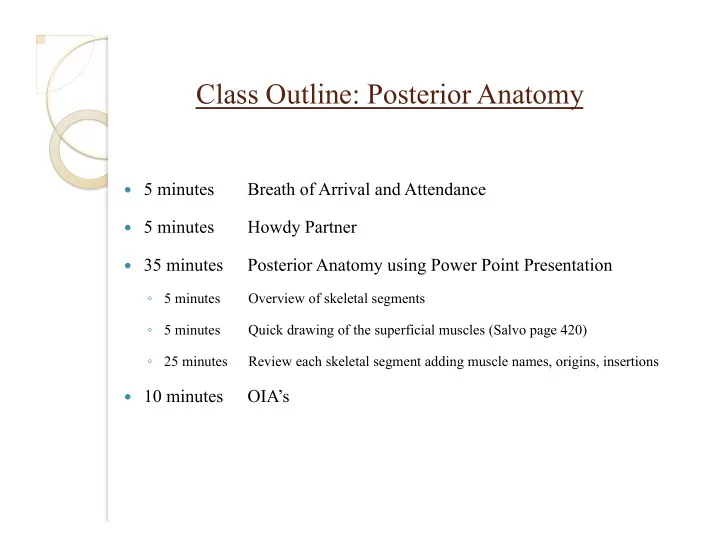
Class Outline: Posterior Anatomy

 5 minutes

Breath of Arrival and Attendance

 5 minutes

Howdy Partner

 35 minutes

Posterior Anatomy using Power Point Presentation

  • 5 minutes

Overview of skeletal segments

  • 5 minutes

Quick drawing of the superficial muscles (Salvo page 420)

  • 25 minutes

Review each skeletal segment adding muscle names, origins, insertions  10 minutes

OIA’s

slide-2
SLIDE 2

Classroom Rules

Punctuality- everybody's time is precious:

  • Be ready to learn by 9:00, we'll have you out of here by 1:30
  • Tardiness: arriving late, late return after breaks, leaving early

The following are not allowed:

  • Bare feet
  • Side talking
  • Lying down
  • Inappropriate clothing
  • Food or drink except water
  • Phones in classrooms, clinic or bathrooms

You will receive one verbal warning, then you'll have to leave the room.

slide-3
SLIDE 3

Posterior Anatomy

Names, locations, and shapes of muscles

slide-4
SLIDE 4

Posterior Skeletal Segments

Giving names to the bones on the back of the body.

slide-5
SLIDE 5

Posterior Anatomy

As we explore the skeletal segments, label them with the images supplied.

slide-6
SLIDE 6

The Big Picture

slide-7
SLIDE 7

Head

Bones: skull or cranium

slide-8
SLIDE 8

Neck

Bones: cervical spine

slide-9
SLIDE 9

Trunk

Bones: thoracic spine, lumbar spine, and rib cage

slide-10
SLIDE 10

Shoulder Girdle

Bones: collar bone (clavicle) and shoulder blade (scapula)

slide-11
SLIDE 11

Arm (upper extremity)

Bones: arm bone (humerus), forearm bones (radius and ulna), and hand bones

slide-12
SLIDE 12

Pelvic Girdle

Bones: pelvic bones and tail bone (sacrum and coccyx)

slide-13
SLIDE 13

Thigh

Bones: thigh bone (femur)

slide-14
SLIDE 14

Leg

Bones: lower leg bones (tibia and fibula)

slide-15
SLIDE 15

Foot

Bones: heel bone (calcaneus), and lots of others

slide-16
SLIDE 16

Posterior Muscles

Giving names, shapes and locations to muscles

slide-17
SLIDE 17

Let’s draw the superficial muscles!

slide-18
SLIDE 18

Head These muscles will be covered in Class 11a: Muscles of the Head / Neck

slide-19
SLIDE 19

Neck Muscle: upper trapezius Origin: skull and cervical spine Insertion: shoulder girdle (scapulae)

slide-20
SLIDE 20

Neck Muscle: upper trapezius (upper traps) Origin: skull and cervical spine Insertion: shoulder girdle (scapulae)

slide-21
SLIDE 21

Trunk Thorax and Lumbar Vertebrae

slide-22
SLIDE 22

Trunk Muscle: middle trapezius (middle traps) Origin: thoracic spine Insertion: shoulder girdle (scapulae)

slide-23
SLIDE 23

Trunk Muscle: lower trapezius (lower traps) Origin: thoracic spine Insertion: shoulder girdle (scapulae)

slide-24
SLIDE 24

Trunk Muscle: rhomboids Origin: thoracic spine Insertion: shoulder girdle (scapulae)

slide-25
SLIDE 25

Trunk Muscle: levator scapula Origin: cervical spine Insertion: shoulder girdle (scapulae)

slide-26
SLIDE 26

Overview and Layers of the Trunk trapezius levator scapula rhomboids serratus anterior

slide-27
SLIDE 27
slide-28
SLIDE 28

Trunk Muscle: erector spinae (back strap muscles or spinal erectors) Origin: pelvis, spine, and ribs (lower) Insertion: upper spine and ribs, and skull

slide-29
SLIDE 29

Trunk Muscle: latissimus dorsi (lats) Origin: pelvis, thoracic and lumbar spine Insertion: upper arm (proximal humerus)

slide-30
SLIDE 30
slide-31
SLIDE 31

Other stuff let’s zoom in . . .

slide-32
SLIDE 32

Other stuff that we’ll study later teres major infraspinatus teres minor

slide-33
SLIDE 33

Arm

slide-34
SLIDE 34

Arm Muscle: deltoid (posterior deltoid) Origin: shoulder girdle Insertion: arm (humerus)

slide-35
SLIDE 35

Arm Muscle: deltoid (posterior, middle, and anterior) Origin: shoulder girdle Insertion: arm (humerus)

slide-36
SLIDE 36

Arm Muscle: triceps brachii (triceps) Origin: shoulder girdle Insertion: proximal forearm (ulna)

slide-37
SLIDE 37

Arm Muscle: triceps brachii (triceps) Origin: shoulder girdle Insertion: proximal forearm (ulna)

slide-38
SLIDE 38

Forearm Muscle: forearm extensors Origin: proximal arm (humerus) Insertion: fingers

slide-39
SLIDE 39

Pelvis Gluteal muscles

slide-40
SLIDE 40

Pelvis Muscle: gluteus maximus Origin: sacrum and upper (proximal) pelvis Insertion: upper thigh (proximal femur)

slide-41
SLIDE 41

Pelvis Muscle: gluteus medius Origin: upper (proximal) pelvis Insertion: upper thigh (proximal femur)

slide-42
SLIDE 42

Pelvis gluteus medius gluteus maximus

slide-43
SLIDE 43

Thigh Hamstrings

slide-44
SLIDE 44

Thigh Muscle: biceps femoris (lateral hamstring) Origin: Insertion:

slide-45
SLIDE 45

Thigh Muscle: semitendinosus (medial hamstring) Origin: Insertion:

slide-46
SLIDE 46

Thigh Muscle: semimembranosus (medial hamstring) Origin: Insertion:

slide-47
SLIDE 47

Layering and Positioning of Thigh Muscles semimembranosus is deep to semitendinosus biceps femoris is lateral to semitendinosus and semimembranosus

slide-48
SLIDE 48

Other stuff that we will study later adductors (from pelvis to femur) iliotibial band (from pelvis to tibia)

slide-49
SLIDE 49

Leg Calf muscles, or calves

slide-50
SLIDE 50

Leg Muscle: gastrocnemius (gastroc) Origin: lower thigh (distal femur) Insertion: heel bone (calcaneus)

slide-51
SLIDE 51

Leg Muscle: soleus Origin: leg (tibia and fibula) Insertion: heel bone (calcaneus)

slide-52
SLIDE 52

Layering of Leg Muscles gastrocnemius (superficial) soleus (deep)

slide-53
SLIDE 53

Introducing the concepts of OIA

Where do muscles begin and end? What do they do?

slide-54
SLIDE 54

Where are the hamstrings?

slide-55
SLIDE 55

The hamstrings are here . . . Let’s zoom in.

slide-56
SLIDE 56
slide-57
SLIDE 57

Please turn to packet page II-33

slide-58
SLIDE 58

OIA’s (origin, insertion, and action)

Belly The wide central portion of a skeletal muscle. Tendon Cord-like structure anchoring the end of a muscle to a bone. Origin Tendinous muscle attachment on the less movable bone. Insertion Tendinous muscle attachment on the more movable bone. Action The movement caused by the contraction of a muscle.

slide-59
SLIDE 59

Biceps Femoris Origin:

  • Ischial tuberosity
  • Linea aspera of femur

Insertion:

  • Head of fibula

Actions:

  • Flex the knee
  • Extend the hip

Resource Pages Salvo: 538 Trail Guide: 311-313 Coloring Book: 55

slide-60
SLIDE 60

Semitendinosus Origin:

  • Ischial tuberosity

Insertion:

  • Medial proximal tibia

(AKA: pes anserinus) Actions:

  • Flex the knee
  • Extend the hip

Resource Pages Salvo: 538 Trail Guide: 311-313 Coloring Book: 55

slide-61
SLIDE 61

Semimembranosus Origin:

  • Ischial tuberosity

Insertion:

  • Posterior medial tibial condyle

Actions:

  • Flex the knee
  • Extend the hip

Resource Pages Salvo: 537 Trail Guide: 311-313 Coloring Book: 55

slide-62
SLIDE 62

Hamstrings: the posterior thigh muscles

slide-63
SLIDE 63

Posterior Anatomy

Names, locations, and shapes of muscles