Minimum Spanning Tree 11/26/2003 9:54 AM Minimum Spanning Trees - - PDF document

minimum spanning tree 11 26 2003 9 54 am
SMART_READER_LITE
LIVE PREVIEW

Minimum Spanning Tree 11/26/2003 9:54 AM Minimum Spanning Trees - - PDF document

Minimum Spanning Tree 11/26/2003 9:54 AM Minimum Spanning Trees 2704 BOS 867 849 PVD ORD 187 740 144 1846 JFK 621 184 1258 802 SFO BWI 1391 1464 337 1090 DFW 946 LAX 1235 1121 MIA 2342 Minimum Spanning Trees v1.3 1


slide-1
SLIDE 1

Minimum Spanning Tree 11/26/2003 9:54 AM 1

Minimum Spanning Trees v1.3 1

Minimum Spanning Trees

JFK BOS MIA ORD LAX DFW SFO BWI PVD 867 2704 187 1258 849 144 740 1391 184 946 1090 1121 2342 1846 621 802 1464 1235 337

Minimum Spanning Trees v1.3 2

Outline and Reading

Minimum Spanning Trees (§7.3)

Definitions A crucial fact

The Prim-Jarnik Algorithm (§7.3.2) Kruskal's Algorithm (§7.3.1) Baruvka's Algorithm (§7.3.3)

Minimum Spanning Trees v1.3 3

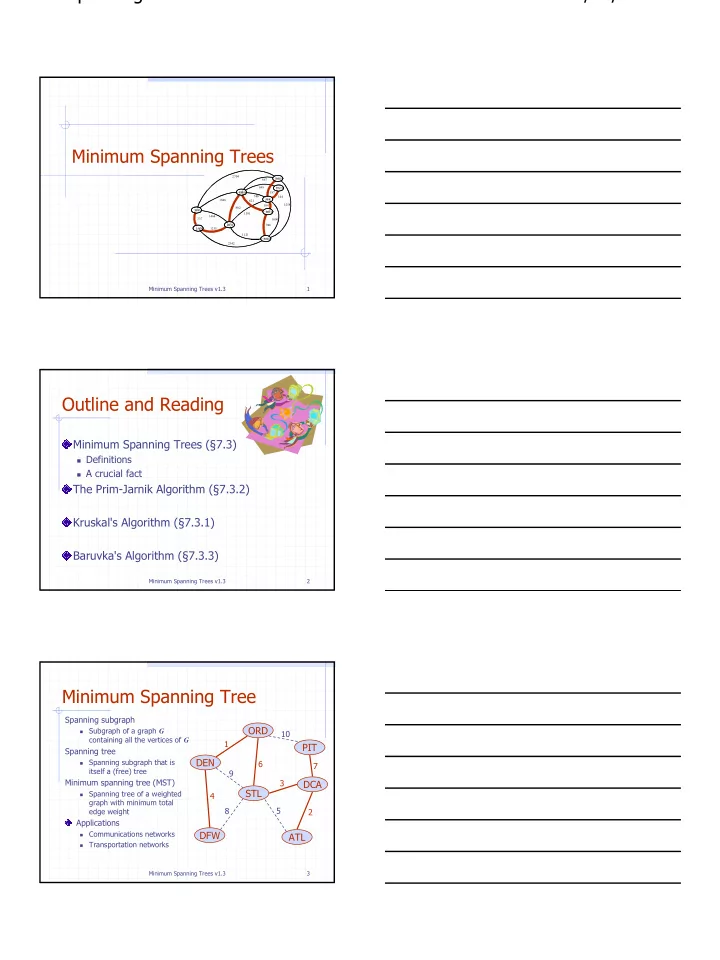
Minimum Spanning Tree

Spanning subgraph

  • Subgraph of a graph G

containing all the vertices of G

Spanning tree

  • Spanning subgraph that is

itself a (free) tree

Minimum spanning tree (MST)

  • Spanning tree of a weighted

graph with minimum total edge weight

Applications

  • Communications networks
  • Transportation networks

ORD PIT ATL STL DEN DFW DCA

10 1 9 8 6 3 2 5 7 4

slide-2
SLIDE 2

Minimum Spanning Tree 11/26/2003 9:54 AM 2

Minimum Spanning Trees v1.3 4

Prim-Jarnik’s Algorithm

Like Dijkstra’s algorithm only simpler Grow the MST from arbitrary vertex s Greedily add vertices into cloud based on distance to any vertex in cloud At v, need to store d(v) = minimum weight edge connecting v to a cloud vertex At each step:

We add to the cloud the

vertex u outside the cloud with the smallest distance label

We update the labels of the

vertices adjacent to u (edge relaxation)

Minimum Spanning Trees v1.3 5

Prim’s Edge Relaxation

Consider an edge e = (u,z) such that

  • u is the vertex most recently

added to the cloud

  • z is not in the cloud

The relaxation of edge e updates distance d(z) as follows:

d(z) ← min{d(z),e}

d(z) = 15

10 z s u

d(z) = 10

10 z s u e e

15 15

Minimum Spanning Trees v1.3 6

Prim’s Example

B D C A F E 7 4 2 8 5 7 3 9 8 7 2 8 ∞ ∞ B D C A F E 7 4 2 8 5 7 3 9 8 7 2 5 4 7 B D C A F E 7 4 2 8 5 7 3 9 8 7 2 5 ∞ 7 B D C A F E 7 4 2 8 5 7 3 9 8 7 2 5 ∞ 7

slide-3
SLIDE 3

Minimum Spanning Tree 11/26/2003 9:54 AM 3

Minimum Spanning Trees v1.3 7

Example (contd.)

B D C A F E 7 4 2 8 5 7 3 9 8 3 2 5 4 7 B D C A F E 7 4 2 8 5 7 3 9 8 3 2 5 4 7

Minimum Spanning Trees v1.3 8

Cycle Property

Cycle Property:

  • Let T be a minimum

spanning tree of a weighted graph G

  • Let e be an edge of G

that is not in T and C let be the cycle formed by e with T

  • For every edge f of C,

weight(f) ≤ weight(e) Proof:

  • By contradiction
  • If weight(f) > weight(e) we

can get a spanning tree

  • f smaller weight by

replacing e with f 8 4 2 3 6 7 7 9 8 e

C

f 8 4 2 3 6 7 7 9 8

C

e f Replacing f with e yields a better spanning tree

Minimum Spanning Trees v1.3 9

Correctness of Prim’s

Let Tk be tree produced by Prim’s after kth

  • iteration. Let Gk be the the subgraph of G

induced by Tk. Then Tk is a MST of Gk.

slide-4
SLIDE 4

Minimum Spanning Tree 11/26/2003 9:54 AM 4

Minimum Spanning Trees v1.3 10

Prim-Jarnik’s Algorithm (cont.)

A priority queue stores the vertices outside the cloud

  • Key: distance
  • Element: vertex

Locator-based methods

  • insert(k,e) returns a

locator

  • replaceKey(l,k) changes

the key of an item

We store three labels with each vertex:

  • Distance
  • Tree edge in MST
  • Locator in priority queue

Algorithm PrimJarnikMST(G) Q ← new heap-based priority queue s ← a vertex of G for all v ∈ G.vertices() if v = s setDistance(v, 0) else setDistance(v, ∞) setTreeEdge(v, ∅) l ← Q.insert(getDistance(v), v) setLocator(v,l) while ¬Q.isEmpty() u ← Q.removeMin() for all e ∈ G.incidentEdges(u) z ← G.opposite(u,e) r ← weight(e) if r < getDistance(z) setDistance(z,r) setTreeEdge(z,e) Q.replaceKey(getLocator(z),r)

Minimum Spanning Trees v1.3 11

Example graph

1 2 3 4 5 6 7 Start at 1, run Prim’s 8 3 21 20 6 7 19 10 9 2

Minimum Spanning Trees v1.3 12

Analysis

Graph operations

  • Method incidentEdges is called once for each vertex

Label operations

  • We set/get the distance, tree and locator labels of vertex z O(deg(z))

times

  • Setting/getting a label takes O(1) time

Priority queue operations

  • Each vertex inserted and removed once taking O(log n) time each time

for 2n times.

  • The key of a vertex w in the priority queue is modified at most deg(w)

times, where each key change takes O(log n) time

Prim-Jarnik’s algorithm runs in O((n + m) log n) time provided the graph is represented by the adjacency list structure The running time is O(m log n) since the graph is connected What is running time for unsorted-sequence based priority queue?

slide-5
SLIDE 5

Minimum Spanning Tree 11/26/2003 9:54 AM 5

Minimum Spanning Trees v1.3 13

Kruskal’s MST algorithm

Another greedy strategy for finding MST Gradually turn forest into tree as edges are added Add cheapest edge possible

Don’t add edge if it forms cycle

Overview: kruskalMST (Graph G) Initalize F (forest) to empty. Place all edges in PQ according to cost For each edge (u,v) in PQ (in sorted order) if (u,v) does not make a cycle in F add (u,v) to F return F;

Minimum Spanning Trees v1.3 14

U V

Partition Property

Partition Property:

  • Consider a partition of the vertices of

G into subsets U and V

  • Let e be an edge of minimum weight

across the partition

  • There is a minimum spanning tree of

G containing edge e Proof:

  • Let T be an MST of G
  • If T does not contain e, consider the

cycle C formed by e with T and let f be an edge of C across the partition

  • By the cycle property,

weight(f) ≤ weight(e)

  • Thus, weight(f) = weight(e)
  • We obtain another MST by replacing

f with e 7 4 2 8 5 7 3 9 8 e f 7 4 2 8 5 7 3 9 8 e f Replacing f with e yields another MST U V

Minimum Spanning Trees v1.3 15

Kruskal’s Algorithm

Each vertex starts in its

  • wn cloud (a partition)

Clouds merge together as edges are added A priority queue stores edges in weight order

  • Key: weight
  • Element: edge

Only edges between clouds will not form cycles

  • add cheapest edge

between clouds

At end of algorithm:

  • All vertices in one cloud
  • Edges added form MST

Algorithm KruskalMST(G) for each vertex V in G do define a Cloud(v) of {v} let Q be a priority queue. Insert all edges into Q using their weights as the key T ∅ while T has fewer than n-1 edges do edge e = T.removeMin() Let u, v be the endpoints of e if Cloud(v) ≠ Cloud(u) then Add edge e to T Merge Cloud(v) and Cloud(u) return T

slide-6
SLIDE 6

Minimum Spanning Tree 11/26/2003 9:54 AM 6

Minimum Spanning Trees v1.3 16

Kruskal Example

JFK BOS MIA ORD LAX DFW SFO BWI PVD 867 2704 187 1258 849 144 740 1391 184 946 1090 1121 2342 1846 621 802 1464 1235 337

Minimum Spanning Trees v1.3 17

JFK BOS MIA ORD LAX DFW SFO BWI PVD 867 2704 187 1258 849 144 740 1391 184 946 1090 1121 2342 1846 621 802 1464 1235 337

Example

Minimum Spanning Trees v1.3 18

Example

JFK BOS MIA ORD LAX DFW SFO BWI PVD 867 2704 187 1258 849 144 740 1391 184 946 1090 1121 2342 1846 621 802 1464 1235 337

slide-7
SLIDE 7

Minimum Spanning Tree 11/26/2003 9:54 AM 7

Minimum Spanning Trees v1.3 19

Example

JFK BOS MIA ORD LAX DFW SFO BWI PVD 867 2704 187 1258 849 144 740 1391 184 946 1090 1121 2342 1846 621 802 1464 1235 337

Minimum Spanning Trees v1.3 20

Example

JFK BOS MIA ORD LAX DFW SFO BWI PVD 867 2704 187 1258 849 144 740 1391 184 946 1090 1121 2342 1846 621 802 1464 1235 337

Minimum Spanning Trees v1.3 21

Example

JFK BOS MIA ORD LAX DFW SFO BWI PVD 867 2704 187 1258 849 144 740 1391 184 946 1090 1121 2342 1846 621 802 1464 1235 337

slide-8
SLIDE 8

Minimum Spanning Tree 11/26/2003 9:54 AM 8

Minimum Spanning Trees v1.3 22

Example

JFK BOS MIA ORD LAX DFW SFO BWI PVD 867 2704 187 1258 849 144 740 1391 184 946 1090 1121 2342 1846 621 802 1464 1235 337

Minimum Spanning Trees v1.3 23

Example

JFK BOS MIA ORD LAX DFW SFO BWI PVD 867 2704 187 1258 849 144 740 1391 184 946 1090 1121 2342 1846 621 802 1464 1235 337

Minimum Spanning Trees v1.3 24

Example

JFK BOS MIA ORD LAX DFW SFO BWI PVD 867 2704 187 1258 849 144 740 1391 184 946 1090 1121 2342 1846 621 802 1464 1235 337

slide-9
SLIDE 9

Minimum Spanning Tree 11/26/2003 9:54 AM 9

Minimum Spanning Trees v1.3 25

Example

JFK BOS MIA ORD LAX DFW SFO BWI PVD 867 2704 187 1258 849 144 740 1391 184 946 1090 1121 2342 1846 621 802 1464 1235 337

Minimum Spanning Trees v1.3 26

Example

JFK BOS MIA ORD LAX DFW SFO BWI PVD 867 2704 187 1258 849 144 740 1391 184 946 1090 1121 2342 1846 621 802 1464 1235 337

Minimum Spanning Trees v1.3 27

Example

JFK BOS MIA ORD LAX DFW SFO BWI PVD 867 2704 187 1258 849 144 740 1391 184 946 1090 1121 2342 1846 621 802 1464 1235 337

slide-10
SLIDE 10

Minimum Spanning Tree 11/26/2003 9:54 AM 10

Minimum Spanning Trees v1.3 28

Example

JFK BOS MIA ORD LAX DFW SFO BWI PVD 867 2704 187 1258 849 144 740 1391 184 946 1090 1121 2342 1846 621 802 1464 1235 337

Minimum Spanning Trees v1.3 29

Example

JFK BOS MIA ORD LAX DFW SFO BWI PVD 867 2704 187 1258 849 144 740 1391 184 946 1090 1121 2342 1846 621 802 1464 1235 337

Minimum Spanning Trees v1.3 30

Data Structure for Kruskal Algortihm

The algorithm maintains a forest of trees An edge is accepted it if connects distinct trees We need a data structure that maintains a partition, i.e., a collection of disjoint sets, with the operations:

  • find(u): return the set storing u
  • union(u,v): replace the sets storing u and v with

their union

slide-11
SLIDE 11

Minimum Spanning Tree 11/26/2003 9:54 AM 11

Minimum Spanning Trees v1.3 31

Representation of a Partition

Each set is stored in a sequence Each element has a reference back to the set

  • peration find(u) takes O(1) time, and returns the set of

which u is a member.

in operation union(u,v), we move the elements of the

smaller set to the sequence of the larger set and update their references

the time for operation union(u,v) is min(nu,nv), where nu

and nv are the sizes of the sets storing u and v

Whenever an element is processed, it goes into a set of size at least double, hence each element is processed at most log n times

Minimum Spanning Trees v1.3 32

Partition-Based Implementation

A partition-based version of Kruskal’s Algorithm performs cloud merges as unions and tests as finds.

Algorithm Kruskal(G): Input: A weighted graph G. Output: An MST T for G. Let P be a partition of the vertices of G, where each vertex forms a separate set. Let Q be a priority queue storing the edges of G, sorted by their weights Let T be an initially-empty tree while Q is not empty do (u,v) ← Q.removeMinElement() if P.find(u) != P.find(v) then Add (u,v) to T P.union(u,v) return T

Running time: O(m log n)

Minimum Spanning Trees v1.3 33

Baruvka’s Algorithm

Like Kruskal’s Algorithm, Baruvka’s algorithm grows many “clouds” at once. Each iteration of the while-loop halves the number of connected components in T.

  • The running time is O(m log n).

Algorithm BaruvkaMST(G) T V {just the vertices of G} while T has fewer than n-1 edges do for each connected component C in T do Let edge e be the smallest-weight edge from C to another component in T. if e is not already in T then Add edge e to T return T

slide-12
SLIDE 12

Minimum Spanning Tree 11/26/2003 9:54 AM 12

Minimum Spanning Trees v1.3 34

JFK BOS MIA ORD LAX DFW SFO BWI PVD 867 2704 187 1258 849 144 740 1391 184 946 1090 1121 2342 1846 621 802 1464 1235 337

Baruvka Example

Minimum Spanning Trees v1.3 35

Example

JFK BOS MIA ORD LAX DFW SFO BWI PVD 867 2704 187 1258 849 144 740 1391 184 946 1090 1121 2342 1846 621 802 1464 1235 337

Minimum Spanning Trees v1.3 36

Example

JFK BOS MIA ORD LAX DFW SFO BWI PVD 867 2704 187 1258 849 144 740 1391 184 946 1090 1121 2342 1846 621 802 1464 1235 337