Minimum Spanning Tree (undirected graph) 2 Path tree vs. spanning - - PowerPoint PPT Presentation

minimum spanning tree undirected graph
SMART_READER_LITE
LIVE PREVIEW

Minimum Spanning Tree (undirected graph) 2 Path tree vs. spanning - - PowerPoint PPT Presentation

1 Minimum Spanning Tree (undirected graph) 2 Path tree vs. spanning tree We have constructed trees in graphs for shortest path to anywhere else (from vertex is the root) Minimum spanning trees instead want to connect every node with the


slide-1
SLIDE 1

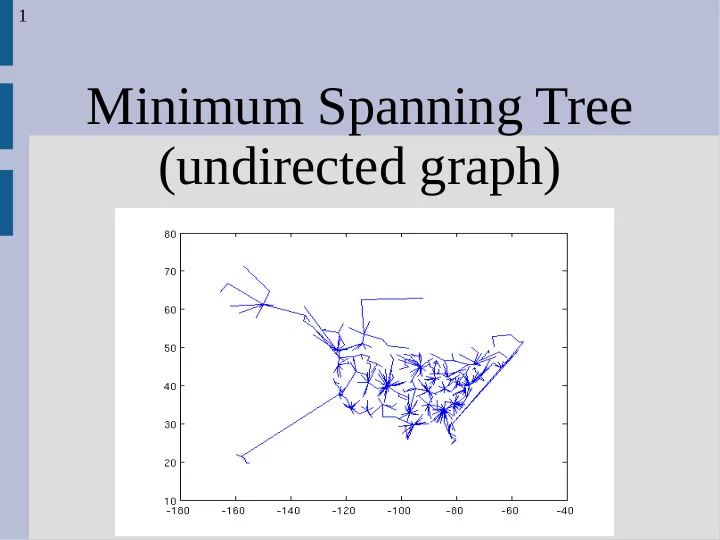
Minimum Spanning Tree (undirected graph)

1
slide-2
SLIDE 2

Path tree vs. spanning tree

We have constructed trees in graphs for shortest path to anywhere else (from vertex is the root) Minimum spanning trees instead want to connect every node with the least cost (undirected edges)

2

slide-3
SLIDE 3

Path tree vs. spanning tree

Example: build the least costly road that allows cars to get from any start to any finish

3

slide-4
SLIDE 4

Safe edges

We an find (again) a greedy algorithm to solve MSTs We can repeatedly add safe edges to an existing solution:

  • 1. Find (u,v) as safe edge for A
  • 2. Add (u,v) to A and repeat 1.

4

slide-5
SLIDE 5

Safe edges

A cut S: (S, V-S) for any verticies S Cut S respects A: no edge in A has

  • ne side in S and another in V-S

5

slide-6
SLIDE 6

Safe edges

A cut S: (S, V-S) for any verticies S Cut S respects A: no edge in A has

  • ne side in S and another in V-S

S = circles V-S = squares S respects A if no red edges

6

slide-7
SLIDE 7

Safe edges

Theorem 23.1: Let A be a set of edges that is included in some MST Let S be a cut that respects A Then the minimum edge that crosses S and V-S is a safe edge for A

7

slide-8
SLIDE 8

Safe edges

Theorem 23.1: LHS = S RHS = V-S blue = minimum safe edge A = red edges

8

slide-9
SLIDE 9

Safe edges

Proof: Let T be a MST that includes A Add minimum safe edge (u,v) Let (x,y) be the other edge on the cut Remove (x,y), and call this T' thus: w(T') = w(T) + w(u,v) - w(x,y) But (u,v) min, so w(u,v) < w(x,y) Thus, w(T ' ) < w(T) and we done

9

slide-10
SLIDE 10

Kruskal

Idea:

  • 1. Sort all edges into a list
  • 2. If the minimum edge in the list

does not create a cycle, add it to A

  • 3. Remove the edge and repeat 2

until no more edges

10

slide-11
SLIDE 11

Kruskal

MST-Kruskal(G,w) A = { } for each v in G.V: Make-Set(V) sort(G.E) for (u,v) in G.E (w(u,v) increasing) if Find-Set(u) ≠ Find-Set(v) A= A U {(u,v)} Union(u,v)

11

slide-12
SLIDE 12

Kruskal

12

slide-13
SLIDE 13

Prim

13

slide-14
SLIDE 14

Kruskal

Runtime: Find-Set takes about O(lg |V|) time (Ch. 21) Thus overall is about O(|E| lg |V|)

14

slide-15
SLIDE 15

Prim

Idea:

  • 1. Select any vertex (as the root)
  • 2. Find the shortest edge from a

vertex in the tree to a vertex outside

  • 3. Add this edge (and the connected

vertex) to the tree

  • 4. Goto 2.

Like Dijkstra, but different relaxation

15

slide-16
SLIDE 16

Prim

MST-Prim(G, w, r) // r is root for each u in G.V: u.key=∞, u.π=NIL r.key = 0, Q = G.V while Q not empty u = Extract-Min(Q) for each v in G.Adj[u] if v in Q and w(u,v) < v.key v.key=w(u,v), v.π=u

16

modified “relax” from Dijkstra

slide-17
SLIDE 17

Prim

Runtime: Extract-Min(V) is O(lg |V|), run |V| times is O(|V| lg |V|) for loop runs over each edge twice, minimizing (i.e. Decrease-Key())... O( (|V|+|E|) lg |V| ) = O(|E| lg |V|) (Fibonacci heaps O(|E| + |V| lg |V|))

17

slide-18
SLIDE 18

Prim

18