Minimum-Cost Spanning Tree weighted connected undirected graph - - PDF document

minimum cost spanning tree
SMART_READER_LITE
LIVE PREVIEW

Minimum-Cost Spanning Tree weighted connected undirected graph - - PDF document

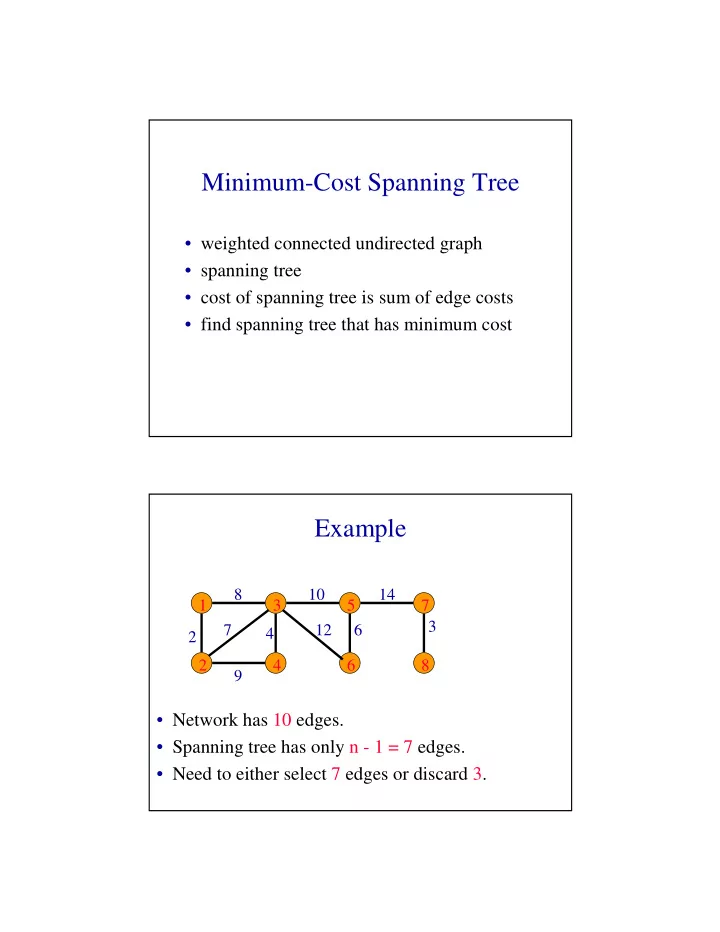
Minimum-Cost Spanning Tree weighted connected undirected graph spanning tree cost of spanning tree is sum of edge costs find spanning tree that has minimum cost Example 8 10 14 1 3 5 7 3 7 12 6 4 2 2 4 6 8 9


slide-1
SLIDE 1

Minimum-Cost Spanning Tree

  • weighted connected undirected graph
  • spanning tree
  • cost of spanning tree is sum of edge costs
  • find spanning tree that has minimum cost

Example

  • Network has 10 edges.
  • Spanning tree has only n - 1 = 7 edges.
  • Need to either select 7 edges or discard 3.

1 3 5 7 2 4 6 8 2 4 6 3 8 10 14 12 7 9

slide-2
SLIDE 2

Edge Selection Greedy Strategies

  • Start with an n-vertex 0-edge forest.

Consider edges in ascending order of cost. Select edge if it does not form a cycle together with already selected edges.

Kruskal’s method.

  • Start with a 1-vertex tree and grow it into an

n-vertex tree by repeatedly adding a vertex and an edge. When there is a choice, add a least cost edge.

Prim’s method.

Edge Selection Greedy Strategies

  • Start with an n-vertex forest. Each

component/tree selects a least cost edge to connect to another component/tree. Eliminate duplicate selections and possible

  • cycles. Repeat until only 1 component/tree

is left.

Sollin’s method.

slide-3
SLIDE 3

Edge Rejection Greedy Strategies

  • Start with the connected graph. Repeatedly

find a cycle and eliminate the highest cost edge on this cycle. Stop when no cycles remain.

  • Consider edges in descending order of cost.

Eliminate an edge provided this leaves behind a connected graph.

Kruskal’s Method

  • Start with a forest that has no edges.

1 3 5 7 2 4 6 8 2 4 6 3 8 10 14 12 7 9 1 3 5 7 2 4 6 8

  • Consider edges in ascending order of cost.
  • Edge (1,2) is considered first and added to

the forest.

slide-4
SLIDE 4

Kruskal’s Method

  • Edge (7,8) is considered next and added.

1 3 5 7 2 4 6 8 2 4 6 3 8 10 14 12 7 9 1 3 5 7 2 4 6 8 2 3

  • Edge (3,4) is considered next and added.

4

  • Edge (5,6) is considered next and added.

6

  • Edge (2,3) is considered next and added.

7

  • Edge (1,3) is considered next and rejected

because it creates a cycle.

Kruskal’s Method

  • Edge (2,4) is considered next and rejected

because it creates a cycle.

1 3 5 7 2 4 6 8 2 4 6 3 8 10 14 12 7 9 1 3 5 7 2 4 6 8 2 3 4

  • Edge (3,5) is considered next and added.

6 10

  • Edge (3,6) is considered next and rejected.

7

  • Edge (5,7) is considered next and added.

14

slide-5
SLIDE 5

Kruskal’s Method

  • n - 1 edges have been selected and no cycle

formed.

  • So we must have a spanning tree.
  • Cost is 46.
  • Min-cost spanning tree is unique when all

edge costs are different.

1 3 5 7 2 4 6 8 2 4 6 3 8 10 14 12 7 9 1 3 5 7 2 4 6 8 2 3 4 6 10 7 14

Prim’s Method

  • Start with any single vertex tree.

1 3 5 7 2 4 6 8 2 4 6 3 8 10 14 12 7 9 5

  • Get a 2-vertex tree by adding a cheapest edge.

6 6

  • Get a 3-vertex tree by adding a cheapest edge.

3 10

  • Grow the tree one edge at a time until the tree

has n - 1 edges (and hence has all n vertices).

4 4 2 7 1 2 7 14 8 3

slide-6
SLIDE 6

Sollin’s Method

1 3 5 7 2 4 6 8 2 4 6 3 10 14 12 7 9

  • Start with a forest that has no edges.

1 3 5 7 2 4 6 8

  • Each component selects a least cost edge

with which to connect to another component.

  • Duplicate selections are eliminated.
  • Cycles are possible when the graph has

some edges that have the same cost.

2 4 6 3 8

Sollin’s Method

1 3 5 7 2 4 6 8 2 4 6 3 8 10 14 12 7 9 1 3 5 7 2 4 6 8

  • Each component that remains selects a

least cost edge with which to connect to another component.

  • Beware of duplicate selections and cycles.

7 2 4 6 3 10 14

slide-7
SLIDE 7

Greedy Minimum-Cost Spanning Tree Methods

  • Can prove that all result in a minimum-cost

spanning tree.

  • Prim’s method is fastest.

O(n2) using an implementation similar to that of Dijkstra’s shortest-path algorithm. O(e + n log n) using a Fibonacci heap.

  • Kruskal’s uses union-find trees to run in

O(n + e log e) time.

Pseudocode For Kruskal’s Method

Start with an empty set T of edges. while (E is not empty && |T| != n-1) { Let (u,v) be a least-cost edge in E. E = E - {(u,v)}. // delete edge from E if ((u,v) does not create a cycle in T) Add edge (u,v) to T. } if (| T | == n-1) T is a min-cost spanning tree. else Network has no spanning tree.

slide-8
SLIDE 8

Data Structures For Kruskal’s Method

Edge set E. Operations are:

Is E empty? Select and remove a least-cost edge.

Use a min heap of edges.

  • Initialize. O(e) time.

Remove and return least-cost edge. O(log e) time.

Data Structures For Kruskal’s Method

Set of selected edges T. Operations are:

Does T have n - 1 edges? Does the addition of an edge (u, v) to T result in a cycle? Add an edge to T.

slide-9
SLIDE 9

Data Structures For Kruskal’s Method

Use an array linear list for the edges of T.

Does T have n - 1 edges?

  • Check size of linear list. O(1) time.

Does the addition of an edge (u, v) to T result in a cycle?

  • Not easy.

Add an edge to T.

  • Add at right end of linear list. O(1) time.

Just use an array rather than ArrayLinearList.

Data Structures For Kruskal’s Method

Does the addition of an edge (u, v) to T result in a cycle?

1 3 5 7 2 4 6 8 2 3 4 6 7

  • Each component of T is a tree.
  • When u and v are in the same component, the

addition of the edge (u,v) creates a cycle.

  • When u and v are in the different

components, the addition of the edge (u,v) does not create a cycle.

slide-10
SLIDE 10

Data Structures For Kruskal’s Method

1 3 5 7 2 4 6 8 2 3 4 6 7

  • Each component of T is defined by the

vertices in the component.

  • Represent each component as a set of

vertices.

{1, 2, 3, 4}, {5, 6}, {7, 8}

  • Two vertices are in the same component iff

they are in the same set of vertices.

Data Structures For Kruskal’s Method

  • When an edge (u, v) is added to T, the two

components that have vertices u and v combine to become a single component.

1 3 5 7 2 4 6 8 2 3 4 6 7

  • In our set representation of components, the

set that has vertex u and the set that has vertex v are united.

{1, 2, 3, 4} + {5, 6} => {1, 2, 3, 4, 5, 6}

slide-11
SLIDE 11

Data Structures For Kruskal’s Method

  • Initially, T is empty.

1 3 5 7 2 4 6 8

  • Initial sets are:

{1} {2} {3} {4} {5} {6} {7} {8}

  • Does the addition of an edge (u, v) to T result

in a cycle? If not, add edge to T.

s1 = find(u); s2 = find(v); if (s1 != s2) union(s1, s2);

Data Structures For Kruskal’s Method

  • Use FastUnionFind.
  • Initialize.

O(n) time.

  • At most 2e finds and n-1 unions.

Very close to O(n + e).

  • Min heap operations to get edges in

increasing order of cost take O(e log e).

  • Overall complexity of Kruskal’s method is

O(n + e log e).