Articles Plasma HDL cholesterol and risk of myocardial infarction: - - PDF document

articles plasma hdl cholesterol and risk of myocardial
SMART_READER_LITE
LIVE PREVIEW

Articles Plasma HDL cholesterol and risk of myocardial infarction: - - PDF document

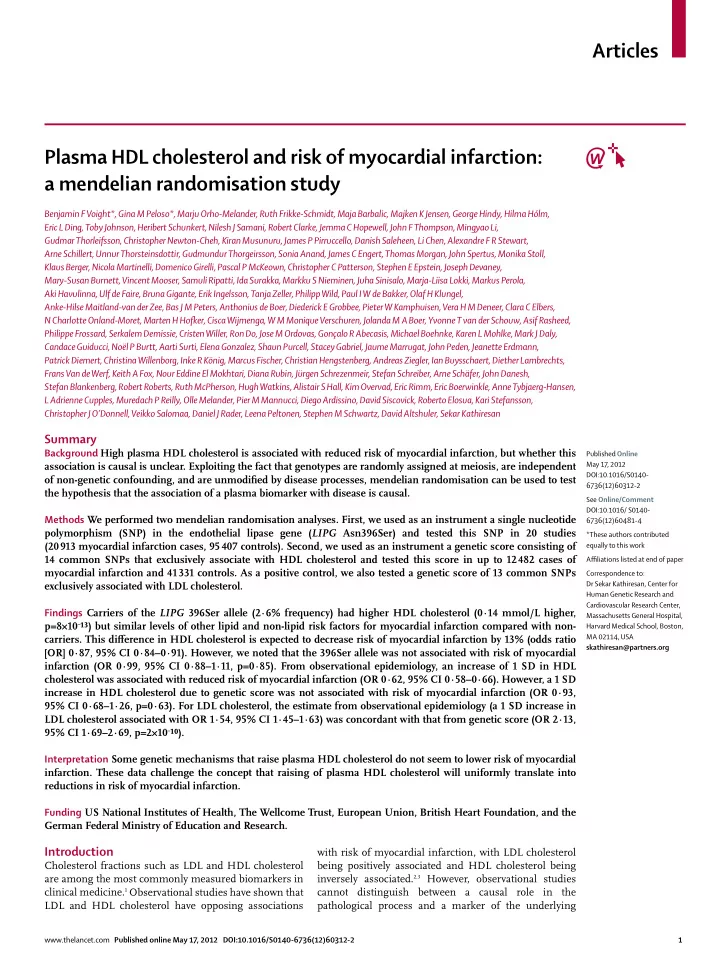
Articles Plasma HDL cholesterol and risk of myocardial infarction: a mendelian randomisation study Benjamin F Voight*, Gina M Peloso*, Marju Orho-Melander, Ruth Frikke-Schmidt, Maja Barbalic, Majken K Jensen, George Hindy, Hilma Hlm, Eric L


slide-1
SLIDE 1

Articles

www.thelancet.com Published online May 17, 2012 DOI:10.1016/S0140-6736(12)60312-2 1

Plasma HDL cholesterol and risk of myocardial infarction: a mendelian randomisation study

Benjamin F Voight*, Gina M Peloso*, Marju Orho-Melander, Ruth Frikke-Schmidt, Maja Barbalic, Majken K Jensen, George Hindy, Hilma Hólm, Eric L Ding, Toby Johnson, Heribert Schunkert, Nilesh J Samani, Robert Clarke, Jemma C Hopewell, John F Thompson, Mingyao Li, Gudmar Thorleifsson, Christopher Newton-Cheh, Kiran Musunuru, James P Pirruccello, Danish Saleheen, Li Chen, Alexandre F R Stewart, Arne Schillert, Unnur Thorsteinsdottir, Gudmundur Thorgeirsson, Sonia Anand, James C Engert, Thomas Morgan, John Spertus, Monika Stoll, Klaus Berger, Nicola Martinelli, Domenico Girelli, Pascal P McKeown, Christopher C Patterson, Stephen E Epstein, Joseph Devaney, Mary-Susan Burnett, Vincent Mooser, Samuli Ripatti, Ida Surakka, Markku S Nieminen, Juha Sinisalo, Marja-Liisa Lokki, Markus Perola, Aki Havulinna, Ulf de Faire, Bruna Gigante, Erik Ingelsson, Tanja Zeller, Philipp Wild, Paul I W de Bakker, Olaf H Klungel, Anke-Hilse Maitland-van der Zee, Bas J M Peters, Anthonius de Boer, Diederick E Grobbee, Pieter W Kamphuisen, Vera H M Deneer, Clara C Elbers, N Charlotte Onland-Moret, Marten H Hofl er, Cisca Wijmenga, W M Monique Verschuren, Jolanda M A Boer, Yvonne T van der Schouw, Asif Rasheed, Philippe Frossard, Serkalem Demissie, Cristen Willer, Ron Do, Jose M Ordovas, Gonçalo R Abecasis, Michael Boehnke, Karen L Mohlke, Mark J Daly, Candace Guiducci, Noël P Burtt, Aarti Surti, Elena Gonzalez, Shaun Purcell, Stacey Gabriel, Jaume Marrugat, John Peden, Jeanette Erdmann, Patrick Diemert, Christina Willenborg, Inke R König, Marcus Fischer, Christian Hengstenberg, Andreas Ziegler, Ian Buysschaert, Diether Lambrechts, Frans Van de Werf, Keith A Fox, Nour Eddine El Mokhtari, Diana Rubin, Jürgen Schrezenmeir, Stefan Schreiber, Arne Schäfer, John Danesh, Stefan Blankenberg, Robert Roberts, Ruth McPherson, Hugh Watkins, Alistair S Hall, Kim Overvad, Eric Rimm, Eric Boerwinkle, Anne Tybjaerg-Hansen, L Adrienne Cupples, Muredach P Reilly, Olle Melander, Pier M Mannucci, Diego Ardissino, David Siscovick, Roberto Elosua, Kari Stefansson, Christopher J O’Donnell, Veikko Salomaa, Daniel J Rader, Leena Peltonen, Stephen M Schwartz, David Altshuler, Sekar Kathiresan

Summary

Background High plasma HDL cholesterol is associated with reduced risk of myocardial infarction, but whether this association is causal is unclear. Exploiting the fact that genotypes are randomly assigned at meiosis, are independent

  • f non-genetic confounding, and are unmodifi

ed by disease processes, mendelian random isation can be used to test the hypothesis that the association of a plasma biomarker with disease is causal. Methods We performed two mendelian randomisation analyses. First, we used as an instrument a single nucleotide polymorphism (SNP) in the endothelial lipase gene (LIPG Asn396Ser) and tested this SNP in 20 studies (20 913 myocardial infarction cases, 95 407 controls). Second, we used as an instrument a genetic score consisting of 14 common SNPs that exclusively associate with HDL cholesterol and tested this score in up to 12 482 cases of myocardial infarction and 41 331 controls. As a positive control, we also tested a genetic score of 13 common SNPs exclusively associated with LDL cholesterol. Findings Carriers of the LIPG 396Ser allele (2·6% frequency) had higher HDL cholesterol (0·14 mmol/L higher, p=8×10–¹³) but similar levels of other lipid and non-lipid risk factors for myocardial infarction compared with non-

  • carriers. This diff

erence in HDL cholesterol is expected to decrease risk of myocardial infarction by 13% (odds ratio [OR] 0·87, 95% CI 0·84–0·91). However, we noted that the 396Ser allele was not associated with risk of myocardial infarction (OR 0·99, 95% CI 0·88–1·11, p=0·85). From observational epidemiology, an increase of 1 SD in HDL cholesterol was associated with reduced risk of myocardial infarction (OR 0·62, 95% CI 0·58–0·66). However, a 1 SD increase in HDL cholesterol due to genetic score was not associated with risk of myocardial infarction (OR 0·93, 95% CI 0·68–1·26, p=0·63). For LDL cholesterol, the estimate from observational epidemiology (a 1 SD increase in LDL cholesterol associated with OR 1·54, 95% CI 1·45–1·63) was concordant with that from genetic score (OR 2·13, 95% CI 1·69–2·69, p=2×10–¹⁰). Interpretation Some genetic mechanisms that raise plasma HDL cholesterol do not seem to lower risk of myocardial

  • infarction. These data challenge the concept that raising of plasma HDL cholesterol will uniformly translate into

reductions in risk of myocardial infarction. Funding US National Institutes of Health, The Wellcome Trust, European Union, British Heart Foundation, and the German Federal Ministry of Education and Research.

Introduction

Cholesterol fractions such as LDL and HDL cholesterol are among the most commonly measured biomarkers in clinical medicine.1 Observational studies have shown that LDL and HDL cholesterol have opposing associations with risk of myocardial infarction, with LDL cholesterol being positively associated and HDL cholesterol being inversely associated.2,3 However, observational studies cannot distinguish between a causal role in the pathological process and a marker of the underlying

Published Online May 17, 2012 DOI:10.1016/S0140- 6736(12)60312-2 See Online/Comment DOI:10.1016/ S0140- 6736(12)60481-4 *These authors contributed equally to this work Affi liations listed at end of paper Correspondence to: Dr Sekar Kathiresan, Center for Human Genetic Research and Cardiovascular Research Center, Massachusetts General Hospital, Harvard Medical School, Boston, MA 02114, USA skathiresan@partners.org

slide-2
SLIDE 2

Articles

2 www.thelancet.com Published online May 17, 2012 DOI:10.1016/S0140-6736(12)60312-2

patho

  • physiology. These two possibilities can be distin-

guished in human beings by changes of the cholesterol fractions in large-scale randomised trials or by studies of inherited DNA variation. For LDL cholesterol, the results

  • f both randomised trials of LDL-cholesterol-lowering

treatments4 and from human mendelian diseases5,6 are concordant and suggest that plasma LDL cholesterol is causally related to risk of myocardial infarction. However, the available evidence for the causal relevance of HDL cholesterol from randomised trials or mendelian diseases is scarce and inconsistent.7,8 If a particular plasma biomarker is directly involved in an underlying pathological process, then inherited variation changing plasma concentrations of this bio- marker should aff ect risk of disease in the direction and magnitude predicted by the plasma concentrations. Referred to as mendelian randomisation,9–11 this ana- lytical approach has been previously applied to plasma HDL cholesterol, albeit with restricted sample sizes, a small number of single nucleotide polymorphisms (SNPs) at a few genes, and with SNPs that aff ect multiple lipid fractions.8,12–15 Hence, these studies have not been able to resolve fully the possible causal relevance of HDL cholesterol concentrations for risk of myocardial infarction. Recently, we have used the genome-wide association approach to identify SNPs that aff ect blood lipid con- centrations.16,17 Additionally, through resequencing, we identifi ed a loss-of-function coding SNP at the endothelial lipase gene (LIPG Asn396Ser) that aff ects plasma HDL cholesterol in isolation.18,19 Here, we use these SNPs in case-control studies and prospective cohort studies to test the hypothesis that genetically raised plasma HDL cholesterol might be protective for myocardial infarction.

Methods

Study design The study design consisted of two components. First, using a case-control design, we tested lipid-associated SNPs individually for association with risk of myocardial

  • infarction. Second, using a mendelian randomisation

design, we tested two instruments: (1) a single SNP that related exclusively to plasma HDL cholesterol (a loss-of- function coding polymorphism at the endothelial lipase gene, LIPG Asn396Ser, rs61755018); and (2) a genetic score consisting of 14 common SNPs that exclusively associate with HDL cholesterol. Study participants Characteristics of cases of myocardial infarction and controls are shown in appendix p 19. Data for up to 19 139 cases of myocardial infarction and 50 812 myo- cardial-infarction-free controls were available from 30 studies. Characteristics of the participants in six prospective cohort studies are shown in the appendix p 20. 50 763 participants from six cohort studies were studied and, of these, 4228 developed an incident fatal or non-fatal myocardial infarction. All participants were of self-reported European or South Asian ancestry. Statistical analysis In myocardial infarction cases and controls, we tested each of 25 SNPs for association with myocardial infarction in up to 30 studies. These 25 SNPs repre- sented the initial polymorphisms mapped for plasma HDL or LDL cholesterol concentrations with a genome- wide association approach.16 Each selected SNP has been associated with either HDL or LDL cholesterol at p<5×10–⁸. Genotyping details are provided in the appendix p 2. We undertook logistic regression with the outcome variable of myocardial infarction status, predictor variable

  • f individual SNP genotype, and covariates of age, sex,

and principal components of ancestry. We assumed a log-additive genetic model. Overall association for each SNP was evaluated with a fi xed-eff ects inverse-variance- weighted meta-analysis. Fatal or non-fatal myocardial infarction outcomes were ascertained in each of six prospective cohort studies as described in the appendix p 10. We constructed logistic regression models to examine the association of LIPG Asn396Ser genotype with myocardial infarction status, excluding participants who had had a previous myocardial infarc tion or ischaemic stroke. The predictor variable of LIPG Asn396Ser genotype was modelled in an additive model (ie, 0, 1, 2 copies of the 396Ser allele). Covariates in the model included age and sex. Overall association for each SNP was evaluated across the six studies with fi xed- eff ects inverse-variance-weighted meta-analysis. We estimated a predicted risk for LIPG Asn396Ser on the basis of the association of this SNP with plasma HDL cholesterol (appendix p 21) and the association of plasma HDL cholesterol with myocardial infarction (appendix p 22) in the population. Details are provided in the appendix p 2. We undertook instrumental variable analysis using LIPG Asn396Ser in six prospective cohort studies as listed in the appendix p 23. We additionally did an instrumental variable analysis using multiple genetic variants as instruments.20 Details of the instrumental variable analysis methods are provided in the appendix p 4. We regarded a two-tailed p<0·05 as nominally signifi

  • cant. Heterogeneity statistics were calculated as

described.21 SAS version 9.1, the R package, STATA, or PLINK software were used for all statistical analyses.22 Role of the funding source The sponsors had no role in the conduct or interpretation

  • f the study. The corresponding author had full access to

all data in the study and had fi nal responsibility for the decision to submit for publication.

Results

To validate the statistical framework and clinical samples, we fi rst tested SNPs related to plasma LDL cholesterol in

See Online for appendix

slide-3
SLIDE 3

Articles

www.thelancet.com Published online May 17, 2012 DOI:10.1016/S0140-6736(12)60312-2 3

case-control studies (table 1). For nine of ten SNPs associated with LDL cholesterol, the allele correlated with increased LDL cholesterol was also associated with increased risk of myocardial infarction (p<0·05; table 1). Having established that SNPs related to plasma LDL cholesterol consistently aff ected risk of myocardial infarction, we applied the same methodological frame- work in the same samples to test the hypothesis that genetic modulation of HDL cholesterol would aff ect risk

  • f myocardial infarction. Of 15 loci related to plasma

HDL cholesterol, at six loci (LPL, TRIB1, APOA1-APOC3- APOA4-APOA5 cluster, CETP, ANGPTL4, and GALNT2)

Chromosome Gene(s) of interest within

  • r near associated interval

Major allele, minor allele (minor allele frequency)* Modelled allele Eff ect of modelled allele on plasma LDL cholesterol (mmol/L)* Eff ect of modelled allele on plasma HDL cholesterol (mmol/L)* Eff ect of modelled allele on plasma triglycerides (mmol/L)* Sample size (MI cases/ MI-free controls) For modelled allele, observed change in MI risk (%; 95% CI) For modelled allele, p value for association with MI rs646776 1p13 CELSR2, PSRC1, SORT1† T, C (0·21) T 0·20 –0·03 ·· 19 139/50 812 16% (12–19) 4×10¹⁶† rs6511720 19p13 LDLR† G, T (0·10) G 0·23 ·· 0·09 16 503/46 576 23% (17–30) 4×10¹²† rs11206510 1p32 PCSK9† T, C (0·17) T 0·05 ·· ·· 18 455/23 075 13% (9–16) 1×10⁹† rs3798220 6q25 LPA† T, C (0·02) C 0·36‡ ·· ·· 6658/5823 72% (39–211) 4×10⁷† rs562338 2p24 APOB† G, A (0·20) G 0·14 ·· ·· 19 139/50 812 8% (4–12) 5×10⁵† rs6544713 2p21 ABCG8† C, T (0·32) T 0·13 ·· ·· 14 818/45 454 8% (4–11) 5×10⁵† rs7953249 12q24 HNF1A† A, G (0·44) G 0·07 ·· ·· 19 139/50 812 5% (3–9) 2×10⁴† rs10402271 19q13 APOE-APOC1-APOC4-APOC2† T, G (0·33) G 0·12 ·· ·· 19 139/50 812 4% (1–7) 0·007† rs3846663 5q13 HMGCR† C, T (0·38) T 0·06 ·· ·· 19 139/50 812 4% (1–7) 0·01† rs1501908 5q23 TIMD4-HAVCR1 C, G (0·37) C 0·06 ·· ·· 18 310/49 897 3% (0–6) 0·08 *Data presented from a meta-analysis of seven cohorts (n up to 19 840) as presented in reference 16; the eff ect of each SNP on a lipid trait was modelled if the association of the SNP with a plasma lipid trait exceeded nominal signifi cance (p<0·05). †Loci and SNPs that exceeded nominal signifi cance (p<0·05) for association of modelled allele with MI; all modelled alleles increased LDL cholesterol. ‡The C allele at this LPA variant is related to increased plasma lipoprotein(a) as presented in reference 16. Table 1: Association of myocardial infarction (MI) with single nucleotide polymorphisms (SNPs) previously found to relate to plasma LDL cholesterol Chromosome Gene(s) of interest within

  • r near associated interval

Major allele, minor allele (minor allele frequency)* Modelled allele Eff ect of modelled allele on plasma HDL cholesterol (mmol/L)* Eff ect of modelled allele on plasma triglycerides (mmol/L)* Eff ect of modelled allele on plasma LDL cholesterol (mmol/L)* Sample size (MI cases/ MI-free controls) For modelled allele, observed change in MI risk (%; 95% CI) For modelled allele, p value for association with MI rs17482753 8p21 LPL† G, T (0·10) T 0·08 –0·24 ·· 19 139/50 812 –12% (–16 to –7) 4×10⁷† rs17321515 8q24 TRIB1† A, G (0·45) G 0·02 –0·11 –0·05 19 139/50 812 –7% (–9 to –4) 2×10⁶† rs6589566 11q23 APOA1-APOC3-APOA4-APOA5† A, G (0·07) A 0·05 –0·27 –0·09 18 310/49 897 –10% (–15 to –5) 8×10⁵† rs4846914 1q42 GALNT2† A, G (0·40) A 0·02 –0·03 ·· 19 139/50 812 –3% (–6 to –1) 0·02† rs2967605 19p13 ANGPTL4† C, T (0·16) C 0·05 –0·07 ·· 13 595/16 423 –5% (–10 to –1) 0·03† rs3764261 16q13 CETP† C, A (0·32) A 0·10 ·· –0·03 16 503/46 576 –4% (–7 to 0) 0·04† rs61755018 (Asn396Ser) 18q21 LIPG A, G (0·015) G 0·14‡ ·· ·· 17 165/49 077 –6% (–18 to 9) 0·41 rs17145738 7q11 MLXIPL C, T (0·11) T 0·03 –0·15 ·· 19 139/50 812 –1% (–4 to 3) 0·61 rs3890182 9q31 ABCA1 G, A (0·14) G 0·03 ·· 0·05 19 139/50 812 –1% (–5 to 4) 0·76 rs2338104 12q24 MMAB, MVK G, C (0·46) G 0·03 ·· ·· 19 139/50 812 0% (–3 to 3) 0·85 rs471364 9p22 TTC39B T, C (0·12) T 0·03 ·· ·· 15 693/47 098 0% (–5 to 5) 0·97 rs2271293 16q22 LCAT G, A (0·11) A 0·03 ·· ·· 19 139/50 812 4% (–1 to 8) 0·10 rs174547 11q12 FADS1-FADS2-FADS3 T, C (0·33) T 0·03 –0·06 ·· 19 139/50 812 3% (–1 to 6) 0·11 rs1800588 15q22 LIPC C, T (0·22) T 0·05 0·07 ·· 17 917/49 514 4% (0 to 7) 0·04 rs16988929 20q13 HNF4A C, T (0·01) T 0·01 ·· ·· 17 041/20 137 31% (12 to 54) 9×10⁴ *Data presented from a meta-analysis of seven cohorts (n up to 19 840) as presented in reference 16; the eff ect of each SNP on a lipid trait was modelled if the association of the SNP with a plasma lipid trait exceeded nominal signifi cance (p<0·05). †Loci and SNPs that exceeded nominal signifi cance (p<0·05) for association of modelled allele with MI; all modelled alleles increased HDL cholesterol. ‡Eff ect size presented is from the Atherosclerosis Risk in Communities Study. Table 2: Association of myocardial infarction (MI) with single nucleotide polymorphisms (SNPs) previously found to relate to plasma HDL cholesterol

slide-4
SLIDE 4

Articles

4 www.thelancet.com Published online May 17, 2012 DOI:10.1016/S0140-6736(12)60312-2

the allele correlated with raised HDL cholesterol was also associated with decreased risk of myocardial infarction (p<0·05; table 2). Of note, at the HNF4A locus, the HDL- cholesterol-raising allele was surprisingly associated with increased risk of myocardial infarction (p=0·0009). All six SNPs associated with both HDL cholesterol and myocardial infarction had additional eff ects on plasma LDL cholesterol or triglycerides, or both (p<5×10–⁸ for the additional eff ects on LDL cholesterol or triglycer ides). For example, at APOA1-APOC3-APOA4-APOA5 rs6589566, the allele associated with increased HDL cholesterol also relates to reduced LDL cholesterol and reduced triglycerides. The pleiotropic eff ects of such SNPs undermine the ability to defi ne a causal role for HDL cholesterol, independent of eff ects on LDL cholesterol or triglycerides. To evaluate plasma HDL cholesterol specifi cally, we undertook mendelian randomisation, a form of instrumental variable analysis.23 We identifi ed a variant that aff ected only plasma HDL cholesterol without changing other lipid or non-lipid cardiovascular risk

  • factors. In the LIPG gene, roughly 2·6% of individuals

carry a serine substitution at aminoacid 396 (substituted for wild-type asparagine). Carrier status for 396Ser was associated with signifi cant increases in HDL cholesterol in each of four prospective cohort studies, with the eff ect size ranging from 0·08 mmol/L to 0·28 mmol/L per copy of the Ser allele (fi gure 1, appendix p 21; p=0·002 in FHS, p=0·02 in CCHS, p=5×10–⁶ in MDC, and p=7×10–⁷ in ARIC). In a meta-analysis including all four studies, carrier status for 396Ser was associated with an increase of roughly 0·29 SD units in HDL cholesterol (p=8×10–¹³). There was no evidence of heterogeneity across the four studies (I²=0·58; Cochran’s heterogeneity p=0·07). LIPG Asn396Ser was not signifi cantly associated with other risk factors for myocardial infarction including plasma LDL cholesterol, triglycerides, systolic blood pressure, body-mass index, risk of type 2 diabetes, fasting glucose, plasma C-reactive protein, waist-to-hip ratio, fi brinogen, and small LDL particle concentration (p>0·05 for each; appendix pp 24–26). Therefore, LIPG Asn396Ser satisfi ed the three main criteria for mendelian randomisation analysis—ie, that the genotype should be associated with an intermediate biomarker (fi gure 1), should not be associated with confounding factors (appendix pp 24–46), and should exert its eff ect on the clinical outcome only through the specifi c intermediate biomarker (appendix p 22).24 Under the model that plasma HDL cholesterol causally relates to risk of myocardial infarction, individuals with an inherited increase in HDL cholesterol (eg, those carrying the LIPG 396Ser allele) are expected to have reduced risk of myocardial infarction. On the basis of the associations between SNPs and HDL cholesterol, and HDL cholesterol and myocardial infarction, we estimated that carriage of LIPG 396Ser should decrease risk of myocardial infarction by 13% (odds ratio [OR] 0·87, 95% CI 0·84–0·91). To establish whether LIPG 396Ser carriers are indeed protected from risk of myocardial infarction, we studied the association of LIPG Asn396Ser with incident myocardial infarction in 50 763 participants from six prospective cohort studies, the gold standard with respect to epidemiological study design. Of these participants, 4228 developed a fi rst myocardial infarction event. LIPG Asn396Ser was not associated with myocardial infarction in any of the six studies (fi gure 2). Combining these

Asn/Asn Ser carriers 1·25 FHS CCHS MDC ARIC Cohort HDL cholesterol (mmol/L) 1·35 1·45 1·55 1·65 Figure 1: Plasma HDL cholesterol concentrations in carriers versus non-carriers of the Ser allele at the LIPG Asn396Ser polymorphism Error bars show standard error. FHS=Framingham Heart Study. CCHS=Copenhagen City Heart Study. MDC=Malmo Diet and Cancer Study. ARIC=Atherosclerosis Risk in Communities Study. AngioGOCARD/KORA IFS deCODE EPIC-NL GerMIFS-II GRACE MAHA PennCATH UCP POPGEN PROCARDIS PROMIS SHEEP WTCCC All case-control studies ARIC CCHS DCH FHS HPFS MDC All cohort studies Overall 0·76 (0·46–1·24) 1·25 (0·51–3·08) 0·97 (0·60–1·58) 0·64 (0·27–1·53) 1·36 (0·82–2·24) 2·48 (1·10–5·56) 1·08 (0·68–1·72) 0·82 (0·37–1·83) 0·87 (0·44–1·72) 0·69 (0·42–1·14) 0·66 (0·45–0·98) 1·27 (0·74–2·16) 1·35 (0·85–2·14) 0·74 (0·49–1·12) 0·94 (0·82–1·09) 0·80 (0·45–1·40) 1·33 (0·73–2·43) 1·12 (0·66–1·90) 2·35 (0·69–8·00) 1·97 (0·86–4·51) 1·01 (0·74–1·38) 1·10 (0·89–1·37) 0·99 (0·88–1·11) 1953 577 729 334 1127 683 785 485 830 2433 2183 1854 1151 1561 16 685 558 655 933 50 426 1606 4228 20 913 1482 719 29 218 1827 1874 656 615 489 1139 1687 3347 1897 1496 2426 48 872 8214 8964 1588 1462 869 25 438 46 535 95 407 Cases OR (95% CI) Controls Number of individuals 0·5 1·5 2·5 1 2 Figure 2: Association of LIPG Asn396Ser with myocardial infarction in 116 320 participants from 20 studies In each study, the HDL-cholesterol-raising serine allele was modelled.

slide-5
SLIDE 5

Articles

www.thelancet.com Published online May 17, 2012 DOI:10.1016/S0140-6736(12)60312-2 5

studies in a meta-analysis, LIPG Asn396Ser allele was not associated with myocardial infarction (OR 1·10, 95% CI 0·89–1·37, p=0·37; fi gure 2). There was no evidence for heterogeneity across the six cohorts (I²=0·17; Cochran’s heterogeneity p=0·31). We also studied LIPG Asn396Ser in case-control studies involving an additional 16 685 cases of myocardial infarction and 48 872 controls and noted that this SNP was not associated with myocardial infarction (OR 0·94, 95% CI 0·82–1·09, p=0·41; table 2, fi gure 2), with no evidence of heterogeneity across the 14 case-control studies (I²=0·34; Cochran’s heterogeneity p=0·11). Finally, we used meta-analysis to combine the evidence from both the prospective studies and case-control studies (116 320 participants; 20 913 cases and 95 407 con- trols). In all available samples, LIPG Asn396Ser remained not associated with risk of myocardial infarction (OR 0·99, 95% CI 0·88–1·11, p=0·85; fi gure 2). There was no evidence for heterogeneity across all 20 studies (I²=0·30; Cochran’s heterogeneity p=0·10). We formally estimated the magnitude of an association

  • f genetically raised HDL cholesterol with myocardial

infarction, using LIPG Asn396Ser as the instrument. The mendelian randomisation estimate was computed from the ratio of the coeffi cient of the association between genotype and disease to that of the association between genotype and plasma HDL cholesterol; this instrumental variable estimate refl ects the potential causal eff ect of plasma HDL cholesterol on the risk of myocardial infarction. Table 3 presents the instrumental variable estimate for the association of plasma HDL cholesterol with risk of myocardial infarction in each of six prospective cohort

  • studies. In each study, genetically raised plasma HDL

cholesterol was not associated with risk of myocardial

  • infarction. In meta-analysis, genetically raised plasma

HDL cholesterol was also not associated with risk of myocardial infarction (OR 1·02 per 0·03 mmol/L [1 mg/dL] increase in HDL cholesterol, 95% CI 0·95–1·09, p=0·64; OR 1·28 per 0·39 mmol/L [15 mg/dL] increase in HDL cholesterol, 95% CI 0·46–3·61, p=0·64). Statistical power for instrumental variable analysis could be increased if multiple genetic variants in combination are used as instruments, according to a recent proposal.20 From our genome-wide association study of plasma lipid traits involving more than 100 000 individuals,17 we noted that 13 common SNPs had statistical evidence at genome-wide levels of signifi cance (p<5×10–⁸) for plasma LDL cholesterol and no evidence for association with triglycerides (p>0·01)

  • r HDL cholesterol (p>0·01). We constructed a genetic

score for LDL cholesterol combining the LDL- cholesterol-raising alleles at each of these 13 SNPs (appendix p 27).25 We also noted that 14 common SNPs had statistical evidence at genome-wide levels of signifi cance (p<5×10–⁸) for plasma HDL cholesterol and no evidence for association with triglycerides (p>0·01)

  • r LDL cholesterol (p>0·01). We constructed a genetic

score for HDL cholesterol combining the HDL- cholesterol-raising alleles at each of these 14 SNPs (appendix p 28). Each SNP was given a weight based on the degree of change in LDL or HDL cholesterol as estimated in roughly 100 000 individuals.17 We tested the association of genetic scores for LDL and HDL cholesterol separately for association with myocardial infarction in up to 53 146 cases and controls from the CARDIoGRAM study.26 From observational epidemiology, an increase of 1 SD in usual LDL cholesterol was associated with raised risk of myocardial infarction (OR 1·54, 95% CI 1·45–1·63; appendix p 22). In a mendelian randomisation analysis, a 1 SD increase in LDL cholesterol due to genetic score was also associated with risk of myocardial infarction (OR 2·13, 95% CI 1·69–2·69, p=2×10–¹⁰; table 4). From observational epidemiology, a 1 SD rise in usual HDL cholesterol was associated with lowered risk of myocardial infarction (OR 0·62, 95% CI 0·58–0·66; appendix p 22). However, in mendelian randomisation analysis, a 1 SD increase in

Observational epidemiology Genetically raised Odds ratio (95% CI) per 0·03 mmol/L (1 mg/dL) increase in plasma HDL cholesterol p value Odds ratio (95% CI) per 0·03 mmol/L (1 mg/dL) increase in plasma HDL cholesterol p value Cohort Atherosclerosis Risk in Communities Study 0·97 (0·96–0·98) 7×10¹⁸ 0·96 (0·86–1·07) 0·44 Copenhagen City Heart Study 0·98 (0·98–0·99) 6×10¹³ 1·09 (0·95–1·26) 0·21 Malmo Diet and Cancer Study, Cardiovascular Cohort 0·97 (0·96–0·98) 1×10⁶ 0·82 (0·66–1·01) 0·06 Framingham Heart Study 0·96 (0·94–0·98) 4×10⁶ 1·17 (1·00–1·37) 0·06 Health Professionals Follow-up Study ·· ·· 1·84 (0·39–8·62) 0·16 Danish Diet, Cancer, and Health Study ·· ·· 1·05 (0·79–1·41) 0·71 Meta-analysis of cohort studies Per 0·03 mmol/L (1 mg/dL) increase in plasma HDL cholesterol 0·98 (0·97–0·98) 4×10³⁶ 1·02 (0·95–1·09) 0·64 Per 0·39 mmol/L (15 mg/dL) increase in plasma HDL cholesterol 0·70 (0·66–0·74) 4×10³⁶ 1·28 (0·46–3·61) 0·64 Table 3: Instrumental variable analysis estimate of the association of genetically raised HDL cholesterol and risk of myocardial infarction using LIPG Asn396Ser as an instrument

slide-6
SLIDE 6

Articles

6 www.thelancet.com Published online May 17, 2012 DOI:10.1016/S0140-6736(12)60312-2

HDL cholesterol due to genetic score was not associated with risk of myocardial infarction (OR 0·93, 95% CI 0·68–1·26, p=0·63; table 4).

Discussion

For a biomarker directly involved in disease patho genesis, we expect a genetic variant that modulates the biomarker to likewise confer risk of disease. We tested this hypothesis for two plasma biomarkers: LDL and HDL

  • cholesterol. SNPs aff

ecting LDL cholesterol were consistently related to risk of myocardial infarction. However, we unexpectedly found that LIPG Asn396Ser, a genetic variant that specifi cally and substantially increases plasma HDL cholesterol, did not reduce risk of myocardial

  • infarction. A genetic score combining 14 variants

exclusively related to HDL cholesterol also showed no association with risk of myocardial infarction (panel). These results challenge several established views about plasma HDL cholesterol. First, these data question the concept that raising of plasma HDL cholesterol should uniformly translate into reductions in risk of myocardial infarction. We raise the strong possibility that a specifi c means of raising of HDL cholesterol in human beings—namely, inhibition of endothelial lipase—will not reduce risk of myocardial

  • infarction. In animal models, inhib

ition or deletion of the endothelial lipase gene increases HDL cholesterol concentrations,27 but there has been debate as to the consequent eff ect on atherosclerosis. One report suggested that mice deleted for Lipg on an Apoe knockout genetic background have decreased aortic atherosclerosis,28 but a subsequent study showed no eff ect of Lipg deletion on aortic atherosclerosis.29 Second, these fi ndings emphasise the potential limi- tation of plasma HDL cholesterol as a surrogate measure for risk of myocardial infarction in intervention trials. The data presented here using mendelian randomisation are consistent with results from completed randomised controlled trials focused on raising plasma HDL

  • cholesterol. Hormone replacement therapy raised

plasma HDL cholesterol but did not lower risk of myocardial infarction.30 In the Atherothrombosis Inter vention in Metabolic Syndrome with Low HDL Cholesterol/High Triglyceride and Impact on Global Health Outcomes (AIM-HIGH) trial,31 the addition of long-acting niacin to background simvastatin increased HDL cholesterol and lowered triglycerides but did not lower risk of cardio vascular events. Of note, at the cholesterol ester transfer protein (CETP) gene, we did fi nd that common genetic variation reduces risk of myocardial infarction by 4%, a result in line with an earlier meta-analysis.32 However, the CETP variant both increases HDL cholesterol and lowers LDL cholesterol17 in a manner similar to pharmacological inhibitors of CETP.33 As such, whether the protection aff

  • rded by the CETP variant is due to the change in

HDL or LDL cholesterol is diffi cult to distinguish. Third, biomarkers that assay HDL function might

  • vercome some limitations of standard HDL cholesterol
  • assays. However, a challenge will remain—namely, to

prove that new functional HDL biomarkers refl ect a causal association with myocardial infarction rather than an indirect one, as seems to be the case with plasma HDL cholesterol. For example, using a new in-vitro measure involving mouse macrophages and human serum, Khera and colleagues34 showed an inverse correlation between a specifi c functional property of HDL, cholesterol effl ux capacity, and coronary artery disease status. The present study suggests that a fruitful approach to the causal evaluation of such functional measures in human beings might be large-scale study of relevant inherited DNA variation of HDL function. There are inherent limitations to the mendelian randomisation study design. Naturally occurring genetic

Odds ratio (95% CI) per SD increase in plasma lipid based

  • n observational

epidemiology* Odds ratio (95% CI) per SD increase in plasma lipid conferred by genetic score† LDL cholesterol 1·54 (1·45–1·63) 2·13 (1·69–2·69), p=2×10¹⁰ HDL cholesterol 0·62 (0·58–0·66) 0·93 (0·68–1·26), p=0·63 *Observational epidemiology estimates derived from more than 25 000 individuals from prospective cohort studies as shown in the appendix p 22. †LDL genetic score consisting of 13 single nucleotide polymorphisms (SNPs) as shown in the appendix p 27; HDL genetic score consisting of 14 SNPs as shown in the appendix p 28. Table 4: Estimate of the association of genetically raised LDL cholesterol

  • r HDL cholesterol and risk of myocardial infarction using multiple

genetic variants as instruments

Panel: Research in context Systematic review Electronic searches of Medline and PubMed, supplemented by hand searches of reference lists of other review articles, identifi ed reports from three large mendelian randomisation studies for plasma HDL cholesterol.7,12,15 In each of these previous reports, genetically increased plasma HDL cholesterol was not associated with risk of ischaemic heart disease. Interpretation The present study tested a naturally occurring loss-of- function variant in the endothelial lipase gene and, with this new instrument, we confi rm that genetically raised plasma HDL cholesterol is not associated with risk of myocardial

  • infarction. The study further extends previous work by testing

an instrument consisting of 14 common variants exclusively associated with plasma HDL cholesterol. A genetic score consisting of these 14 variants was not associated with risk of myocardial infarction. These results show that some ways of raising HDL cholesterol might not reduce risk of myocardial infarction in human beings. Therefore, if an intervention such as a drug raises HDL cholesterol, we cannot automatically assume that risk of myocardial infarction will be reduced.

slide-7
SLIDE 7

Articles

www.thelancet.com Published online May 17, 2012 DOI:10.1016/S0140-6736(12)60312-2 7

variation could be a useful instrument to assess causality provided that several requirements have been satisfi ed.35,36 First, one needs suitable genetic variants for the study of the modifi able exposure of interest (in our case, plasma HDL cholesterol). Although many loci are associated with plasma HDL cholesterol, we found LIPG Asn396Ser to be particularly informative because it is specifi cally associated with substantial increases in HDL cholesterol. Additionally, we evaluated a set of 14 common genetic variants that also exclusively aff ected HDL cholesterol. Both instruments, LIPG Asn396Ser and the genetic score, produced similar results. Second, reliable genotype-to-intermediate-phenotype and intermediate-phenotype-to-disease eff ect estimates are needed. To obtain as precise estimates as possible, we derived SNP-to-lipid eff ect estimates from analysis of a large sample involving more than 24 000 participants. Estimates of plasma lipid to myocardial infarction were derived from meta-analysis of four large cohort studies involving more than 25 000 participants. Third, there must not be pleiotropic eff ects of the genetic variants of interest. We cannot exclude all potential pleiotropic eff ects of the LIPG Asn396Ser SNP; however, we have assessed but did not detect pleiotropic eff ects on other cardiovascular risk factors including LDL cholesterol, small LDL particle concentration, tri- glycerides, body-mass index, systolic blood pressure, plasma C-reactive protein, and type 2 diabetes status. Finally, the absence of association of individual SNPs with myocardial infarction could be due to low statistical

  • power. However, for the crucial SNP in the mendelian

randomisation study for plasma HDL cholesterol, we had suffi cient power. In this study, LIPG Asn396Ser has been tested in 20 913 myocardial infarction cases and 95 407 myocardial-infarction-free participants. We had 90% power to detect the expected 13% reduction in risk

  • f myocardial infarction for the LIPG Asn396Ser variant

(at a two-sided α of 0·05). In summary, our results showed that polymorphisms related to plasma LDL cholesterol were consistently associated with risk of myocardial infarction, whereas this was not the case for variants related to plasma HDL

  • cholesterol. A polymorphism in the endothelial lipase

gene and a genetic score of 14 common SNPs that specifi cally raised HDL cholesterol were not associated with myocardial infarction, suggesting that some genetic mechanisms that raise HDL cholesterol do not lower risk

  • f myocardial infarction. Hence, interventions (lifestyle
  • r pharmacological) that raise plasma HDL cholesterol

cannot be assumed ipso facto to lead to a corresponding benefi t with respect to risk of myocardial infarction.

Affi liations Department of Pharmacology and Department of Genetics (B F Voight PhD), University of Pennsylvania, Philadelphia, PA, USA; Center for Human Genetic Research (B F Voight PhD, C Newton-Cheh MD, K Musunuru MD, J Pirruccello BS, R Do PhD, M J Daly PhD, S Purcell PhD, Prof D Altshuler PhD, S Kathiresan MD), Department of Molecular Biology (Prof D Altshuler MD), Cardiovascular Research Center (C Newton-Cheh MD, K Musunuru MD, J Pirruccello BS, R Do PhD, S Kathiresan MD), Cardiology Division (C Newton-Cheh MD, C J O’Donnell MD, S Kathiresan MD), Massachusetts General Hospital, Boston, MA, USA; Program in Medical and Population Genetics, Broad Institute, Cambridge, MA, USA (B F Voight PhD, C Newton-Cheh MD, K Musunuru MD, J Pirruccello BS, Prof P I W de Bakker PhD, M J Daly PhD, C Guiducci BS, N P Burtt BS, A Surti BS, E Gonzalez BS, S Purcell PhD, S Gabriel PhD, Prof D Altshuler PhD, S Kathiresan MD); Department of Biostatistics, Boston University School of Public Health, Boston, MA, USA (G M Peloso PhD, S Demissie PhD, Prof L A Cupples PhD); Framingham Heart Study of the National, Heart, Lung, and Blood Institute, Framingham, MA, USA (G M Peloso PhD, S Demissie PhD, Prof L A Cupples PhD, C J O’Donnell MD); Diabetes and Cardiovascular Disease Genetic Epidemiology (M Orho-Melander PhD, G Hindy MD), and Department of Clinical Sciences, Hypertension and Cardiovascular Diseases (Prof O Melander MD), Skania University Hospital, Lund University, Malmö, Sweden; Department of Clinical Biochemistry, Section for Molecular Genetics, Rigshospitalet, Copenhagen University Hospital, Copenhagen, Denmark (R Frikke-Schmidt DMSc, Prof A Tybjaerg-Hansen DMSc); Human Genetics Center, University of Texas Health Science Center at Houston, Houston, TX, USA (M Barbalic PhD, E Boerwinkle PhD); Department of Nutrition and Epidemiology (M K Jensen PhD, E B Rimm ScD), and Department of Nutrition (E L Ding ScD), Harvard School of Public Health, Boston, MA, USA; Channing Laboratory, Department of Medicine, Brigham and Women’s Hospital, Boston, MA, USA (E B Rimm ScD, E L Ding ScD); deCODE Genetics, Reykjavik, Iceland (H Holm MD, G Thorleifsson PhD, K Stefannson MD, U Thorsteinsdottir PhD); Clinical Pharmacology and The Genome Centre, William Harvey Research Institute, Barts and The London School of Medicine and Dentistry, Queen Mary University of London, London, UK (T Johnson PhD); Medizinische Klinik II (Prof H Schunkert MD, J Erdmann PhD, P Diemert MD), and Institut für Medizinische Biometrie und Statistik (A Schillert PhD, C Willenborg MSc, I R Koenig PhD, A Ziegler PhD), Universität zu Lübeck, Lübeck, Germany; Department of Cardiovascular Sciences (Prof N J Samani MD), and Department of Health Sciences (Prof J F Thompson PhD), University of Leicester, Leicester, UK; Leicester National Institute of Health Research Biomedical Research Unit in Cardiovascular Disease, Glenfi eld Hospital, Leicester, UK (Prof N J Samani MD); Biostatistics and Epidemiology (M Li PhD), and The Institute for Translational Medicine and Therapeutics and The Cardiovascular Institute (M Reilly MD, Prof D Rader MD), University of Pennsylvania, Philadelphia, PA, USA; Department of Public Health and Primary Care, University of Cambridge, Cambridge, UK (D Saleheen MBBS, Prof J Danesh FRCP); The John & Jennifer Ruddy Canadian Cardiovascular Genetics Centre, University of Ottawa Heart Institute, Ottawa, ON, Canada (L Chen MSc, A F R Stewart PhD, Prof R McPherson MD, Prof R Roberts MD); The Clinical Trial Service Unit and Epidemiological Studies Unit (R Clarke MD, J C Hopewell PhD), and Department of Cardiovascular Medicine (J Peden PhD, Prof H Watkins MD on behalf of the PROCARDIS Consortium), University of Oxford, Oxford, UK; University of Iceland Faculty of Medicine, Reykjavik, Iceland (K Stefannson MD, U Thorsteinsdottir PhD, G Thorgeirsson MD); Department of Internal Medicine, Division of Cardiology, Landspitali University Hospital, Reykjavik, Iceland (G Thorgeirsson); Population Health Research Institute, Hamilton Health Sciences and Department of Medicine and Department of Clinical Epidemiology and Biostatistics, McMaster University, Hamilton, ON, Canada (Prof S Anand PhD); Department of Medicine and Department of Human Genetics, McGill University, Montréal, QC, Canada (J Engert PhD); Department of Pediatrics, Vanderbilt University School of Medicine, Nashville, TN, USA (T Morgan MD); Mid-America Heart Institute and University of Missouri-Kansas City, Kansas City, MO, USA (Prof J Spertus MD); Leibniz-Institute for Arteriosclerosis Research (Prof M Stoll PhD), and Institute of Epidemiology and Social Medicine (Prof K Berger MD), University of Münster, Münster, Germany; Department of Medicine, University of Verona, Verona, Italy (N Martinelli MD, Prof D Girelli MD); Centre for Public Health, Queen’s University

slide-8
SLIDE 8

Articles

8 www.thelancet.com Published online May 17, 2012 DOI:10.1016/S0140-6736(12)60312-2 Belfast, Institute of Clinical Science, Belfast, UK (Prof P P McKeown MD, C C Patterson PhD); Cardiovascular Research Institute, MedStar Research Institute, Washington Hospital Center, Washington, DC, USA (S E Epstein MD, J Devaney PhD, M-S Burnett PhD); Genetics Division and Drug Discovery, GlaxoSmithKline, King of Prussia, Pennsylvania, PA, USA (V Mooser MD); Institute for Molecular Medicine Finland FIMM, University of Helsinki, Finland (S Ripatti PhD, I Surakka BSci, Prof M S Nieminen PhD, L Peltonen PhD); Division of Cardiology Department of Medicine, Helsinki University Central Hospital, Helsinki, Finland (Prof M S Nieminen PhD, J Sinisalo MD); Transplantation Laboratory, Haartman Institute, University of Helsinki, Helsinki, Finland (M-L Lokki PhD); Chronic Disease Epidemiology and Prevention Unit, Department of Chronic Disease Prevention, National Institute for Health and Welfare, Helsinki, Finland (A S Havulinna PhD, Prof V Salomaa MD); Division of Cardiovascular Epidemiology and Institute of Environmental Medicine (Prof U de Faire MD, B Gigante MD), and Department of Medical Epidemiology and Biostatistics (E Ingelsson PhD), Karolinska Institutet, Stockholm, Sweden; der Johannes Gutenberg-Universität Mainz II, Medizinische Klinik und Poliklinik, Mainz, Germany (T Zeller PhD, P Wild MD, Prof S Blankenberg MD); Division of Genetics, Department of Medicine, Brigham and Women’s Hospital, and Harvard Medical School, Boston, MA, USA (Prof P I W de Bakker PhD); Division of Pharmaco- epidemiology and Clinical Pharmacology, Utrecht Institute for Pharmaceutical Sciences, Utrecht University, Netherlands (O H Klungel PhD, A H Maitland-van der Zee PhD, B J M Peters PhD, Prof A de Boer PhD); Julius Center for Health Sciences and Primary Care (Prof D E Grobbee PhD, C C Elbers PhD, N C Onland-Moret PhD, Prof Y T van der Schouw PhD, Prof P I W de Bakker PhD), and Department of Medical Genetics (C C Elbers PhD, N C Onland-Moret PhD, Prof P I W de Bakker PhD), University Medical Center Utrecht, Utrecht, Netherlands; Department of Vascular Medicine (P W Kamphuisen PhD), Department of Pathology and Medical Biology (Prof M H Hofker PhD), and Department of Genetics (Prof C Wijmenga PhD), University Medical Center Groningen, Groningen, Netherlands; Department of Clinical Pharmacy, St Antonius Hospital, Nieuwegein, Netherlands (V H M Deneer PhD); Center for Prevention and Health Services Research (W M M Verschuren PhD), and Center for Nutrition and Health (J M A Boer PhD), National Institute for Public Health and the Environment, Bilthoven, Netherlands; Center for Non-Communicable Diseases, Karachi, Pakistan (A Rasheed, P Frossard); Center for Statistical Genetics, Department of Biostatistics, University of Michigan, Ann Arbor, MI, USA (C Willer PhD, Prof G R Abecasis PhD, Prof M Boehnke PhD); Nutrition and Genomics Laboratory, Jean Mayer United States Department of Agriculture Human Nutrition Research Center on Aging at Tufts University, Boston, MA, USA (Prof J M Ordovas PhD); Department of Cardiovascular Epidemiology and Population Genetics, Centro Nacional de Investigaciones Cardiovasculares, Madrid, Spain (Prof J M Ordovas PhD); Department of Genetics, University of North Carolina, Chapel Hill, NC, USA (K Mohlke PhD); Cardiovascular Epidemiology and Genetics, IMIM, Barcelona, Spain (J Marrugat PhD, R Elosua PhD); CIBER Epidemiología y Salud Pública, Barcelona, Spain (R Elosua PhD); Klinik und Poliklinik für Innere Medizin II, Universitätsklinikum Regensburg, Regensburg, Germany (M Fischer MD, C Hengstenberg MD); Vesalius Research Center, VIB- KU Leuven (I Buysschaert MD, D Lambrechts PhD), and Department of Cardiology, University Hospital Gasthuisberg (I Buysschaert MD, D Lambrechts PhD, Prof F van de Werf MD), Leuven, Belgium; Cardiovascular Research, Division of Medical and Radiological Sciences, The University of Edinburgh, Edinburgh, UK (Prof K A Fox MBChB); Institut für Klinische Molekularbiologie, Christian-Albrechts Universität, Kiel, Germany (N E El Mokhtari MD, Prof S Schreiber MD, A Schäfer PhD); Medizinische Klinik I, Universitätsklinikum Schleswig Holstein, Campus Kiel, Kiel, Germany (D Rubin MD); Max-Rubner- Institut, Institut für Physiologie und Biochemie der Ernährung, Kiel, Germany (J Schrezenmeir PhD); LIGHT and LIMM Research Institutes, Faculty of Medicine and Health, University of Leeds, Leeds, UK (Prof A Hall MD); Department of Epidemiology, School of Public Health, Aarhus University, Aarhus, Denmark (Prof K Overvad MD); The Copenhagen City Heart Study Bispebjerg University Hospital, Copenhagen, Denmark (Prof A Tybjaerg-Hansen MD); Department of Internal Medicine and Medical Specialities, IRCCS Fondazione Cà Granda Ospedale Maggiore Policlinico, Milan, Italy (Prof P M Mannucci MD); Division of Cardiology, Azienda Ospedaliero- Universitaria di Parma, Parma, Italy (Prof D Ardissino MD); Cardiovascular Health Research Unit, Department of Medicine and Department of Epidemiology, University of Washington, Seattle, WA, USA (Prof D Siscovick MD, Prof S Schwartz PhD); Wellcome Trust Sanger Institute Cambridge, UK (Prof L Peltonen PhD); and Department

  • f Genetics, Harvard Medical School, Boston, MA, USA

(Prof D Altshuler MD) Contributors BFV, DAltshuler, and SK contributed to study design. BFV, GMP, MO-M, RF-S, MB, MKJ, GH, HH, ELD, TJ, HS, NJS, RClarke, JCH, JFT, ML, GThorleifsson, CN-C, KM, JP, DS, LC, AFRS, SA, JCE, TM, JS, MS, KB, NM, DG, PPM, CCP, UT, GThorgeirsson, BG, PIWdeB, SR, CWiller, JE, PD, JD, SB, RR, RM, HW, ASH, KO, ER, EB, AT-H, LAC, MPR, OM, PMM, DAltshuler, DS, RE, KS, CJO, VS, DJR, LP, SMS, DArdissino, SK, and all collaborators contributed to data collection and did research. BFV, GMP, MO-M, RF-S, MB, MJK, GH, ELD, JCH, JFT, ML, GThorleifsson, KM, JP, DS, LD, ASurti, JCE, TM, MS, NM, CCP, BG, PIWdeB, SR, CWijmenga, SMS, DArdissino, and SK contributed to data analysis and interpreted results. BFV, GMP, DAltshuler, and SK wrote the report. HS, NJS, RClarke, CN-C, KM, JP, JCE, TM, JS, DG, PPM, EB, MPR, OM, DS, RE, CJO, VS, DJR, SMS, DAltshuler, and SK revised and reviewed the fi nal report. Confl icts of interest KS, UT, HH, GThorleifsson, and GThorgeirsson are employees of or

  • wn stock options in deCODE Genetics, or both. SK serves on a

scientifi c advisory board for Merck and has received research grants from Pfi zer, Shire Therapeutics, and Alnylam Pharmaceuticals. HS serves on scientifi c advisory boards for Merck, Servier, and AstraZeneca and received lecture fees from Pfi zer, Novartis, and Boehringer

  • Ingelheim. The collection of clinical and sociodemographic data in the

Dortmund Health Study was supported by the German Migraine & Headache Society (DMKG) and by unrestricted grants of equal share from AstraZeneca, Berlin Chemie, Boots Healthcare, GlaxoSmithKline, McNeil Pharma (formerly Woelm Pharma), MSD Sharp & Dohme, and Pfi zer to the University of Muenster. VM, DW, CK, and MW are full-time employees of GlaxoSmithKline. All other authors declare that they have no confl icts of interest. Acknowledgments This Article is dedicated to Leena Peltonen, who passed away on March 11, 2010. A full listing of the acknowledgments is provided in the appendix p 12. References 1 Expert Panel on Detection, Evaluation, and Treatment of High Blood Cholesterol in Adults. Executive summary of the third report

  • f the National Cholesterol Education Program (NCEP) Expert

Panel on Detection, Evaluation, and Treatment of High Blood Cholesterol In Adults (Adult Treatment Panel III). JAMA 2001; 285: 2486–97 . 2 Prospective Studies Collaboration. Blood cholesterol and vascular mortality by age, sex, and blood pressure: a meta-analysis of individual data from 61 prospective studies with 55 000 vascular

  • deaths. Lancet 2007; 370: 1829–39.

3 Di Angelantonio E, Sarwar N, Perry P, et al. Major lipids, apolipoproteins, and risk of vascular disease. JAMA 2009; 302: 1993–2000. 4 Cholesterol Treatment Trialists’ (CTT) Collaborators. Effi cacy and safety of cholesterol-lowering treatment: prospective meta-analysis

  • f data from 90 056 participants in 14 randomised trials of statins.

Lancet 2005; 366: 1267–78. 5 Rader DJ, Cohen J, Hobbs HH. Monogenic hypercholesterolemia: new insights in pathogenesis and treatment. J Clin Invest 2003; 111: 1795–803. 6 Cohen JC, Boerwinkle E, Mosley TH Jr, Hobbs HH. Sequence variations in PCSK9, low LDL, and protection against coronary heart disease. N Engl J Med 2006; 354: 1264–72.

slide-9
SLIDE 9

Articles

www.thelancet.com Published online May 17, 2012 DOI:10.1016/S0140-6736(12)60312-2 9 7 Barter PJ, Caulfi eld M, Eriksson M, et al. Eff ects of torcetrapib in patients at high risk for coronary events. N Engl J Med 2007; 357: 2109–22. 8 Frikke-Schmidt R, Nordestgaard BG, Stene MC, et al. Association of loss-of-function mutations in the ABCA1 gene with high-density lipoprotein cholesterol levels and risk of ischemic heart disease. JAMA 2008; 299: 2524–32. 9 Gray R, Wheatley K. How to avoid bias when comparing bone marrow transplantation with chemotherapy. Bone Marrow Transplant 1991; 7 (suppl 3): 9–12. 10 Katan MB. Apolipoprotein E isoforms, serum cholesterol, and

  • cancer. Lancet 1986; 327: 507–08.

11 Davey Smith G, Ebrahim S. ‘Mendelian randomization’: can genetic epidemiology contribute to understanding environmental determinants of disease? Int J Epidemiol 2003; 32: 1–22. 12 Johannsen TH, Kamstrup PR, Andersen RV, et al. Hepatic lipase, genetically elevated high-density lipoprotein, and risk of ischemic cardiovascular disease. J Clin Endocrinol Metab 2009; 94: 1264–73. 13 Kathiresan S, Melander O, Anevski D, et al. Polymorphisms associated with cholesterol and risk of cardiovascular events. N Engl J Med 2008; 358: 1240–49. 14 Willer CJ, Sanna S, Jackson AU, et al. Newly identifi ed loci that infl uence lipid concentrations and risk of coronary artery disease. Nat Genet 2008; 40: 161–69. 15 Haase CL, Tybjaerg-Hansen A, Ali Qayyum A, Schou J, Nordestgaard BG, Frikke-Schmidt R. LCAT, HDL cholesterol and ischemic cardiovascular disease: a mendelian randomization study

  • f HDL cholesterol in 54,500 individuals. J Clin Endocrinol Metab

2012; 97: E248–56. 16 Kathiresan S, Willer CJ, Peloso GM, et al. Common variants at 30 loci contribute to polygenic dyslipidemia. Nat Genet 2009; 41: 56–65. 17 Teslovich TM, Musunuru K, Smith AV, et al. Biological, clinical and population relevance of 95 loci for blood lipids. Nature 2010; 466: 707–13. 18 deLemos AS, Wolfe ML, Long CJ, Sivapackianathan R, Rader DJ. Identifi cation of genetic variants in endothelial lipase in persons with elevated high-density lipoprotein cholesterol. Circulation 2002; 106: 1321–26. 19 Edmondson AC, Brown RJ, Kathiresan S, et al. Loss-of-function variants in endothelial lipase are a cause of elevated HDL cholesterol in humans. J Clin Invest 2009; 119: 1042–50. 20 Palmer TM, Lawlor DA, Harbord RM, et al. Using multiple genetic variants as instrumental variables for modifi able risk factors. Stat Methods Med Res 2011; published online Jan 7 . DOI:10.1177/0962280210394459. 21 Higgins JP, Thompson SG. Quantifying heterogeneity in a meta-analysis. Stat Med 2002; 21: 1539–58. 22 Purcell S, Neale B, Todd-Brown K, et al. PLINK: a tool set for whole-genome association and population-based linkage analysis. Am J Hum Genet 2007; 81: 3. 23 Lawlor DA, Harbord RM, Sterne JA, Timpson N, Davey Smith G. Mendelian randomization: using genes as instruments for making causal inferences in epidemiology. Stat Med 2008; 27: 1133–63. 24 Ding EL, Song Y, Manson JE, et al. Sex hormone-binding globulin and risk of type 2 diabetes in women and men. N Engl J Med 2009; 361: 1152–63. 25 Ehret GB, Munroe PB, Rice KM, et al. Genetic variants in novel pathways infl uence blood pressure and cardiovascular disease risk. Nature 2011; 478: 103–09. 26 Schunkert H, Konig IR, Kathiresan S, et al. Large-scale association analysis identifi es 13 new susceptibility loci for coronary artery

  • disease. Nat Genet 2011; 43: 333–38.

27 Ishida T, Choi S, Kundu RK, et al. Endothelial lipase is a major determinant of HDL level. J Clin Invest 2003; 111: 347–55. 28 Ishida T, Choi SY, Kundu RK, et al. Endothelial lipase modulates susceptibility to atherosclerosis in apolipoprotein-E-defi cient mice. J Biol Chem 2004; 279: 45085–92. 29 Ko KW, Paul A, Ma K, Li L, Chan L. Endothelial lipase modulates HDL but has no eff ect on atherosclerosis development in apoE-/- and LDLR-/- mice. J Lipid Res 2005; 46: 2586–94. 30 Hulley S, Grady D, Bush T, et al. Randomized trial of estrogen plus progestin for secondary prevention of coronary heart disease in postmenopausal women. Heart and Estrogen/progestin Replacement Study (HERS) Research Group. JAMA 1998; 280: 605–13. 31 Boden WE, Probstfi eld JL, Anderson T, et al. Niacin in patients with low HDL cholesterol levels receiving intensive statin therapy. N Engl J Med 2011; 365: 2255–67 . 32 Thompson A, Di Angelantonio E, Sarwar N, et al. Association of cholesteryl ester transfer protein genotypes with CETP mass and activity, lipid levels, and coronary risk. JAMA 2008; 299: 2777–88. 33 Cannon CP, Shah S, Dansky HM, et al. Safety of anacetrapib in patients with or at high risk for coronary heart disease. N Engl J Med 2010; 363: 2406–15. 34 Khera AV, Cuchel M, de la Llera-Moya M, et al. Cholesterol effl ux capacity, high-density lipoprotein function, and atherosclerosis. N Engl J Med 2011; 364: 127–35. 35 Smith GD, Ebrahim S. Mendelian randomization: prospects, potentials, and limitations. Int J Epidemiol 2004; 33: 30–42. 36 Nitsch D, Molokhia M, Smeeth L, DeStavola BL, Whittaker JC, Leon DA. Limits to causal inference based on Mendelian randomization: a comparison with randomized controlled trials. Am J Epidemiol 2006; 163: 397–403.