
SLIDE 1
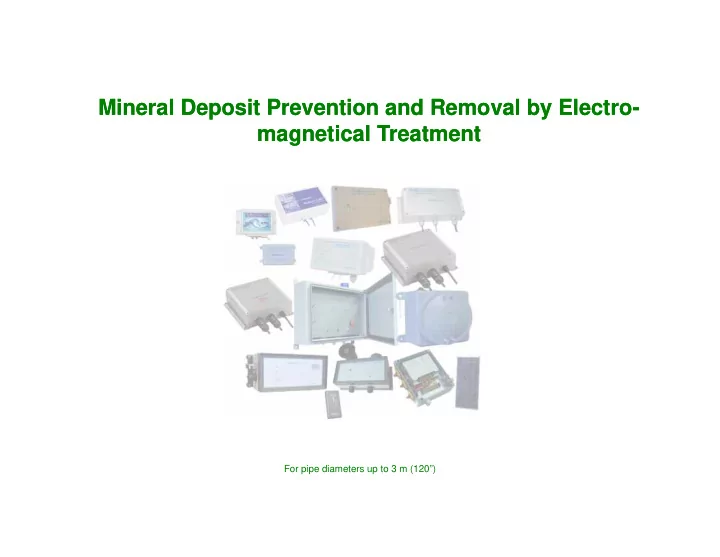
Mineral Deposit Prevention and Removal by Electro- magnetical Treatment Mineral Deposit Prevention and Removal by Electro- magnetical Treatment
For pipe diameters up to 3 m (120”)
Mineral Deposit Prevention and Removal by Electro- Mineral Deposit - - PowerPoint PPT Presentation
Mineral Deposit Prevention and Removal by Electro- Mineral Deposit Prevention and Removal by Electro- magnetical Treatment magnetical Treatment For pipe diameters up to 3 m (120) Problems caused by minerals in water Problems caused by
For pipe diameters up to 3 m (120”)
Adverse effect of mineral scaling:
have to work harder and consume more energy
by a 1 mm scale thickness on the heating surface to achieve the same temperature as without scaling.
a breeding ground for bacteria.
The treatment has a positive effect on the above mentioned adverse effects by influencing crystal growth in the water. Old hard layers will be gradually softened and carried away by the flow of water.
Alternating magnetic field Cross section of pipe Electric field as concentric circles
FT=FE + FB and is the total force on a charge moving in an electric and magnetic field
Alternating electric field
Water contains dissolved mineral crystals and the mineral crystals itself. Among them are Calcium- and Carbonate ions, which are interacting to form an equilibrium with Calcium Carbonate crystals. Meaning that when crystals are dissolved other mineral ions will combine and form crystals again. This is a continuous process. The force of an electric and magnetic field of the right frequency and signal-shape influences this process, shifting the equilibrium towards much more crystals of smaller size and roundish
The alternating fields are generated by an alternating current with continuous changing frequencies within a specific band.
Pipe wall
822 x magnified 8430 x magnified Note the matted structures that Calcium Carbonate forms in untreated water. These "mats" stick even on smooth surfaces and offer newly formed CaCO3 crystals a lot of places to attach to. This is the very base of scaling! Note that the crystals are smaller and have a rotund shape, which means that they have a larger volume in relation to a smaller surface. This feature makes them sensitive to water currents and they are easily flushed out of the pipeline.
Not treated Treated
20 micron Pictures have been taken with an electron microscope at a university in Germany on request of Scalewatcher.
Close up showing the difference between untreated and treated crystals as to shape and size.
Not treated: Crystals have sharp edges and a large surface, which eases adhesion to pipe walls. Treated: Crystals are smaller and have roundish
walls. It must be noted that the pictures of the 2 micron sized crystals have been taken some time after treatment. One can expect that the initial size is in the nano range and that the crystals grow out to a larger size over time.
Once the size of 2 micron is reached the crystals can be filtered out. However when
filtering is not possible as the crystals are still in the nano range and need time to grow.
Pictures taken with a three dimensional (3D) microscope
The 2D-cut through the 3D-pic shows the matted structure in the boundary region of the untreated drop (right), where the particles stick together and overlay each
through the boundary of the treated drop (left) shows singular, scattered crystals of about 3 micrometers size.
Difference between treated and untreated water:
grow much slower than not treated.
much less.
settlement on the metal iron plate.
Iron test plates in a basin filled with stagnant treated or untreated water. Pictures taken three days after the inoculation of bacteria. Normal chlorinated tap water is used of 20 °C.
Bacteria were inoculated in untreated water to breed for three days. (Left). After three days the water with bacteria was treated and the difference
two days. The difference is obvious. The bacteria are dying. This test simulates the real world where bacteria are growing in galvanized iron pipes. (Private houses, elderly homes, hospitals etc…)
Iron test plates in a basin filled with stagnant treated or untreated water. Pictures taken three days after the inoculation of bacteria. Normal chlorinated tap water is used of 20 °C.
10
Six bowls of the kitchen of a hospital were given a mark with the numbers 1 to 6, cleaned by de dishwasher and the next 56 days every day used and cleaned again. Before this experiment the bacterial activity was measured with an ATP meter and was on average 3800. Scalewatcher was installed and one can see that the living material decreases rather quick. After 24 days 50 % less detergent was used in the dishwasher. One can see that the bacterial activity is insignificant after 56 days. Of course this is valid for any surface cleaned by Scalewatcher treated water repeatedly. There does not exist cleaner cutlery in restaurants, elderly homes and hospitals when the water is treated with Scalewatcher.
100 % detergent 50 % detergent Effect of Scalewatcher on the cleanliness of a dishwasher
The treatment can be used for:
Advantages:
WARNING: Existing water treatment cannot be switched off after installation of Scalewatcher. Both should work together. Once it is noticed that the blow down water gets dirty one knows the treatment has effect and the boiler is being cleaned out. At the same time the TDS level should sharply increase. Therefore the TDS level should be measured daily and when it increases more blow down should be applied to keep the level down. When the TDS has the normal value again after a few weeks, the customer can decide to decrease the old water treatment while observing pH and TDS daily.
TDS level change of blow down water after installation
1: Before, 2: After 15 days, 3: After 30 days, 4: After 60 days
Process water inside tubes 180 ºC Cooling water outside tubes ambient temperature Scaling after six months without SW Completely clean after being treated with SW during six months
Plate heat exchangers are difficult to treat caused by the low flow velocity between the plates. On a circulation system Scalewatcher will have a better effect than
This treatment needs flowing water to be able to remove old scale layers. As the water is distributed over a large surface the flow velocity may be too low to remove old scale layers.
SW1 will treat the cold water, keeping the chiller and cooling tower scale free, reducing bacterial count, reducing slime and algae, while saving water. Water can be saved as less or no chemicals are used to treat the water, which otherwise will rapidly increase the TDS, making blow down more often necessary. Water savings of 50 % or more is possible. SW2 treats the closed loop of the chiller. As heat transfer properties are better with treated water this is beneficial.
It was reported that a hotel with 350 rooms, the guests were not complaining about the air conditioning for the first time in 20 years. It was reported that a 500 tons cooling tower saved $17,500 on water alone
about less cost for discharge, maintenance and chemicals.
SW Within two weeks the corrosion was significantly reduced Seawater is used for cooling purposes in heat exchangers. The problem was heavy corrosion as can be expected from sea water.
Water, Oxygen and iron pipes create rust. Within a few weeks the rust disappears and the pipe wall will be covered by a very thin Black layer called Magnetite. The layer will not grow in thickness over time and has very good heat transfer properties which is beneficial for steam boilers and heat exchangers.
Energy consumption insignificant No maintenance Friendly for the environment Easy to install Quick return on investment Lifespan more than 20 years Non invasive
Model SW Nano 3 Star 4 Star 5 Star Well water N N Y Y Outdoor use N N N Y Large house N Y Y Y Warranty 2 years 10 years 10 years 10 years Performance guarantee 4 months
3 Star 4 Star 5 Star Nano 3 Star US
For all pipe material and pipe size as usually found in private houses
Models CM2 and CM4 for indoor use Models CMN2, CMN4 and CMN8 heavy duty.
For use in, but not limited to:
IE2, IE4 and IE8 SE4, SE8, LE12, LE16 HIME24, HIME40, HIME60, HIME80
Light Industry IE series Heavy Industry, SE, LE and HIME series