
SLIDE 1
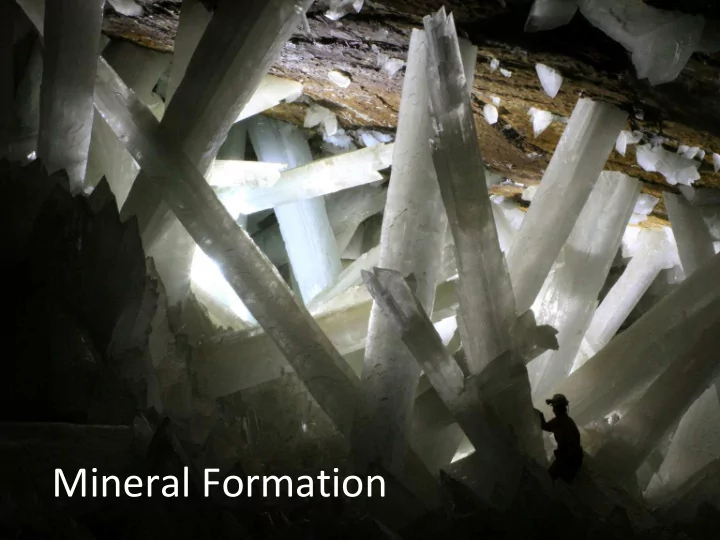
Mineral Formation Mineral Chemistry General Notes jot form - - PowerPoint PPT Presentation
Mineral Formation Mineral Chemistry General Notes jot form Mineral Formation Precipitation Solid state reactions Definition: Definition: Examples - Examples - Magma Crystallization Definition: Examples - Mineral Chemistry
Definition: Examples - Definition: Examples - Definition: Examples - General Notes – jot form
compounds
structure Covalent Bonding
Example: SiO2 = Quartz Ionic Bonding
Example: Halite = NaCl (salt) Metallic Bonding
Examples: Gold and Silver
Minerals can be described by their chemical formula. Sometimes multiple elements can fill the same spot in a mineral structure. Example
Every mineral is a combination of elements; the atoms are organized into geometric structures called crystals or crystal lattices. The shape of the mineral is determined by how the atoms creating the mineral are
If two different minerals have the same chemical formula but different crystal structure, they are called polymorphs (e.g., graphite and diamond). They are both made up of Carbon = C
Crystals form by a seed (nucleation), which other atoms attach to through
the crystal is at its outer edge. If the atoms available in the environment change, the composition of the mineral can change, thus creating compositional zoning. If space to grow is not constrained then crystals will form a characteristic shape based on their structure. However, growth is often restricted, and their shape is controlled by the shape of their surroundings.
Watermelon Tourmaline Plagioclase Zoning (Ca and Na)
Definition: Examples - Definition: Examples - Definition: Examples - General Notes – jot form
Mineral Precipitation: is when a mineral forms by crystallization from a solution (for example salt precipitating from a salty lake when the water evaporates).
minerals such as salt or iron.
becomes saturated.
(supersaturated) the particles come together to form mineral solids and precipitate out.
behind a solid “precipitate” of minerals.
(hydrothermal fluid) changes temperature, pressure or composition, such that the fluid becomes supersaturated and deposits the dissolved
form veins.
Geodes – quartz = amethyst. Also, can be calcite or apatite Salt flats – evaporated sea Potash = Sylvite Halite Anhydrite Quartz veins in a gold mine
Quartz veins (Box Mine, SK) Limestone cave
Igneous Crystallization: is when a mineral forms by solidification of magma (deep in the earth) or lava (on the surface) .
crystallize out of the magma.
Series.
more quickly the crystals are smaller.
time to nucleate and grow and then you get volcanic glass (obsidian).
Granite is a felsic rock that contains the minerals quartz (grey), plagioclase feldspar (shiny white), potassium feldspar (pale pink) and biotite (black). Diabase is a mafic rock that in this case contains plagioclase (white), pyroxene (brown) and amphibole (black).
Garnet is a common metamorphic mineral that forms at moderate to high temperatures and pressures.
Sedimentary rock = sand (quartz) plus clay (kaolinite) Increasing pressure Increasing temperature Quartz + Kaolinite Pyrophyllite + Water Andalusite + Quartz + water Kyanite + Quartz + water Sillimanite + Quartz + water
Biomineralization: is when a mineral is formed by living organisms -
calcium that are used with polymers such as collagen and chitin to give structural support to bones and shells.
Seashells, crustaceans, turtle shells, and corals Bacteria producing gold Teeth and bone in mammals and birds