
SLIDE 1
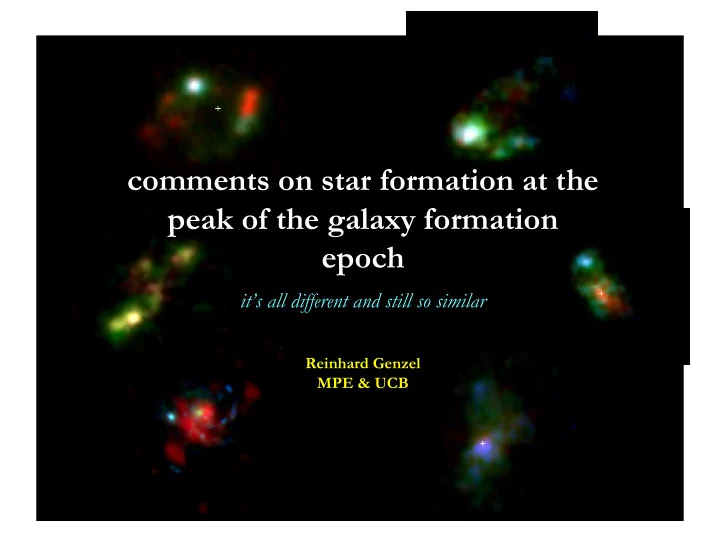
comments on star formation at the peak of the galaxy formation epoch
it’s all different and still so similar
Reinhard Genzel MPE & UCB
comments on star formation at the peak of the galaxy formation - - PowerPoint PPT Presentation
comments on star formation at the peak of the galaxy formation epoch its all different and still so similar Reinhard Genzel MPE & UCB star formation and feedback at the peak of the galaxy formation epoch continuous LIRGs accretion
Reinhard Genzel MPE & UCB
ULIRGs
LIRGs
(major) mergers & starbursts continuous accretion from halo & disk instabilities
Lilly et al. 1996, Steidel et al. 1996, Hopkins & Beacom 2006, Soifer et al. 2008, Rees & Ostriker 1977, Silk 1977, White & Rees 1978, Kauffmann et al. 1993, Steinmetz & Navarro 2003, Hernquist, Springel, di Matteo, Hopkins et al. 2003-2009, Robertson & Bullock 2008, Sanders & Mirabel 1996, Dekel & Birnboim 2003,2006, Keres et al. 2005, 2009, Nagamine et al. 2005, Davé 2007, Kitzbichler & White 2007, Naab et al. 2007, Governato et al. 2008, Ocvirk et al. 2008, Dekel et al. 2009, Agertz et al. 2009, Guo et al. 2009, Teyssier et al. 2010, Bournaud 2010, Davè et al. 2011a,b, Kauffmann et al. 2010
extrapolation from z~0: high-z star formation dominated by starbursts & mergers Soifer et al. 2008
Rosetta cluster GMC: PACS & SPIRE
z~0 star forming galaxies have a low efficiency of star formation εSF; this may be the direct consequence of the small fraction of self-gravitating gas on small scales in a highly turbulent medium driven by feedback. As a result the ‘depletion’ time scale from molecular gas to stars is long tdepletion~ tdyn/ εSF ~109 yrs Krumholz ¡& ¡McKee ¡2005, ¡McKee ¡& ¡Ostriker ¡2008, ¡Bigiel ¡et ¡
Bournaud ¡2011, ¡Saintonge ¡et ¡al. ¡2011 ¡
Q~1
Pipe nebula ~8x10³ M, D=20pc 21 YSOs ρ Oph ~1.4x10⁴ M, D=20pc 316 YSOs distance 130pc Lada, Alves, Lombardi 2006-2009 active star formation only occurs in dense (>104 cm-3), highly obscured (AV>7) regions
SMGs ¡ ULIRGs ¡ L I R G s / s t a r b u r s t s ¡
AGN ¡powered ¡ HYLIRGs ¡
SDSS: Schiminovich et al. 2007 Tacconi, Daddi et al. 2010, 2011
z~0
Noeske +07, Daddi+07, Elbaz+07
Wuyts et al. 2011 (PEP): SDSS/GALEX, COSMOS,GOODS
6x10⁵ galaxies 1x10⁵ galaxies 2.5x10⁴ galaxies
ULIRGs SMGs SMGs
Rodighiero et al. 2011 (PEP):
for ~10% of cosmic star formation at z~2
Kereš et al. 2005, 2009, Neistein et al. 2006, Genel et al. 2008, Guo et al. 2009, Oppenheimer & Davè 2006, Dekel et al. 2009, Davè et al. 2010, 2011, Dutton et al. 2009, Bouchè et al. 2010
Noguchi 1999, Immeli et al. 2004, Bournaud et al. 2007, Elmegreen et al. 2008, Dekel et al. 2009b, Genzel et al. 2008, 2011, Krumholz & Burkert 2010
R ~ 1kpc largest star formation clumps in high-z ‘main-sequence’ disks are the largest scale of gravitational fragmentation, scaled up to the 5-10 times greater gas fraction & 101.5…3 greater interstellar pressure than at z~0
2.1 ¡ 1.6 ¡ 1.3 ¡ 1.1 ¡ 0.8 ¡ 0.4 ¡ 0.2 ¡
5 kpc
da Cunha et al. 2010
star formation rate (Myr-1) log (Mdust (M) )
LFIR/M(H2) (L/M) L[CII] 158/LFIR
increasing ionization parameter U,
z>1
ms
Gracia-Carpio et al. 2010 FIR line deficits main-sequence galaxies across z have remarkably uniform infrared spectral energy distributions
across z are warmer and have much lower PAH emission Elbaz et al. 2010, 2011, Hwang et al. 2011, Nordon et al. 2010, 2011