SLIDE 1
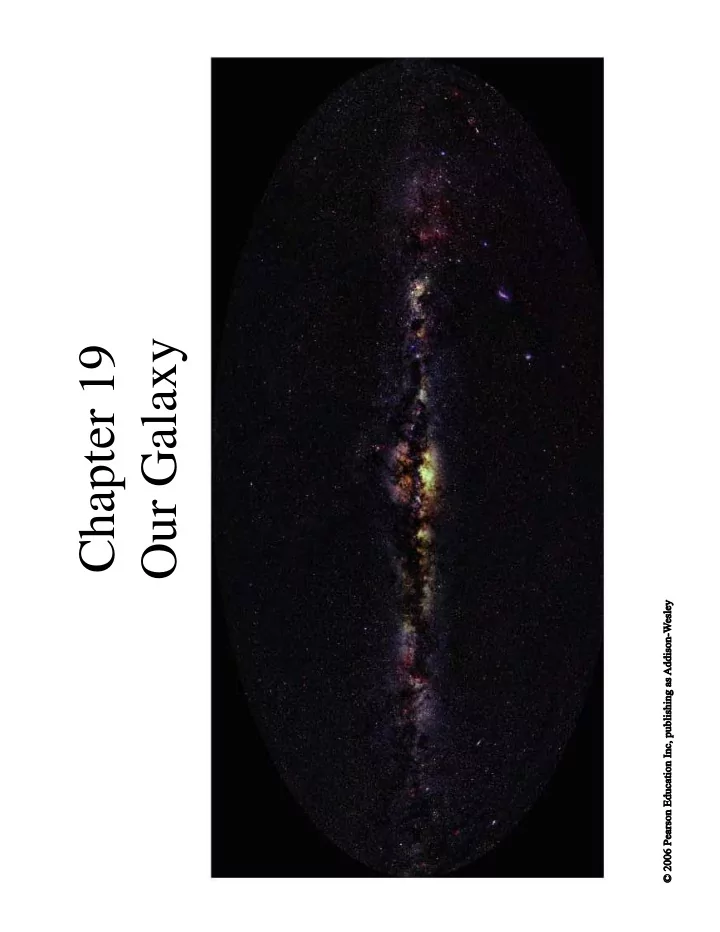
Chapter 19 Our Galaxy
SLIDE 2 19.1 The Milky Way Revealed
- Our goals for learning
- What does our galaxy look like?
- How do stars orbit in our galaxy?
SLIDE 3
What does our galaxy look like?
SLIDE 4 The Milky Way galaxy appears in our sky as a faint band of light
SLIDE 5 Dusty gas clouds obscure
because they absorb visible light This is the interstellar medium that makes new star systems
SLIDE 6
All-Sky View
SLIDE 7
We see our galaxy edge-on Primary features: disk, bulge, halo, globular clusters
SLIDE 8
If we could view the Milky Way from above the disk, we would see its spiral arms
SLIDE 9
How do stars orbit in our galaxy?
SLIDE 10
Stars in the disk all orbit in the same direction with a little up-and-down motion
SLIDE 11 Orbits of stars in the bulge and halo have random
SLIDE 12
SLIDE 13
Sun’s orbital motion (radius and velocity) tells us mass within Sun’s orbit: 1.0 x 10¹¹ MSun
SLIDE 14 Orbital Velocity Law
- The orbital speed (v) and radius (r) of an object on a
circular orbit around the galaxy tells us the mass (Mr) within that orbit
Mr = r × v 2 G
SLIDE 15 What have we learned?
- What does our galaxy look like?
– Our galaxy consists of a disk of stars and gas, with a bulge of stars at the center of the disk, surrounded by a large spherical halo
- How do stars orbit in our galaxy?
– Stars in the disk orbit in circles going in the same direction with a little up-and-down motion – Orbits of halo and bulge stars have random
SLIDE 16 19.2 Galactic Recycling
- Our goals for learning
- How is gas recycled in our galaxy?
- Where do stars tend to form in our galaxy?
SLIDE 17
How is gas recycled in our galaxy?
SLIDE 18
Star-gas-star cycle Recycles gas from old stars into new star systems
SLIDE 19
High-mass stars have strong stellar winds that blow bubbles of hot gas
SLIDE 20
Lower mass stars return gas to interstellar space through stellar winds and planetary nebulae
SLIDE 21
X-rays from hot gas in supernova remnants reveal newly- made heavy elements
SLIDE 22
Supernova remnant cools and begins to emit visible light as it expands New elements made by supernova mix into interstellar medium
SLIDE 23
Radio emission in supernova remnants is from particles accelerated to near light speed Cosmic rays probably come from supernovae
SLIDE 24
Multiple supernovae create huge hot bubbles that can blow out of disk Gas clouds cooling in the halo can rain back down on disk
SLIDE 25
Atomic hydrogen gas forms as hot gas cools, allowing electrons to join with protons Molecular clouds form next, after gas cools enough to allow to atoms to combine into molecules
SLIDE 26 Molecular clouds in Orion Composition:
- Mostly H2
- About 28% He
- About 1% CO
- Many other
molecules
SLIDE 27
Gravity forms stars out of the gas in molecular clouds, completing the star-gas- star cycle
SLIDE 28
Radiation from newly formed stars is eroding these star- forming clouds
SLIDE 29 Summary of Galactic Recycling
- Stars make new elements by fusion
- Dying stars expel gas and new elements, producing hot
bubbles (~106 K)
- Hot gas cools, allowing atomic hydrogen clouds to form
(~100-10,000 K)
- Further cooling permits molecules to form, making
molecular clouds (~30 K)
- Gravity forms new stars (and planets) in molecular clouds
Gas Cools
SLIDE 30
We observe star-gas-star cycle operating in Milky Way’s disk using many different wavelengths of light
SLIDE 31
Infrared light reveals stars whose visible light is blocked by gas clouds Infrared Visible
SLIDE 32
X-rays are observed from hot gas above and below the Milky Way’s disk X-rays
SLIDE 33
21-cm radio waves emitted by atomic hydrogen show where gas has cooled and settled into disk Radio (21cm)
SLIDE 34
Radio waves from carbon monoxide (CO) show locations of molecular clouds Radio (CO)
SLIDE 35
Long-wavelength infrared emission shows where young stars are heating dust grains IR (dust)
SLIDE 36
Gamma rays show where cosmic rays from supernovae collide with atomic nuclei in gas clouds
SLIDE 37 Where do stars tend to form in
SLIDE 38
Ionization nebulae are found around short-lived high-mass stars, signifying active star formation
SLIDE 39
Reflection nebulae scatter the light from stars Why do reflection nebulae look bluer than the nearby stars? For the same reason that our sky is blue!
SLIDE 40
What kinds of nebulae do you see?
SLIDE 41
Disk: Ionization nebulae, blue stars ⇒ star formation Halo: No ionization nebulae, no blue stars ⇒ no star formation
SLIDE 42 Much of star formation in disk happens in spiral arms
Whirlpool Galaxy Ionization Nebulae Blue Stars Gas Clouds
SLIDE 43
Spiral arms are waves of star formation
SLIDE 44 Spiral arms are waves
- f star formation
- 1. Gas clouds get
squeezed as they move into spiral arms
triggers star formation
- 3. Young stars flow
- ut of spiral arms
SLIDE 45 What have we learned?
- How is gas recycled in our galaxy?
– Gas from dying stars mixes new elements into the interstellar medium which slowly cools, making the molecular clouds where stars form – Those stars will eventually return much of their matter to interstellar space
- Where do stars tend to form in our galaxy?
– Active star-forming regions contain molecular clouds, hot stars, and ionization nebulae – Much of the star formation in our galaxy happens in the spiral arms
SLIDE 46 19.3 The History of the Milky Way
- Our goals for learning
- What clues to our galaxy’s history do halo
stars hold?
SLIDE 47
What clues to our galaxy’s history do halo stars hold?
SLIDE 48 Halo Stars: 0.02-0.2% heavy elements (O, Fe, …),
Disk Stars: 2% heavy elements, stars of all ages Halo stars formed first, then stopped Disk stars formed later, kept forming
SLIDE 49
How did our galaxy form?
SLIDE 50
Our galaxy probably formed from a giant gas cloud
SLIDE 51
Halo stars formed first as gravity caused cloud to contract
SLIDE 52
Remaining gas settled into spinning disk
SLIDE 53
Stars continuously form in disk as galaxy grows older
SLIDE 54 Stars continuously form in disk as galaxy grows older
Warning: This model is
SLIDE 55
Detailed studies: Halo stars formed in clumps that later merged
SLIDE 56 What have we learned?
- What clues to our galaxy’s history do halo
stars hold?
– Halo stars are all old, with a smaller proportion of heavy elements than disk stars, indicating that the halo formed first
– Our galaxy formed from a huge cloud of gas, with the halo stars forming first and the disk stars forming later, after the gas settled into a spinning disk
SLIDE 57 19.4 The Mysterious Galactic Center
- Our goals for learning
- What lies in the center of our galaxy?
SLIDE 58
What lies in the center of our galaxy?
SLIDE 59
Infrared light from center Radio emission from center
SLIDE 60
Radio emission from center Swirling gas near center
SLIDE 61
Swirling gas near center Orbiting star near center
SLIDE 62 Stars appear to be orbiting something massive but invisible … a black hole? Orbits of stars indicate a mass
million MSun
SLIDE 63 X-ray flares from galactic center suggest that tidal forces
black hole
tear apart chunks of matter about to fall in
SLIDE 64 What have we learned?
- What lies in the center of our galaxy?
– Orbits of stars near the center of our galaxy indicate that it contains a black hole with 4 million times the mass of the Sun