SLIDE 1
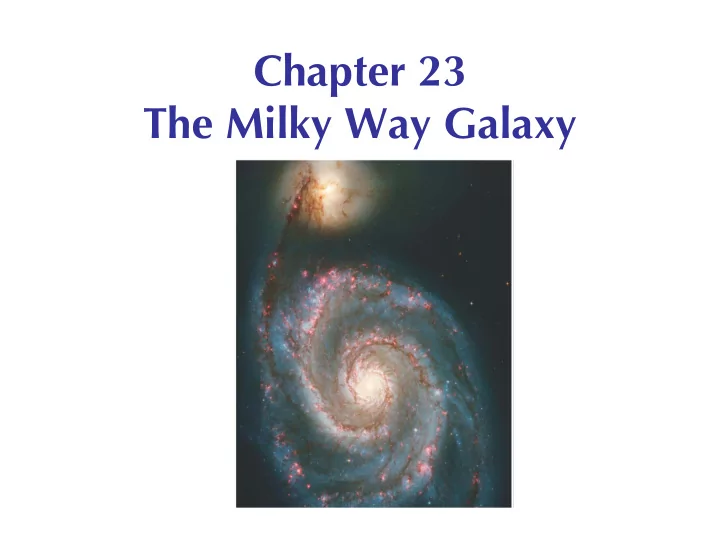
Chapter 23 The Milky Way Galaxy
SLIDE 2
23.1 Our Parent Galaxy 23.2 Measuring the Milky Way
XXEarly “Computers”
23.3 Galactic Structure 23.4 The Formation of the Milky Way 23.5 Galactic Spiral Arms
XXDensity Waves
23.6 The Mass of the Milky Way Galaxy 23.7 XXThe Galactic Center
Units of Chapter 23
SLIDE 3 From Earth, we see few stars when looking out of our galaxy (red arrows) and many stars when looking in (blue arrows). Milky Way is what our galaxy appears as in the night sky.
23.1 Our Parent Galaxy
SLIDE 4
Our galaxy is a spiral galaxy. The Andromeda Galaxy, our closest spiral neighbor, probably resembles the Milky Way fairly closely.
23.1 Our Parent Galaxy
SLIDE 5
Here are two other spiral galaxies, one viewed from the side and the other from the top:
23.1 Our Parent Galaxy
SLIDE 6
One of the first attempts to measure the Milky Way was done by Herschel using visible stars. Unfortunately, he was not aware that most of the galaxy, particularly the center, is blocked from view by vast clouds of gas and dust.
23.2 Measuring the Milky Way
SLIDE 7 We have already encountered variable stars—novae, supernovae, and related phenomena. There are other stars whose luminosity varies in a regular way, but much more
- subtly. These are called intrinsic variable
stars. Two types of intrinsic variables have been found: RR Lyrae stars and Cepheids.
23.2 Measuring the Milky Way
SLIDE 8
The upper plot is an RR Lyrae star. All such stars have essentially the same luminosity curve with periods from 0.5 to 1 day. The lower plot is a Cepheid variable; Cepheid periods range from about 1 to 100 days.
23.2 Measuring the Milky Way
SLIDE 9
The variability of these stars comes from a dynamic balance between gravity and pressure—they have large oscillations around stability.
23.2 Measuring the Milky Way
SLIDE 10
The usefulness of these stars comes from their period–luminosity relation:
23.2 Measuring the Milky Way
SLIDE 11 This allows us to measure the distances to these stars:
- RR Lyrae stars all have about the same
luminosity; knowing their apparent magnitude allows us to calculate the distance.
- Cepheids have a luminosity that is strongly
correlated with the period of their oscillations;
- nce the period is measured, the luminosity is
known and we can proceed as above.
23.2 Measuring the Milky Way
SLIDE 12
We have now expanded our cosmic distance ladder one more step:
23.2 Measuring the Milky Way
SLIDE 13 Many RR Lyrae stars are found in globular
are not all in the plane of the galaxy, so they are not obscured by dust and can be measured. This yields a much more accurate picture of the extent of our galaxy and
23.2 Measuring the Milky Way
SLIDE 14 This artist’s conception shows the various parts
- f our galaxy, and the position of our Sun:
23.3 Galactic Structure
SLIDE 15
The galactic halo and globular clusters formed very early; the halo is essentially spherical. All the stars in the halo are very old, and there is no gas and dust. The galactic disk is where the youngest stars are, as well as star formation regions— emission nebulae and large clouds of gas and dust. Surrounding the galactic center is the galactic bulge, which contains a mix of older and younger stars.
23.3 Galactic Structure
SLIDE 16 Stellar orbits in the disk move on a plane and in the same direction;
and bulge are much more random.
23.3 Galactic Structure
SLIDE 17
Any theory of galaxy formation should be able to account for all the properties below:
23.4 The Formation of the Milky Way
SLIDE 18
The formation of the galaxy is believed to be similar to the formation of the solar system, but on a much larger scale:
23.4 The Formation of the Milky Way
SLIDE 19
Measurement of the position and motion of gas clouds shows that the Milky Way has a spiral form:
23.5 Galactic Spiral Arms
SLIDE 20
The spiral arms cannot rotate at the same speed as the galaxy; they would “curl up”.
23.5 Galactic Spiral Arms
SLIDE 21
Rather, they appear to be density waves, with stars moving in and out of them such as cars move in and out of a traffic jam:
23.5 Galactic Spiral Arms
SLIDE 22 As clouds of gas and dust move through the spiral arms, the increased density triggers star
- formation. This may contribute to propagation
- f the arms. The origin of the spiral arms is not
yet understood.
23.5 Galactic Spiral Arms
SLIDE 23
The orbital speed of an object depends only on the amount of mass between it and the galactic center:
23.6 The Mass of the Milky Way Galaxy
SLIDE 24
Once all the galaxy is within an orbit, the velocity should diminish with distance, as the dashed curve shows. It doesn’t; more than twice the mass of the galaxy would have to be outside the visible part to reproduce the observed curve.
23.6 The Mass of the Milky Way Galaxy
SLIDE 25 What could this “dark matter” be? It is dark at all wavelengths, not just the visible.
- Stellar-mass black holes?
Probably no way enough of them could have been created
- Brown dwarfs, faint white dwarfs, and red dwarfs?
This was the best star-like option, but comes up short by a significant margin.
- Subatomic particles?
- Recall the solution to the “solar neutrino problem”, that neutrinos have
a tiny bit of mass. Neutrinos turn out to be the most abundant particle in the universe (more than even photons). But falls short by an order of magnitude. A “weird subatomic particle” is the most (only?) favored candidate. But whatever they are, they are too massive to observe in present-day particle accelerators (takes too much energy to create them).
23.6 The Mass of the Milky Way Galaxy
Conclusion: Our galaxy (and others) consist mostly of “dark matter,” but we have no idea what that is, other than it exerts a gravitational force.
SLIDE 26
A Hubble search for red dwarfs turned up too few to account for dark matter; if enough existed, they should have been detected.
23.6 The Mass of the Milky Way Galaxy
SLIDE 27 The bending of spacetime can allow a large mass to act as a gravitational lens. Observation of such events suggests that low- mass white dwarfs could account for as much as 20% of the mass
- needed. The rest is still a mystery.
23.6 The Mass of the Milky Way Galaxy
SLIDE 28
- A galaxy is stellar and interstellar matter bound
by its own gravity.
- Our galaxy is spiral.
- Variable stars can be used for distance
measurement through the period–luminosity relationship.
- The true extent of the galaxy can be mapped
- ut using globular clusters.
- Star formation occurs in the disk, but not in the
halo or bulge.
Summary of Chapter 23
SLIDE 29
- Spiral arms may be density waves.
- The galactic rotation curve shows large
amounts of undetectable mass at large radii called dark matter.
- Activity near galactic center suggests presence
- f a 2 to 3 million solar-mass black hole
Summary of Chapter 23 (cont.)