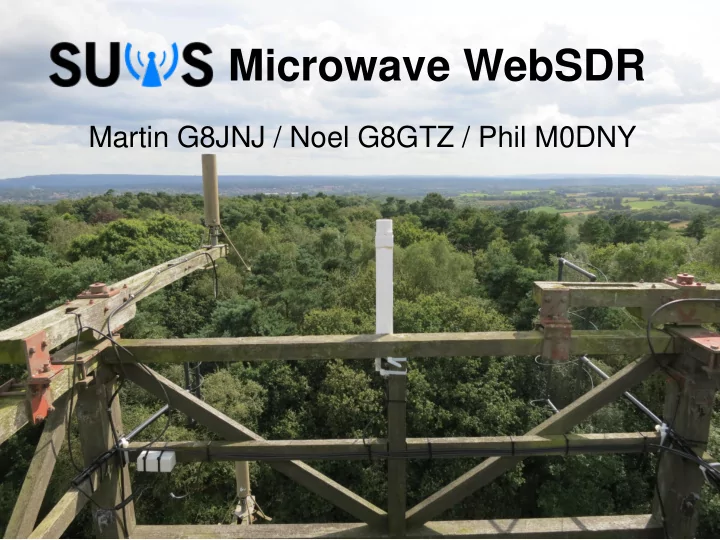
SLIDE 1
Microwave WebSDR
Martin G8JNJ / Noel G8GTZ / Phil M0DNY
SLIDE 2 What is it?
- A system of remote SDR receivers which are on
the web
- Useable by anyone with a standard web browser
- All modes and many users!
- The system at Farnham runs s/w developed by
www.sdr.org
- More than 30 systems around the world
- Most cover HF but Farnham covers VHF/UHF
SLIDE 3 Where is it?
IO91OF - Latitude: 51.23, Longitude: -0.82
SLIDE 4
The site
SLIDE 5 Farnham SDR is different!
- Most websdr cover HF and VHF using sound cards
- Only 96 KHz band coverage
- Just like Softrock
- OK for HF but no good for VHF / UHF
- Farnham uses the cheap £5 RTL dongles
- Covers 2 MHz band!
- 50 MHz up to 2 GHz!
- And we run 6 of them!
- But the rx performance could be better....
SLIDE 6 So why 6 receivers?
- So we can cover lots of bands!
- 144 – 146 MHz = 2mts
- 432 – 434 MHz = 70cms Narrowband and beacons
- 434 – 436 MHz = 70cms FM & HAB & Satellites
- 436 – 438 MHz = 70cms satellites
- 1296 – 1298 MHz = 23cms NB and Beacons
- 10368 – 10370 MHz = 10 GHz NB and beacons (via
LNB)
SLIDE 7
System Configuration
SLIDE 8
The RF in the shed
SLIDE 9
RTL-SDR Modifications
SLIDE 10 10 GHz rx for less than £25!
- 144, 432 and 1296 all just
use the RTL dongle
dongle is fed from a PLL satellite LNB
- Available from ebay for £15
- A stable sub 1dB NF rx on
10 Ghz for less than £25
SLIDE 11
uWave Antennas
SLIDE 12
VHF & UHF Antennas (Martin – G8JNJ)
SLIDE 13 So can I use it?
- YES!
- Go to http://websdr.suws.org.uk
- You will instantly hear APRS on 144.800 MHz
- The default start frequency
- But what if someone else is using it?
- No problem – it can support 25+ simultaneous
users all tuned to different (or the same) frequencies and modes!
SLIDE 14 And then....
- Log in with your call sign or name
- You do not need to be licensed to use it
- You will then appear on the scale and others can see
what frequency you are listening to
- What will I hear?
- Anything on VHF / UHF that you would expect to hear
- n a 90ft mast on Farnham hill!
- Why can I hear GB3FN everywhere?
- Because it is VERY strong and the rxs are cheap but...
- We do have a big notch filter inline but...
SLIDE 15
WEB GUI
SLIDE 16
Who is on the band ?
SLIDE 17 2 metres
- GB3VHF beacon = 144.430
- 2m FM simplex =145.500
- 2m repeater outputs = 145.600-145.7875
- International Space Station FM =145.800
- ISS Packet Digipeater = 145.825
- FunCube-2 = 145.930 – 145.950
- AO-73 (FUNCube-1) = 145.950 – 145.970
- AO-7 (Phase-2B) =145.975-145.925
SLIDE 18 70cms
- 70cm SSB, CW & beacons = 432.000-433.000
- 70cm FM repeater = 433.000-433.400
- 70cm FM Simplex = 433.400-434.800
- Short range radio devices (Licence free) = 434.900
- High Altitude Balloon RTTY = 434.000-434.800
- FO-29 (JAS-2) =435.900-435.800
- Cubesat beacons (40+) 436.800 - 437.700
SLIDE 19 23cms and 10 GHz
- 23cm NB & beacons = 1296.000-1297.000
- 23cm FM repeaters = 1297.000-1298.000
- 3cm NB modes = 10368.100-10368.250
- 3cm beacons = 10368.750-10369.000
- GB3SEE (visible at all times) = 10368.850
- Other beacons via Rain scatter!
SLIDE 20
Different modes
CW FM JT
SLIDE 21
Receiving balloons - UKHAS
SLIDE 22
Satellite users
SLIDE 23
LitSat-1
“The Southampton University Wireless Society (SUWS) Web-based software defined radio (SDR) has been used to receive signals from the new amateur radio LitSat-1 satellite.” “The Lithuanian satellite LitSat-1 was deployed from the ISS on February 28 and the builders of the satellite have been able to use the SUWS WebSDR to receive the satellite when it is out of the range of Lithuania.”
SLIDE 24
Different ways to see the signal
SLIDE 25 How do I decode signals?
SSTV, RTTY etc signals
- You need to run the decode
software on your PC
- Feed the audio out from your
soundcard in to the input
– Cable, VAC, Fbaudio
- Then you can decode what you
hear
- You record and download the
audio as a file!
- But remember the rx location is
IO91OF!!! ISS SSTV received at Farnham and decoded in Southampton!
SLIDE 26
Any Questions?