Mercedes-Benz Diesel Technology: Clean, Efficient and Powerful Dr. - - PDF document

mercedes benz diesel technology clean efficient and
SMART_READER_LITE
LIVE PREVIEW

Mercedes-Benz Diesel Technology: Clean, Efficient and Powerful Dr. - - PDF document

Mercedes-Benz Diesel Technology: Clean, Efficient and Powerful Dr. Klaus Fieweger, Daimler AG, Stuttgart Thai Automotive Institute Diesel Symposium, Bangkok, June 13, 2008 Global Challenges and Demands on Vehicles Reduction of Emissions (incl.


slide-1
SLIDE 1

Mercedes-Benz Diesel Technology: Clean, Efficient and Powerful

  • Dr. Klaus Fieweger, Daimler AG, Stuttgart

Thai Automotive Institute Diesel Symposium, Bangkok, June 13, 2008

Folie 3 Thai Automotive Institute Diesel Symposium, Bangkok, June 13, 2008: Mercedes-Benz Diesel Technology - Clean, Efficient and Powerful

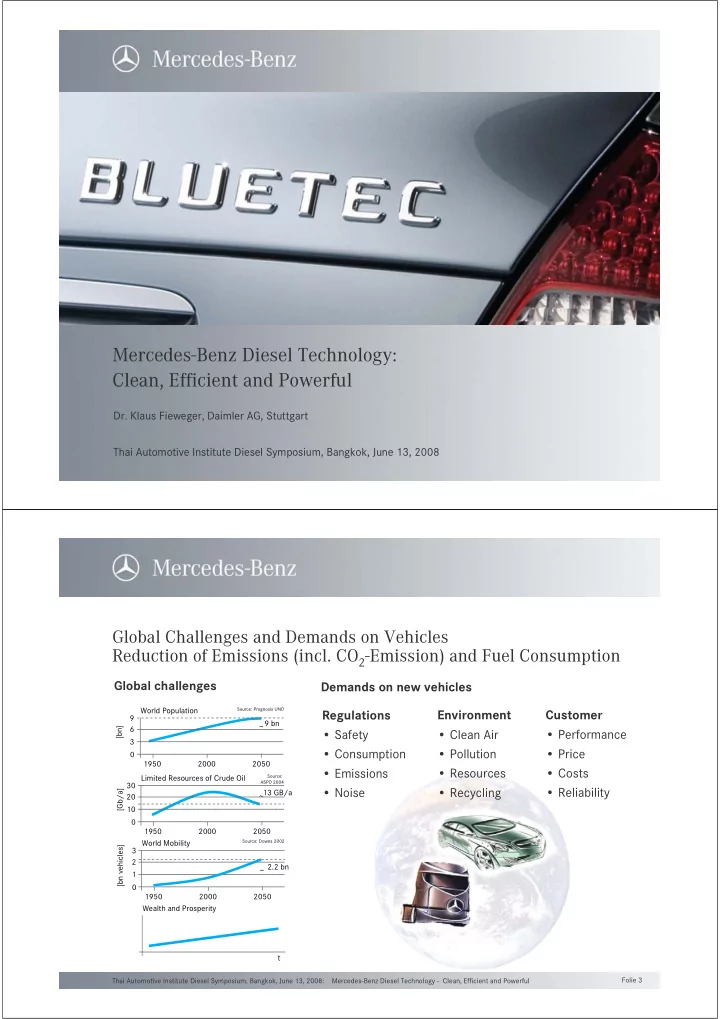
Global Challenges and Demands on Vehicles Reduction of Emissions (incl. CO2-Emission) and Fuel Consumption

Regulations

  • Safety
  • Consumption
  • Emissions
  • Noise

t World Population 1950 2050 2000 [bn] 3 6 9

Source: Prognosis UNO

Global challenges Demands on new vehicles Environment

  • Clean Air
  • Pollution
  • Resources
  • Recycling

Customer

  • Performance
  • Price
  • Costs
  • Reliability

9 bn ~ Limited Resources of Crude Oil 1950 2050 2000 [Gb/a] 10 20 30

Source: ASPO 2004

13 GB/a ~ World Mobility 1950 2050 2000 [bn vehicles] 1 2 3

Source: Downs 2002

2.2 bn ~ Wealth and Prosperity

slide-2
SLIDE 2

Folie 5 Thai Automotive Institute Diesel Symposium, Bangkok, June 13, 2008: Mercedes-Benz Diesel Technology - Clean, Efficient and Powerful

Introduction

  • About 110 years ago Rudolf Diesel invented the self-ignition engine which was named

DIESEL engine since then.

  • The diesel engine was for a long time known as robust and efficient, but for some

attributes like power, driveability, sportiness the gasoline engine was often favoured.

  • Due to a lot of technical improvements within the last 15 years, e.g. turbo charging, 4-

valve technology, common rail direct injection, particular trap and BlueTEC, the DIESEL engine has become a competitive power train with outstanding torque and driveability properties.

  • Today about 50 % of the customers make their choice for a diesel car and accordingly

the diesel share has grown significantly in Europe.

  • Looking on the global energy demand, the DIESEL engine has a big potential to save the

crude oil reserves and to reduce the total CO2 emissions, due to economical benefits in terms of fuel economy.

  • The technology evolution of today’s high performance DIESEL engines was extensively

driven by Mercedes-Benz.

slide-3
SLIDE 3

Folie 6 Thai Automotive Institute Diesel Symposium, Bangkok, June 13, 2008: Mercedes-Benz Diesel Technology - Clean, Efficient and Powerful

Diesel History and Success

1890 1900 1910 1920 1930 1940 1950 1960 1970 1980 1990 2000 2010 First Diesel Engine (1893) Prechamber Prin- ciple,Injection Pump by Prosper L‘Orange (1908- 1921)

  • 1. Diesel Passenger Car

Mercedes-Benz Type 260 D (1936) 4-Valve-Diesel,

  • electr. Diesel

Control (1993) Common Rail Injection (1997) Self ignition engine by Rudolf Diesel (Patent 1892) First Diesel Truck Benz 5-Tons (1923) Exhaust Gas Turbo Charger (1976) Noise Encapsulation (1983) Particular Trap without Additive, Maintenance free as standard in all MB Diesel Passenger Cars (2005) First cleanest BlueTEC Diesel (2006)

The evolution of the Diesel is closely linked to innovative Mercedes-Benz developments.

First BlueTEC Heavy Duty Truck (2005)

Folie 7 Thai Automotive Institute Diesel Symposium, Bangkok, June 13, 2008: Mercedes-Benz Diesel Technology - Clean, Efficient and Powerful

Mercedes-Benz 260 D Rudolf Diesel

1936

More than 70 Years of Diesel Competence: Mercedes-Benz 260 D - First Diesel Passenger Car

slide-4
SLIDE 4

Folie 8 Thai Automotive Institute Diesel Symposium, Bangkok, June 13, 2008: Mercedes-Benz Diesel Technology - Clean, Efficient and Powerful

Mercedes-Benz E 320 BlueTEC Rudolf Diesel

2006

More than 70 Years of Diesel Competence Mercedes-Benz E 320 BlueTEC – World‘s Cleanest Diesel Car

Folie 9 Thai Automotive Institute Diesel Symposium, Bangkok, June 13, 2008: Mercedes-Benz Diesel Technology - Clean, Efficient and Powerful

Four Times around the World 160.934 Kilometer, Ø-Velocity 224.823 km/h 1672 km without Fueling 4,75 l/100 km

Mercedes-Benz E-Class 320 CDI: World Record in Laredo/USA (2005) Low Fuel Consumption and High Mileage

slide-5
SLIDE 5

Folie 10 Thai Automotive Institute Diesel Symposium, Bangkok, June 13, 2008: Mercedes-Benz Diesel Technology - Clean, Efficient and Powerful

E-Class Challenge with V6 Diesel Engine – Paris – Beijing (2006)

Folie 11 Thai Automotive Institute Diesel Symposium, Bangkok, June 13, 2008: Mercedes-Benz Diesel Technology - Clean, Efficient and Powerful

E-Class Challenge with V6 Diesel Engine – Paris – Beijing: 450 000 Kilometers in 26 Days (2006)

slide-6
SLIDE 6

Folie 12 Thai Automotive Institute Diesel Symposium, Bangkok, June 13, 2008: Mercedes-Benz Diesel Technology - Clean, Efficient and Powerful

?

China

Perspektive of Diesel Market Share

Folie 13 Thai Automotive Institute Diesel Symposium, Bangkok, June 13, 2008: Mercedes-Benz Diesel Technology - Clean, Efficient and Powerful

Since the introduction of first emission standards the emissions have been reduced extensively. EURO 1 (1992) EURO 2 (1996) EURO 3 (2000) EURO 4 (2005) EURO 5 (2010)

10 20 30 40 50 60 70 80 90 100

CO - 98 % HC + NOx - 96 % PM - 98 %

EU

NEFZ CO PM HC+NOx [%]

Development of EU Emission Standards

slide-7
SLIDE 7

Folie 14 Thai Automotive Institute Diesel Symposium, Bangkok, June 13, 2008: Mercedes-Benz Diesel Technology - Clean, Efficient and Powerful

lower emissions

  • incl. particulate

emissions

  • xidizing catalytic converter,

particulate filter internal measures, clean fuels efficient and clean combustion process BlueTEC technology reduces emissions of nitrogen oxides by 80 percent

Oxi- Cat. PF SCR-Cat.

In Three Steps – Towards the Cleanest Diesel of the World

Folie 15 Thai Automotive Institute Diesel Symposium, Bangkok, June 13, 2008: Mercedes-Benz Diesel Technology - Clean, Efficient and Powerful

Control of emission components Reduction of engine out emissions Particulate filter and

  • xidation catalyst

NOx aftertreatment

Oxidizing catalyst Particulate filter BlueTEC with advanced NSC BlueTEC with SCR

BlueTEC: The Key Elements of Clean Diesel Technology Diesel Engines as Clean as Gasoline Engines

Goal: Diesel engines as clean as gasoline engines thanks to BlueTEC Showing the way to the most stringent emission standards EU5 and EU6

slide-8
SLIDE 8

Folie 17 Thai Automotive Institute Diesel Symposium, Bangkok, June 13, 2008: Mercedes-Benz Diesel Technology - Clean, Efficient and Powerful

20 % to 40 % fuel consumption advantage for BlueTEC compared to gasoline vehicles Diesel market share of about 11 % in US E-Class sales E 320 BlueTEC Market launch in October 2006 “World Green Car Of The Year 2007“

First BlueTEC in the US

slide-9
SLIDE 9

Folie 19 Thai Automotive Institute Diesel Symposium, Bangkok, June 13, 2008: Mercedes-Benz Diesel Technology - Clean, Efficient and Powerful

with ULEV / BIN5 certification for MY2009 in all 50 states of the US

Next Steps … … Mercedes-Benz GL-, R and ML 320 BlueTEC

slide-10
SLIDE 10

Folie 20 Thai Automotive Institute Diesel Symposium, Bangkok, June 13, 2008: Mercedes-Benz Diesel Technology - Clean, Efficient and Powerful

ADAC: „Innovation

  • f the Year“: BlueTEC

„Best New Technology 2007“: 320 BlueTEC „World Green Car 2007“: E320 BlueTEC New York Autoshow, 04/07 Munich, 01/06 Toronto Autoshow, 02/07

Success Story of BlueTEC Technology

Folie 21 Thai Automotive Institute Diesel Symposium, Bangkok, June 13, 2008: Mercedes-Benz Diesel Technology - Clean, Efficient and Powerful

The new four-cylinder Diesel generation from Mercedes-Benz …

slide-11
SLIDE 11

Folie 22 Thai Automotive Institute Diesel Symposium, Bangkok, June 13, 2008: Mercedes-Benz Diesel Technology - Clean, Efficient and Powerful

Key Data

250 CDI 220 CDI 200 CDI Number of cylinders 4 4 4 Valves per cylinder 4 4 4 Displacement, cc 2143 2143 2143 Bore/stroke, mm 83.0/99.0 83.0/99.0 83.0/99.0 Compression ratio 16.2:1 16.2:1 16.2:1 Output, kW/hp 150/204 at 4200 rpm 125/170 at 3200 -4800 rpm 100/136 at 3000 -4600 rpm Torque, Nm 500 at 1600 - 1800 rpm 400 at 1400 - 2800 rpm 330 *) at 1600 - 2800 rpm

*) with automatic transmission

The engine will be introduced in the Mercedes-Benz C-Class in autumn 2008

Folie 23 Thai Automotive Institute Diesel Symposium, Bangkok, June 13, 2008: Mercedes-Benz Diesel Technology - Clean, Efficient and Powerful

… taking performance, consumption and emissions into a new dimension.

  • 20 per cent more power
  • 25 per cent more torque
  • 13 per cent less CO2 emissions
  • EU5 emissions standard
  • Two-stage turbo charging system
  • Fourth-generation common-rail technology 2000 bar with a new piezoelectric injector

concept featuring direct injector needle control

  • Ignition pressure of 200 bar and such a high power-to-displacement ratio
  • Both the oil-spray nozzles and the water pump are activated in accordance
  • Camshaft drive is positioned at the rear
  • Engine block is made from cast iron, the cylinder head from aluminum.
  • High vibrational comfort:
  • Forged crankshaft with eight counterweights
  • Two Lanchester balancer shafts in low-friction roller bearings
  • Two-mass flywheel
slide-12
SLIDE 12

Folie 24 Thai Automotive Institute Diesel Symposium, Bangkok, June 13, 2008: Mercedes-Benz Diesel Technology - Clean, Efficient and Powerful