MEETING AGENDA Community Wildfire Protection Planning Community - - PowerPoint PPT Presentation

meeting agenda community wildfire protection planning
SMART_READER_LITE
LIVE PREVIEW

MEETING AGENDA Community Wildfire Protection Planning Community - - PowerPoint PPT Presentation

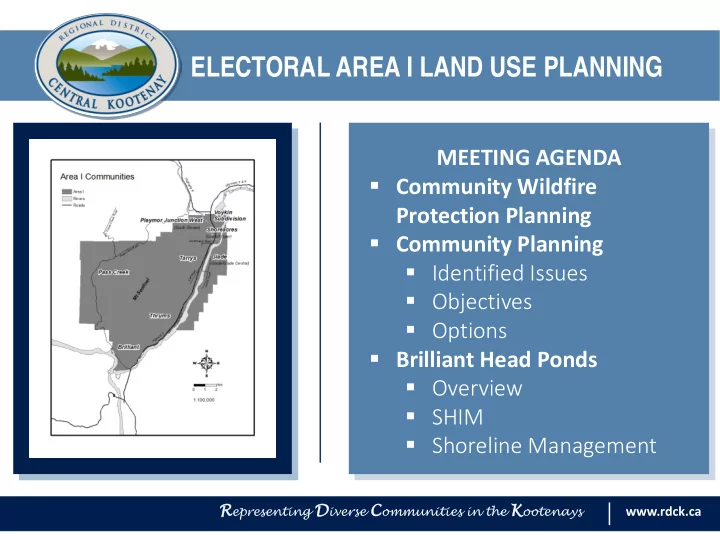
ELECTORAL AREA I LAND USE PLANNING MEETING AGENDA Community Wildfire Protection Planning Community Planning Identified Issues Objectives Options Brilliant Head Ponds Overview SHIM Shoreline Management R


slide-1
SLIDE 1

Representing Diverse Communities in the Kootenays www.rdck.ca

MEETING AGENDA

  • Community Wildfire

Protection Planning

  • Community Planning
  • Identified Issues
  • Objectives
  • Options
  • Brilliant Head Ponds
  • Overview
  • SHIM
  • Shoreline Management

ELECTORAL AREA I LAND USE PLANNING

slide-2
SLIDE 2

Representing Diverse Communities in the Kootenays www.rdck.ca

ELECTORAL AREA I LAND USE PLANNING

The Area I Community Plan Review was initiated in the spring of 2016 as required under Part 14 of the Local Government Act. A Community Backgrounder was prepared over the summer of 2016 which was followed by a Land Use Survey distributed to households and property owners over September and October of 2016. Following the Land Use Survey, a series of community specific workshops were held in November of 2016 which further refined the information gathered from the survey and also provided greater detail as to the issues and values of each community. A Gap Analysis was conducted over the winter of 2017 and additional community meetings are being held to further define community specific options for policy development. INVENTORY  SURVEY  COMMUNITY WORKSHOPS  GAP ANALYSIS  OPTIONS

slide-3
SLIDE 3

Representing Diverse Communities in the Kootenays www.rdck.ca

ELECTORAL AREA I LAND USE PLANNING

OFFICIAL COMMUNITY PLAN An ‘Official Community Plan’ is a general statement of the broad objectives and policies of a local government respecting the character of existing and proposed land use and servicing needs in the area covered by the Plan. The purpose of an Official Community Plan is to guide future land use decisions by local and provincial governments. An OCP can be adopted on its own or with a set of bylaws in order to implement the

  • OCP. OCP’s themselves can only regulate

land use with Development Permit Areas and/or Temporary Industrial and Commercial Use Permits. ZONING If legal controls are desired to govern growth or manage activities, a community would have to set up regulatory bylaws. This is called ‘Zoning’. Zoning bylaws establish specific land use patterns for development; such as permitted uses of land, as well as guidelines to development; such as height restrictions, setbacks from property lines, and appropriate lot sizes for subdivision purposes. Area I has had land use regulation since 1983, although the community of Brilliant had its own plan by 1980.

slide-4
SLIDE 4

Representing Diverse Communities in the Kootenays www.rdck.ca

ELECTORAL AREA I LAND USE PLANNING

The following THEMES must be considered during the development of an Official Community Plan:

RESIDENTIAL (type and density for anticipated housing needs over a 5 to 10 year period)

COMMERCIAL (location, amount and type)

INDUSTRIAL (location, amount and type)

INSTITUTIONAL (location, amount and type)

AGRICULTURAL (location, amount and type)

RECREATIONAL (location, amount and type)

PUBLIC UTILILITIES (location, amount and type)

SAND AND GRAVEL (location and amount)

HAZARDS AND ENVIRONMENTALLY SENSITIVE LANDS restrictions on the use of land

ROADS, SEWER AND WATER the approximate location and phasing

PROPOSED PUBLIC FACILITIES including schools, parks and waste treatment and disposal sites;

HOUSING POLICIES respecting affordable housing, rental housing and special needs housing; and

TARGETS for the reduction of greenhouse gas emissions (GHGs) in the area covered by the plan, and policies and actions of the local government proposed with respect to achieving those targets.
slide-5
SLIDE 5

Representing Diverse Communities in the Kootenays www.rdck.ca

ELECTORAL AREA I LAND USE PLANNING

RESIDENTIAL AND HOUSING POLICIES (type and density for anticipated housing needs, housing policies)

  • Slow population growth of 6% between 2006 and 2011 and slight decrease in 2016 - but higher population

growth in adjacent areas indicate this will not persist

  • Expected need for housing for additional 185 persons by 2026 – greater diversity in population and senior

population growing – large lots are difficult to maintain for aging population CONSTRAINTS

  • Vulnerable aquifers below all three communities and constraints to septic disposal
  • Housing stock is primarily single family dwellings and in need of maintenance
  • Few rentals and single occupancy household options

SHOREACRES, VOYKIN AND PLAYMOR SPECIFICS

  • Voykin Subdivision is small lot residential and may not have additional capacity for in-fill – issue of utility

corridor being sold for private use and lack of capacity in water system to accommodate

  • Concern over allowance of additional home for a relative if two septic systems installed on properties
  • Needs to be consideration to either not allow additional dwellings or restrict them in size to those that can be

accommodated on existing septic systems – secondary suites, carriage homes, etc.

slide-6
SLIDE 6

Representing Diverse Communities in the Kootenays www.rdck.ca

ELECTORAL AREA I LAND USE PLANNING

COMMERCIAL AND INDUSTRIAL (location, amount and type)

  • There are no commercially or industrially designated properties within all three communities

CONSTRAINTS

  • There is limited highway frontage to accommodate commercial and industrial development
  • Home based businesses exist in all three communities – concerns expressed over heavy equipment and vehicle

storage SHOREACRES, VOYKIN AND PLAYMOR SPECIFICS

  • Home based business regulations seem to be working well in most communities, with the exception of heavy

equipment storage and/or parking

  • Tourist accommodation options supported generally provided they are kept small scale and do not put undue

pressure on servicing capacity within the community

  • Support for a small farmer’s market during the summer and fall
  • Voykin is situated proximate to the community boundaries with Electoral Area H which is seeing a number of

commercial and small scale industrial activity occurring in the last ten years which are not screened for visual impacts or noise and nuisance mitigation

slide-7
SLIDE 7

Representing Diverse Communities in the Kootenays www.rdck.ca

ELECTORAL AREA I LAND USE PLANNING

COMMUNITY SERVICES AND PROPOSED PUBLIC FACILITIES (location, amount and type; including schools, parks and waste treatment and disposal sites;)

  • Civic uses within the community include the Shoreacres Community Hall and Beach
  • The Shoreacres Elementary School has now been sold for private residential use

CONSTRAINTS

  • Limited facilities available for children in Shoreacres and trail systems do not easily connect to walking trails to

access schools or Slocan Pools

  • Boat launch facilities do not exist in the community
  • Loss of school in Shoreacres has led to social isolation and disconnection as there is no where to congregate

and interact with the exception of the Shoreacres Beach SHOREACRES, VOYKIN AND PLAYMOR SPECIFICS

  • Emphasis needed in identifying connections within the community for walking and public access to the

Kootenay River

  • Enhanced use and facilities needed at the community hall and Shoreacres beach - children’s play area or picnic

tables

slide-8
SLIDE 8

Representing Diverse Communities in the Kootenays www.rdck.ca

ELECTORAL AREA I LAND USE PLANNING

AGRICULTURAL (location, amount and type)

  • There are no lands within the ALR in all three communities – though there is one agriculturally assessed

property in Shoreacres CONSTRAINTS

  • There is arable land within Shoreacres that could be used for enhanced agricultural opportunities like market

gardens or forage

  • Limited number of large parcels in the community

SHOREACRES, VOYKIN AND PLAYMOR SPECIFICS

  • Strong community support for small scale agriculture and expanded opportunity in farm related business
  • Concerns over keeping of farm animals in areas where they need to be concentrated due to land constraints

and potential risk to domestic water supply

  • Small poultry and rabbits kept in Voykin and Playmor
slide-9
SLIDE 9

Representing Diverse Communities in the Kootenays www.rdck.ca

ELECTORAL AREA I LAND USE PLANNING

RECREATIONAL (location, amount and type)

  • There are limited outdoor recreational opportunities within each of the three communities, though facilities

exist at Shoreacres Beach, Crescent Valley Beach and Slocan Pools and the playing fields

  • Indoor recreation is generally served within the community through the recreation complexes in Nelson and

Castlegar CONSTRAINTS

  • There is a lack of facilities at local beaches, with the exception of on-going development at Crescent Valley Beach
  • Local trail development is limited by private property and the CPR tracks

SHOREACRES, VOYKIN AND PLAYMOR SPECIFICS

  • There is increased use of Shoreacres Hall for community events and there is dialogue to expands its use by

residents

  • Opportunities for development of trails toward Slocan Pools would be an asset
  • Boat launch facilities and public access points on the Kootenay and Slocan Rivers should be identified and

enhanced

slide-10
SLIDE 10

Representing Diverse Communities in the Kootenays www.rdck.ca

ELECTORAL AREA I LAND USE PLANNING

OTHER CONSIDERATIONS

  • Public Utilities
  • Voykin and Playmor Improvement Districts
  • Sand and Gravel
  • Ministry of Transportation Properties
  • Hazards and Environmentally Sensitive Lands
  • Flood and Hazard Management – Emergency Evacuation Routes (CPR Tracks)
  • Erosion
  • Targets for Greenhouse Gas Emissions
  • SCEEP, Accelerate Kootenays, Woodstove Exchange, Retro-fit Programs
slide-11
SLIDE 11

Representing Diverse Communities in the Kootenays www.rdck.ca

ELECTORAL AREA I LAND USE PLANNING NEXT STEPS

Community Mapping

Community Policy (Official Community Plan)

Land Use Regulation (Zoning)

Community Review and Feedback

slide-12
SLIDE 12

Brilliant Headpond Stewardship Collaborative

The Brilliant Headpond Stewardship

Collaborative aims to bring together residents of the Brilliant Headpond area, government, First Nations and industry in a collaborative effort to build a stewardship plan that supports informed decision making in order to ensure the area is best managed for ecological, social, cultural and industrial values.

slide-13
SLIDE 13

Brilliant Headpond Stewardship Collaborative

Initiated in 2017 following the completion of a Scoping Study that identified opportunities and challenges for stewardship of the headpond area, as well as helped prioritize stewardship activities. The Brilliant Headpond is defined as the area between the Brilliant Dam and Slocan Pools. The Brilliant Headpond Reservoir was created by the damming

  • f the Kootenay River at the Brilliant

Canyon in 1944.

slide-14
SLIDE 14

Brilliant Headpond Stewardship Collaborative

The Scoping Study was the first phase of the project and was guided by the Brilliant Headpond Stewardship Initiative Steering Committee, which includes leaders from the Brilliant Headpond communities of Tarrys, Thrums, Glade, Shoreacres and South Slocan, representatives from the Ktunaxa First Nation and Okanagan Nation Alliance, the Electoral Area Directors from Area I and H of the Regional District, Regional District staff and representatives from FortisBC and the Columbia Power

  • Corporation. A Literature Review was also completed in 2017.

Since completion of the West Kootenay Power Corps. (now Columbia Power Corporation) Brilliant Dam, the BHPR has been managed solely for hydro-electric generation purposes, and has been referred to as an “industrial commodity”. The priority has been to maximize economic revenue while providing an energy source for area residents and industry. Construction of the dams created more stable flows leading to the establishment of housing developments, recreation and public access. However, fluctuating water levels have impacted riparian areas, caused erosion issues, and increased access has led to the introduction of invasive species. Residents of the Headpond have expressed the need for improved planning and water management (CRT Local Governments’ Committee, 2014) (from BHSI Scoping Study, 2017).

slide-15
SLIDE 15

Brilliant Headpond Stewardship Collaborative

The priority determined by the Collaborative was to conduct a comprehensive Sensitive Habitat Inventory Mapping project (also known as SHIM). The project involves an inventory and assessment of ecological, archaeological and cultural values along the shoreline

  • f the Headpond in an effort to protect high value

shoreline habitat and values. Similar work was completed on Kootenay Lake. As of last week the first component of this work was completed. The FIM identifies and breaks the shoreline into segments based on land use, shore type, substrate, riparian condition and modifications such as docks or retaining walls.

slide-16
SLIDE 16

Brilliant Headpond Stewardship Collaborative

The next stages of this project will include assessment of fisheries and wildlife data, filling gaps and completing the report. We will also be working to incorporate archaeological and cultural values mapping, similarly to Kootenay Lake. THANK YOU