Cibola County Community Wildfire Protection Plan Agenda 1. Welcome - - PowerPoint PPT Presentation

cibola county community wildfire protection plan agenda
SMART_READER_LITE
LIVE PREVIEW

Cibola County Community Wildfire Protection Plan Agenda 1. Welcome - - PowerPoint PPT Presentation

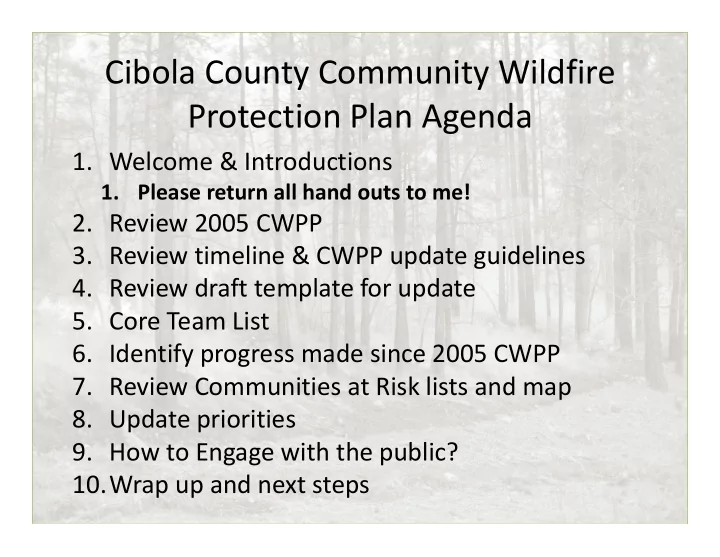
Cibola County Community Wildfire Protection Plan Agenda 1. Welcome & Introductions 1. Please return all hand outs to me! 2. Review 2005 CWPP 3. Review timeline & CWPP update guidelines 4. Review draft template for update 5. Core Team


slide-1
SLIDE 1

Cibola County Community Wildfire Protection Plan Agenda

  • 1. Welcome & Introductions
  • 1. Please return all hand outs to me!
  • 2. Review 2005 CWPP
  • 3. Review timeline & CWPP update guidelines
  • 4. Review draft template for update
  • 5. Core Team List
  • 6. Identify progress made since 2005 CWPP
  • 7. Review Communities at Risk lists and map
  • 8. Update priorities
  • 9. How to Engage with the public?

10.Wrap up and next steps

slide-2
SLIDE 2

2006 CWPP

slide-3
SLIDE 3

CWPP update guidelines

Process

1. Review existing CWPP 2. Host collaborative meetings 3. Update maps 4. Reflect changes in risk ratings 5. Develop updated priorities 6. Distribute CWPP update drafts to key stakeholders 7. Submit the final document to local government body, local fire department, and state Forestry for signatures and endorsement 8. Submit signed and endorsed plan to NM State Forestry no later than 9/1/20

Plan Requirements

1. Collaboration 2. Prioritized fuel reduction 3. Recommendations to reduce structural ignitability 4. Signatures from: 1. Applicable local government 2. Local fire department 3. NM State Forestry 5. Describe progress made and list accomplishments since last CWPP was adopted 6. Changes in community risk ratings (High, Medium, Low) 7. List of CARs and each hazard risk rating 8. Map of WUI with risk ratings 9. List of new prioritized projects

slide-4
SLIDE 4

September October November December Finalize Agreements Gather Background Information Build Core Team list 1st Core Team Meeting:

  • verview of CWPP update

process, progress made since 2006, and to gather input from community members about priorities Work on first draft of CWPP update GIS Analysis Outreach to Core Team Conference Call with COG, County Staff and FSG Core Team Survey & Questions, Resident survey, publicize CWPP Begin compiling accomplishments, updated priorities, and relevant changes since 2006 CWPP January February March April Work on CWPP Draft Work on CWPP Draft Work on CWPP Draft First draft submitted to core team for review Public Meeting Core Team meeting to review CWPP Progress May June Final core team meeting to finalize CWPP update Present CWPP to County Commission Submit CWPP update for signatures Submit signed CWPP update to NM State Forestry Public meeting to review CWPP update draft.

slide-5
SLIDE 5

Document

Executive Summary Introduction What is a Community Wildfire Protection Plan (CWPP)? CWPP Updates 1| Geography Land tenure Vegetation 2| Accomplishments Since 2006 CWPP 3| Wildland Urban Interface Communities at Risk 4| Priority actions Fuels Treatments Human Sources of Ignition Volunteer Fire District Consolidation CWPP implementation and action items 5| Fire Districts: Accomplishments since 2006 and Priority Actions for 2020 6| Companion plan crosswalk Statewide Natural Resources Assessment New Mexico State Hazard Mitigation Plan Cibola County Plans? 7| Fire adapted communities and Firewise communities 8| Wildfire preparedness Ingress and egress Roads Evacuation Smoke impacts Communication Community Emergency Response Team Defensible space 9| Planning for post-fire recovery Safety Flooding and Erosion NM After Wildfire Guide 10| Collaboration Core team Community meetings Community surveys Themes from the Community 11| Geospatial Analysis and Map Descriptions

slide-6
SLIDE 6

Potential Maps

1. Surface Ownership 2. Wildland Urban Interface 3. Communities at Risk 4. Fire Districts 5. Fuel Treatments 6. Wildfire Hazard Potential 7. Wildfire Risk 8. Wildfire History since 2000 9. Flame Length 10. Vegetation Cover 11. Vegetation Type 12. Post-Wildfire Debris Flow Hazard 13. Population Density 14. Poverty Level 15. Senior Citizens

slide-7
SLIDE 7

Review Core Team List

  • Who else should we invite?
slide-8
SLIDE 8

Community Hazard Ratings

  • Create a list of Communities in the County
  • Conforming to NM State Forestry CAR ratings

(Low, Medium, High)

  • Are there any communities missing?
  • Consolidate communities?
slide-9
SLIDE 9

2006 Ratings

Previous Rating 2020 Rating Bluewater Moderate Bluewater Acres Moderate Candy Kitchen Moderate Crestview/Twin Buttes/ Crested Butte Moderate Lobo Canyon Moderate Morrow Low Milan Low San Mateo Low

slide-10
SLIDE 10
slide-11
SLIDE 11

Priorities for 2018 and beyond

Use handouts to list priorities 2018 Priority action areas

  • 1. Community involvement
  • 2. Wildfire Preparedness
  • 3. Improving fire district capacity
  • 4. Fuels Reduction projects
  • 5. Reducing structural ignitability
  • 6. Roads and transportation
  • 7. Adjacent lands
slide-12
SLIDE 12

How to engage with the public?

  • Online surveys
  • Meetings
  • Suggestions of how to connect?
  • Social media, flyers, newspapers, radio?
  • Other organizations?
  • Events
slide-13
SLIDE 13

Accomplishments since 2006?

Use handouts to list accomplishments since 2006

slide-14
SLIDE 14

Next steps

  • 1. Gather input from Core Team and Community
  • 1. Interviews
  • 2. Surveys
  • 3. Meetings
  • 2. Refine List of Communities at Risk
  • 3. Refine Fire Districts & Map
  • 4. Create New Fire Risk Map
  • 5. Schedule Community Meeting
  • 6. Begin GIS analysis
  • 7. Begin Drafting Document
slide-15
SLIDE 15
slide-16
SLIDE 16

Contact

Sam Berry sam@forestguild.org 541 816 6371 Gabe Kohler gabe@forestguild.org