Climate Change and Insurance: Recent Litigation and Regulatory - - PowerPoint PPT Presentation

climate change and insurance recent litigation and
SMART_READER_LITE
LIVE PREVIEW

Climate Change and Insurance: Recent Litigation and Regulatory - - PowerPoint PPT Presentation

Presenting a live 90 minute webinar with interactive Q&A Climate Change and Insurance: Recent Litigation and Regulatory Developments Navigating the Impact of Climate Change on Coverage Issues, Green Insurance, Supply Chains and More THURS


slide-1
SLIDE 1

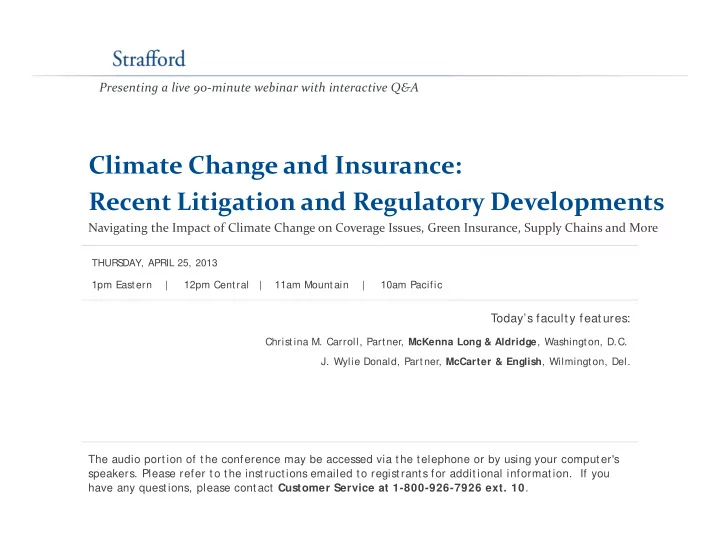
Climate Change and Insurance: Recent Litigation and Regulatory Developments

Navigating the Impact of Climate Change on Coverage Issues, Green Insurance, Supply Chains and More

Today’s faculty features:

1pm Eastern | 12pm Central | 11am Mountain | 10am Pacific

The audio portion of the conference may be accessed via the telephone or by using your computer's

  • speakers. Please refer to the instructions emailed to registrants for additional information. If you

have any questions, please contact Customer Service at 1-800-926-7926 ext. 10.

THURS DAY, APRIL 25, 2013

Presenting a live 90‐minute webinar with interactive Q&A

Christina M. Carroll, Partner, McKenna Long & Aldridge, Washington, D.C.

  • J. Wylie Donald, Partner, McCarter & English, Wilmington, Del.
slide-2
SLIDE 2

Tips for Optimal Quality

S

  • und Qualit y

If you are listening via your computer speakers, please note that the quality of your sound will vary depending on the speed and quality of your internet connection. If the sound quality is not satisfactory and you are listening via your computer speakers, you may listen via the phone: dial 1-866-927-5568 and enter your PIN when prompted. Otherwise, please send us a chat or e-mail sound@straffordpub.com immediately so we can address the problem. If you dialed in and have any difficulties during the call, press *0 for assistance.

Viewing Qualit y

To maximize your screen, press the F11 key on your keyboard. To exit full screen, press the F11 key again.

slide-3
SLIDE 3

Continuing Education Credits

For CLE purposes, please let us know how many people are listening at your location by completing each of the following steps:

  • In the chat box, type (1) your company name and (2) the number of

attendees at your location

  • Click the S

END button beside the box

FOR LIVE EVENT ONLY

slide-4
SLIDE 4

Program Materials

If you have not printed the conference materials for this program, please complete the following steps:

  • Click on the + sign next to “ Conference Materials” in the middle of the left-

hand column on your screen.

  • Click on the tab labeled “ Handouts” that appears, and there you will see a

PDF of the slides for today's program.

  • Double click on the PDF and a separate page will open.
  • Print the slides by clicking on the printer icon.
slide-5
SLIDE 5

Climate Change and Insurance

Presented By:

Christina M. Carroll

McKenna Long & Aldridge LLP 1900 K S

  • t. NW

Washington, DC 20006 ccarroll@ mckennalong.com

  • J. Wylie Donald

McCarter & English LLP 405 N. King S

  • t. 8th Fl.

Wilmington, DE 19801 j donald@ mccarter.com

slide-6
SLIDE 6
  • Post-Election – The end of the period of “climate silence.”
  • Inaugural Address:

– Obama vowed to respond to “the threat of climate change,” noting that “the failure to do so would betray our children and future generations.” – “Some may still deny the overwhelming judgment of science, [ ] none can avoid the devastating impact of raging fires, and crippling drought, and more powerful storms.”

  • State of the Union speech:

– “We must do more to combat climate change” and called on Congress to pass comprehensive greenhouse gas-related legislation. – “If Congress won’t act soon to protect future generations, I will,” he declared. “I will direct my Cabinet to come up with executive actions to take, now and in the future, to reduce pollution, prepare our communities for the consequences of climate change and speed the transition to more sustainable sources of energy.”

Political Back Drop - Obama Administration Signals Climate Action in Second Term

6

slide-7
SLIDE 7
  • What is it? More storms, stronger storms. Also more thunderstorms

and precipitation short of a named storm. Droughts. Tornado activity.

  • In 2012, natural catastrophes caused $160 billion in overall losses

and $65 billion in insured losses worldwide.

  • North America – largest losses due to extreme weather in recent

years.

  • The National Climate Assessment (draft) – examples:

– Additional 2 to 4º F of warming in coming decades – Wildfires and droughts; floods and heavy downpours – Human activity has doubled probability of events like the Texas/Oklahoma heat wave of 2011 – Ocean acidification from carbon dioxide from burning of fossil fuels – Sea level rising; decline of sea ice levels in summer (Arctic)

Background: Extreme Weather

7

slide-8
SLIDE 8

C L I M A T E C H A N G E

Insurance Coverage

The New York Times

December 6, 2012, 3:25 pm Comment

Gas Tanker Completes Arctic Sea Journey

By Clifford Krauss

http://www.youtube.com/watch?v=jr_SqvitTzk play this

Background

8

slide-9
SLIDE 9
  • E.g., Superstorm Sandy

– $60.2 billion – federal relief (including infrastructure, NFIP replenishment) – Losses: $25 billion (insured) / over $50 billion (total) (Munich Re)

  • $15 trillion in insured property on Atlantic and Gulf coasts is

vulnerable due to hurricanes and other coastal hazards like storm surge

  • Impacts on critical infrastructure – e.g., power supply, transportation
  • Implications for how the private and public insurance systems

should work going forward

  • Changes in local, state, and federal regulation – land use,

insurance, environmental, FEMA-related

Extreme Weather - Implications

9

slide-10
SLIDE 10
  • “Climate change is real, and you don’t risk the solvency of

your company by saying, ‘I don’t believe it.’”

– Maurice “Hank” Greenberg, CEO of the Starr Cos. (former AIG CEO)

  • Seventy percent of 2400+ companies surveyed (with a

combined spending power of $1 trillion) believe that climate change has the potential to affect their revenue significantly.

– Carbon Disclosure Project and Accenture (2013)

Recent Reaction from Corporate America

10

slide-11
SLIDE 11

Overview:

  • Depends on who you ask
  • Depends on how insurer or

insured categorizes claims

Examples:

  • Extreme weather event?

– BI, PD, business interruption

  • Tort claims

– Nuisance, negligence, etc. – For injunctive relief or damages – Civil conspiracy

What is a climate change-related claim?

  • Climate change

mismanagement claims – D&O

  • Liability of governmental

entities for aging infrastructure (e.g., Katrina-related)

  • Greenwashing
  • Green building
  • Renewable energy
  • Claims against professional

service providers

  • Public trust claims

11

slide-12
SLIDE 12
  • What does all this mean for claims, underwriting, and

insurance regulation?

  • What types of coverages might be involved?

– CGL – D&O – Professional / E&O – Property / Business Interruption – Political risk

  • New products, Evolving concerns

– Renewable energy – Green building / replacement – Supply chain risk

Climate Change and Insurance - Overview

12

slide-13
SLIDE 13

C L I M A T E C H A N G E

Insurance Coverage

California v. General Motors (9th Cir.) – DISMISSED, APPEAL WITHDRAWN American Electric Power v. Connecticut (S. Ct.) – DISMISSED, REVERSED, REVERSED Comer v. Murphy Oil USA (5th Cir.) – DISMISSED, 2D APPEAL PENDING Native Village of Kivalina v. ExxonMobil (9th Cir.) – DISMISSED, AFFIRMED, PETITION FOR CERTIORARI

Climate Change Litigation

13

slide-14
SLIDE 14

C L I M A T E C H A N G E

Insurance Coverage Climate Change Litigation

14

slide-15
SLIDE 15

C L I M A T E C H A N G E

Insurance Coverage

The Future

"Pawa likened the current state of climate change litigation to the early stages of suits against cigarette makers and companies with asbestos liability. Before plaintiffs' lawyers in those cases were able to win judgments and settlements, they were stymied by defense arguments. "We haven't exhausted our theories or our efforts," he said. "Future success in climate change litigation, [Maples] said, may depend on whether state attorneys general get involved, as they did in the tobacco litigation of the 1990s. With home insurance premiums rising as a result of climate change, Maples said, the litigation could become attractive to state AGs, who like consumer protection cases. 'If you can't afford insurance, that's almost like not affording food,'“

Andrew Longstreth, RIP, climate change litigation? (Dec. 7, 2012) Climate Change Litigation

15

slide-16
SLIDE 16
  • Background:

– AES Corporation was sued in the Native Village of Kivalina

  • v. ExxonMobil Corp., one of the first climate change

nuisance cases brought in federal court. – After being sued, AES asked its insurer, Steadfast Insurance Company, to defend. Steadfast denied coverage because:

  • (1) the Kivalina complaint did not allege “property damage” caused by an

“occurrence” under its policies;

  • (2) the alleged injuries arose before Steadfast’s coverage incepted; and
  • (3) the GHG emissions alleged in Kivalina were “pollutants” excluded from

coverage by virtue of the policies’ pollution exclusion.

– Steadfast filed a DJ action against AES in Virginia (where AES is headquartered).

The First Climate “Coverage” Case: AES Corp. v. Steadfast Ins. Co.

16

slide-17
SLIDE 17
  • Coverage may exist where an intentional act results in unforeseen harm,

but not where resulting harm is alleged to be the “natural or probable consequence” of the insured’s act. – Court found that Kivalina plaintiffs allege both that (i) AES intentionally released carbon dioxide into the atmosphere as part of its energy- producing activities, and (ii) there is a “clear scientific consensus that the natural and probable consequence of such emissions is global warming and damages such as Kivalina suffered.” – Accordingly, court reiterated that whether or not AES’s intentional act constitutes negligence, the natural or probable consequence of that intentional act is not an accident under Virginia law. – Whether the defendant should have known to a “substantial probability” that its conduct would cause harm is not the required test.

AES v. Steadfast – Virginia Supreme Court Round 2 (April 2012)

17

slide-18
SLIDE 18

AES v. Steadfast – Implications

  • Implications:

– Positive decision from insurance industry perspective. However:

  • Virginia is generally regarded as among the most insurer friendly

jurisdictions in the U.S. with regard to alleged breach of contract; thus, some have opined that a different jurisdiction might reach a different result.

  • The AES case was decided on “occurrence” grounds, but the court

did not reach the pollution exclusion issue.

18

slide-19
SLIDE 19
  • Obama Administration Second Term Agenda
  • National Flood Insurance Program (NFIP) reforms
  • FEMA rules on rebuilding after extreme weather events
  • Local rules on rebuilding after extreme weather events
  • Insurability of property on coastlines, other areas impacted

by climate change

Recent Regulatory Developments

19

slide-20
SLIDE 20
  • EPA

– GHG reporting program (many industries) – GHG standards for new and modified power plants (proposed) – GHG standards for other industries? – Fuel economy standards (in conjunction with NHTSA)

  • Energy

– R&D investment

  • DHS

– Ensuring resilience to disasters – Borders

  • State

– Keystone pipeline – Transnational reductions

  • Department of Interior

– Endangered species – NEPA (impacts of federal projects)

  • SEC

– Guidance on disclosures – Shareholder resolutions

  • FTC

– Updated Green Guides

Federal Department and Agency Involvement – Highlights at a Glance

20

slide-21
SLIDE 21

TITLE 40--Protection of Environment CHAPTER I--ENVIRONMENTAL PROTECTION AGENCY SUBCHAPTER C--AIR PROGRAMS PART 98--MANDATORY GREENHOUSE GAS REPORTING

What is Regulated?

21

slide-22
SLIDE 22

http://www.epa.gov/climatechange/Downloads/ghgemissions/2013Workshop/ghgrp- draft-summary.pdf

22

slide-23
SLIDE 23
  • The NFIP Reform Act (July 2012) established a Technical Mapping

Advisory Council ("TMAC"), which will provide guidance to the FEMA Administrator on risk-based approaches to assessing future flood risk vulnerability.

  • With respect to climate change, TMAC is required to “consult with

scientists and technical experts, other federal agencies, states, and local communities and develop recommendations on how to ensure that flood insurance rate maps incorporate the best available climate science to assess flood risks.” These recommendations should also include steps FEMA can to take to develop methodologies that take into account the rise in sea level.

  • TMAC is required to develop and submit these recommendations in

writing to the FEMA Administrator within a year.

Recent Regulatory Developments – National Flood Insurance Program (NFIP) Reforms

23

slide-24
SLIDE 24

C L I M A T E C H A N G E

Insurance Coverage

Maryland. The Barrier Islands. Ocean City. Do the math.

Rebuilding: Context

24

slide-25
SLIDE 25

C L I M A T E C H A N G E

Insurance Coverage

Example

ake

http://blog.foreignpolicy.com/files/images/080613_iowa.jpg

Rebuilding: Context

25

slide-26
SLIDE 26

C L I M A T E C H A N G E

Insurance Coverage

Hurricane Sandy Rebuilding Task Force

U.S. Housing Secretary Shaun Donovan and U.S. Transportation Secretary Ray LaHood came to the Meadowlands of NJ to announce new post-Sandy rebuilding regulations. (photo by Jim O'Grady) http://transportationnation.org/2013/04/04/feds-set-uniform- standards-for-sandy-rebuilding/

Rebuilding: New Rules

26

slide-27
SLIDE 27

C L I M A T E C H A N G E

Insurance Coverage

Hurricane Sandy Rebuilding Task Force Recommendations

Elevating – the standard would require structures to elevate their bottom floor one foot higher than the most recent flood risk guidance provided by FEMA; and/or Flood-proofing – in situations where elevation is not possible, the standard will require structures to prepare for flooding a foot higher than the most recent flood risk guidance provided by FEMA – for example, by relocating or sealing boilers or other utilities located below the standard elevation

Rebuilding: New Rules

27

slide-28
SLIDE 28

C L I M A T E C H A N G E

Insurance Coverage

Flood Proofing

FEMA, Flood Damage Resistant Materials Requirements 5 (Aug. 2008) Rebuilding: New Rules

28

slide-29
SLIDE 29

C L I M A T E C H A N G E

Insurance Coverage

Going Beyond FEMA

Rebuilding: New Rules

29

slide-30
SLIDE 30

C L I M A T E C H A N G E

Insurance Coverage

Rebuilding: New Rules

30

slide-31
SLIDE 31

C L I M A T E C H A N G E

Insurance Coverage

Rebuilding: New Rules

31

slide-32
SLIDE 32

C L I M A T E C H A N G E

Insurance Coverage

Wind Pools

Texas House Insurance Committee, Windpool Survey (2012)

Rebuilding: Insurability

32

slide-33
SLIDE 33

C L I M A T E C H A N G E

Insurance Coverage

Are Wind Pools Going Away? (Voluntary Writers)

Texas House Insurance Committee, Windpool Survey (2012)

Rebuilding: Insurability

33

slide-34
SLIDE 34
  • Property / Business Interruption
  • CGL
  • D&O
  • E&O

Potential Claims and Coverage Issues: Types of Claims

34

slide-35
SLIDE 35
  • First-party property coverage

– Commercial, residential

  • Business interruption
  • Contingent business interruption
  • Extra expense coverage
  • Civil authority
  • Ingress/Egress
  • Coverage issues include:

– physical damage requirement

  • Exclusions – acts of God, flood, rain, wind, storm surge,

mold, sewer backups, power outages

Property / Business Interruption

35

slide-36
SLIDE 36
  • Pollution exclusion
  • Occurrence
  • Multiple perils - Wind / flood / anti-concurrent causation

Potential Coverage Issues - Examples

36

slide-37
SLIDE 37

C L I M A T E C H A N G E

Insurance Coverage

DIRECTORS AND OFFICERS COVERAGE

Issue: Alleged Misleading Disclosures Wrongful Act: “any breach of duty, neglect, error, misstatement, misleading statement, omission or other act wrongfully done or attempted by the Insured” Cases concerning pollution exclusion:

National Union Fire Ins. Co. of Pittsburgh, Pa. v. U.S. Liquids, Inc. (5th Cir. 2004) Owens Corning v. National Union Fire Ins. Co. of Pittsburgh, Pa. (6th Cir. 1998) Sealed Air Corp. v. Royal Indemnity Co. (N.J. App. Div. 2008) Boliden Ltd. v. Liberty Mut. Ins. Co. (Ont. Super. Ct. 2007)

Coverage: Policies

37

slide-38
SLIDE 38

C L I M A T E C H A N G E

Insurance Coverage

ERRORS & OMISSIONS COVERAGE

TRUE OR FALSE GIVING ADVICE ABOUT HOW TO MAKE YOUR CLIENT’S BUSINESS “CARBON NEUTRAL” IMPLICATES THE POLLUTION EXCLUSION

Coverage: Policies

38

slide-39
SLIDE 39

C L I M A T E C H A N G E

Insurance Coverage

20 QUESTIONS

Is it naturally in the atmosphere in billions of tons? Is it essential to life? Is it exhaled in every breath? Is it non-toxic? Is it an unavoidable product of combustion? Is it the most common greenhouse gas? Is it carbon dioxide?

Coverage Issues: Pollution

39

slide-40
SLIDE 40

C L I M A T E C H A N G E

Insurance Coverage

COVERAGE FOR “POLLUTION”

1966 – occurrence form 1970 – “sudden & accidental” pollution exclusion added 1986 – “total” or “absolute” pollution exclusion added Late 80s, 90s and 00s – “environmental impairment liability” and “pollution legal liability” products

Coverage Issues: Pollution

40

slide-41
SLIDE 41

C L I M A T E C H A N G E

Insurance Coverage

ABSOLUTE POLLUTION EXCLUSION

  • f. (1) “Bodily injury or “property damage” arising out of the

actual, alleged, or threatened discharge, dispersal, release

  • r escape of pollutants:

Pollutants means any solid, liquid, gaseous or thermal irritant or contaminant, including smoke, vapor, soot, fumes, acid, alkalis, chemicals and waste. Waste includes materials to be recycled, reconditioned or reclaimed.

Coverage Issues: Pollution

41

slide-42
SLIDE 42

C L I M A T E C H A N G E

Insurance Coverage

SO, WHY DO WE CARE?

Coverage Issues: Pollution

42

slide-43
SLIDE 43

C L I M A T E C H A N G E

Insurance Coverage CGL Coverage Map 1961-1985 Pollution Exclusions Ineffective Coverage Issues: Pollution

43

slide-44
SLIDE 44

C L I M A T E C H A N G E

Insurance Coverage CGL Coverage Map 1961-2013 Effective Absolute P.E. Eroded pre-85 Coverage Issues: Pollution

44

slide-45
SLIDE 45

C L I M A T E C H A N G E

Insurance Coverage CGL Coverage Map 1961-2013 with Erosion and Ineffective Pollution Exclusions

45

slide-46
SLIDE 46
  • “Pollutants” mean any solid, liquid, gaseous or thermal

irritant or contaminant, including smoke, vapor, soot, fumes, acids, alkalis, chemicals and waste. Waste includes materials to be recycled, reconditioned or reclaimed

  • Variability by state
  • Timing of when substance was considered a pollutant
  • “Traditional” pollution?
  • Pollution-related exclusions in D&O and E&O – response in

certain jurisdictions

Pollution Exclusion – Insurers’ Perspective

slide-47
SLIDE 47

C L I M A T E C H A N G E

Insurance Coverage

Mantoloking on March 18, 2007 (Source: NOAA via NASA) Mantoloking on October 31, 2012 (Source: NOAA via NASA)

Coverage Issues: Wind & Flood

47

slide-48
SLIDE 48

C L I M A T E C H A N G E

Insurance Coverage

Anti-Concurrent Causation The ACC Clause “We do not insure for loss caused directly or indirectly by any of the following. Such loss is excluded regardless of any other cause or event contributing concurrently or in any sequence to the loss.”

Coverage Issues: Wind & Flood

48

slide-49
SLIDE 49

C L I M A T E C H A N G E

Insurance Coverage

  • Leonard v. Nationwide Mut. Ins. Co., 499 F.3d 419, 430 (5th Cir.

2007) (construing Mississippi law) (“The only species of damage covered under the policy is damage caused exclusively by wind. But if wind and water synergistically caused the same damage, such damage is excluded.”)

  • Tuepker v. State Farm Fire & Cas. Co., 507 F.3d 346, 354 (5th Cir.

2007) (“the ACC Clause in combination with the Water Damage Exclusion clearly provides that indivisible damage caused by both excluded perils and covered perils or other causes is not covered”)

  • Corban v. USAA, 20 So. 3d 601 (Miss. 2009) (“An insurer cannot

avoid its obligation to indemnify the insured based upon an event which occurs subsequent to the covered loss. The insured’s right to be indemnified for a covered loss vests at time of loss. Once the duty to indemnify arises, it cannot be extinguished by a successive cause or event.”)

Coverage Issues: Wind & Flood

49

Anti-Concurrent Causation

slide-50
SLIDE 50

C L I M A T E C H A N G E

Insurance Coverage

“As a practical matter, the proof problems in establishing what damage was caused by water in a storm event as opposed to prior

  • r subsequent wind damage could prove

challenging.”

Simpson Thacher, Corban v. USAA: Reinterpreting the Anti-Concurrent Causation Clause (Oct. 15, 2009)

Coverage Issues: Wind & Flood

50

Anti-Concurrent Causation

slide-51
SLIDE 51
  • D&O coverage extensions for climate change-related

claims

  • Renewable energy
  • Green building / green replacement coverage
  • Evan Mills research

– Mills, E. 2012. "The Greening of Insurance," Science 338, 1424, December 14. – http://insurance.lbl.gov/opportunities/ro-12-summary.html

New Products

51

slide-52
SLIDE 52
  • Categories
  • Wind
  • Solar
  • Biomass
  • Geothermal
  • Hydropower
  • Applications of traditional coverages to new situations
  • Property, Builder’s Risk, Business Interruption
  • Equipment breakdown
  • Commercial General Liability (CGL)
  • Professional

What’s Ahead – Renewable Energy

52

slide-53
SLIDE 53
  • Insurance Products Tailored for the Renewable Energy

Industry

– Product liability: e.g., wind turbines, photovoltaic cells – Warranty / replacement policies (solar panels) – Other risks special to renewable projects:

  • Guaranteed output
  • System performance

– Debris removal – Recycling expenses – “Green” upgrades for damaged equipment / property

What’s Ahead – Renewable Energy

53

slide-54
SLIDE 54

CONTACT INFORMATION

Christina M. Carroll, Partner McKenna Long & Aldridge LLP 1900 K Street NW Washington, DC 20006 (202) 496-7212 ccarroll@mckennalong.com Read more: Carroll, Evans, Zimolzak & Patton, Climate Change and Insurance (Nov. 2012) published by ABA, http://apps.americanbar.org/abasto re/index.cfm?pid=5190484&section =main&fm=Product.AddToCart

  • J. Wylie Donald, Partner

McCarter & English LLP 405 N. King Street Wilmington, DE 19801 (302) 984-6361 jdonald@mccarter.com Getting Ahead of Storm Surge, Especially in the Era of Climate Change, BNA Environment Reporter (June 20, 2012) Coverage for Carbon Dioxide Claims: Considering the Evolution of “Absolute” Exclusions, The Brief (Summer 2011)