Oil in in the the Arctic Arctic : : the the Oil rush for the - - PowerPoint PPT Presentation

oil in in the the arctic arctic the the oil rush for the
SMART_READER_LITE
LIVE PREVIEW

Oil in in the the Arctic Arctic : : the the Oil rush for the - - PowerPoint PPT Presentation

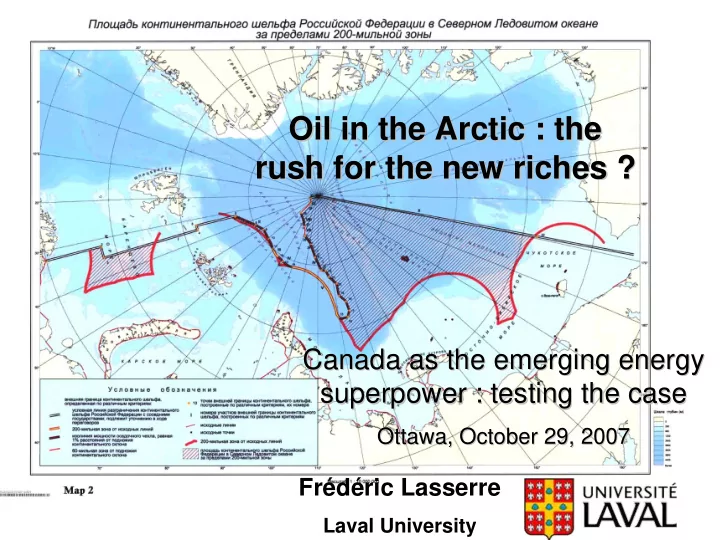
Oil in in the the Arctic Arctic : : the the Oil rush for the the new riches ? new riches ? rush for Canada as the the emerging emerging energy energy Canada as superpower : : testing testing the the case case superpower Ottawa,


slide-1
SLIDE 1

Oil Oil in in the the Arctic Arctic : : the the rush for rush for the the new riches ? new riches ?

Frédéric Lasserre

Laval University
Canada as Canada as the the emerging emerging energy energy superpower superpower : : testing testing the the case case

Ottawa, Ottawa, October October 29, 2007 29, 2007

slide-2
SLIDE 2
slide-3
SLIDE 3

A new Eldorado ?

  • About 25% of oil to be discovered would be in the Arctic

according to USGS (2000).

  • Discovered reserves 20 billion barrels of oil and 8 000

billion m3

  • According to present estimations, the Arctic shelf

contains about 80 percent of Russia's potential hydro- carbon resources.

  • Arctic’s estimated reserves : 200 billion barrels and

80 000 billion m3

  • Alaska’s North Slope : estimated 50 billion barrels –

USGS 2000

  • Eastern Greeland, Fram Strait and Svalbard area : about

110 billion barrels, half of Saudi Arabia’s reserves (Blog Finance July 19, 2006)

  • More than 22% of all known reserves of gas in the world

are reportedly located in only one area in the north, in the Yamal peninsula (Rune Rautio, Barents Secretariat, BBC News, Aug. 13, 2006)

slide-4
SLIDE 4

A comparison…

Oil reserves (2006, billion barrels)

  • Saudi Arabia : 264,2 -> 27,1% of world total
  • Venezuela : 80,1 -> 6,6%
  • Russia : 79,2 -> 6,6%

Gas reserves (2006, billion m3)

  • Saudi Arabia : 6 838
  • Russia : 47 592
slide-5
SLIDE 5

Hydrocarbon deposists all along the margins of the Arctic ocean

slide-6
SLIDE 6

Norway

  • Snohvit : 161,5 billion m3 gas
  • Disputed area in Svalbard sea zone :

12 billion barrels oil equivalent – dispute ended in June 2007 so as to ease investments.

slide-7
SLIDE 7

Russia

  • Barents and Kara Seas contain potential

resources of :

– between 50 (Institute of Energy Policy, Moscow) and 100 billion barrels (Society of Petroleum Engineers) – 3 200 billion m³ of gas.

  • Shtokmanovskoe gas field is probably the

world's largest known offshore gas field. Its reserves total about 3 000 m3 of gas and more than 20 million tons of gas condensate.

  • BP signed a 17 billion $ exploration agreement

with Russia

slide-8
SLIDE 8
  • Eastern Siberia (Laptev Sea, Lena basin) is one

area where little exploration has taken place.

  • Only four or five oil and gas fields have been

discovered up to 2006.

  • A 1996 Petroconsultants study (the latest

available) estimated that

– around 35 billion barrels of oil (3 billion proven in 2006) and – 141,6 billion m3 of natural gas exist in the region.

slide-9
SLIDE 9

A need for new export routes

slide-10
SLIDE 10

Canada

Canada’s Discovered Oil and Gas Resources North of 60* Kenneth J. Drummond

Oil exploration is not new to the Canadian Arctic – during the 1970s and 1980s, policy of developing national resources

slide-11
SLIDE 11

The Canadian Arctic islands (Sverdrup basin) have reserves of 334 million barrels of oil, 493 billion m3 of gas.

slide-12
SLIDE 12

Exploration Exploration is is well well under under way way now now in in the the Canadian Canadian Arctic Arctic islands islands : : example example here here of

  • f Sverdrup basin.

Sverdrup basin.

August 2007

slide-13
SLIDE 13
  • F. Lasserre

An exploration frenzy for minerals as well is taking place

slide-14
SLIDE 14

Exploration is well under way

  • Oct. 2007 : Imperial Oil and Exxon paid

600 million $ for an exploration block in the Beaufort Sea, 120 km offshore.

slide-15
SLIDE 15

Promising reserves… but not enormous

  • Total Canadian Northern oil reserves :

1 665 million barrels,

– Of which 20,1 % in Arctic islands – 0,9% of Canadian oil reserves (incl. tar sands) ; 9,7% without – 0,6% Saudi Arabia’s reserves.

  • Total Canadian Northern gas reserves :

886,7 billion m3

– 55,3 % of Canadian gas reserves – 1,9 % Russia’s reserves

slide-16
SLIDE 16

But then…

  • Devon Energy in Paktoa well (180 km

north of Inuvik), 2006 : 240 M bbl, but not the billions of m3 of gas the firm had targeted

slide-17
SLIDE 17
  • According to a 2006 study by Wood Mackenzie

and Fugro Robertson (energy research firms), the Arctic contains much less undiscovered oil than previous estimated, including the often- cited estimate from the 2000 U.S. Geological Survey report that said 25% of all the world's remaining oil would be found there…

  • The U.S. Alaskan North Slope would have an

estimated 6 billion barrels of oil equivalent in undiscovered reserves, compared with a USGS assessment of more than 50 billion barrels.

  • The Arctic will more likely end up producing

something closer to 3 percent of the world's oil when it is explored and developed in the coming decades, the report says.

slide-18
SLIDE 18

Conclusion

  • Several more oil and gas fields are

discovered as exploration is eased with the melting ice… and rising world prices

  • Arctic oil and gas remain difficult and

costly to extract

  • Reserves may not be as dramatic as first

thought.