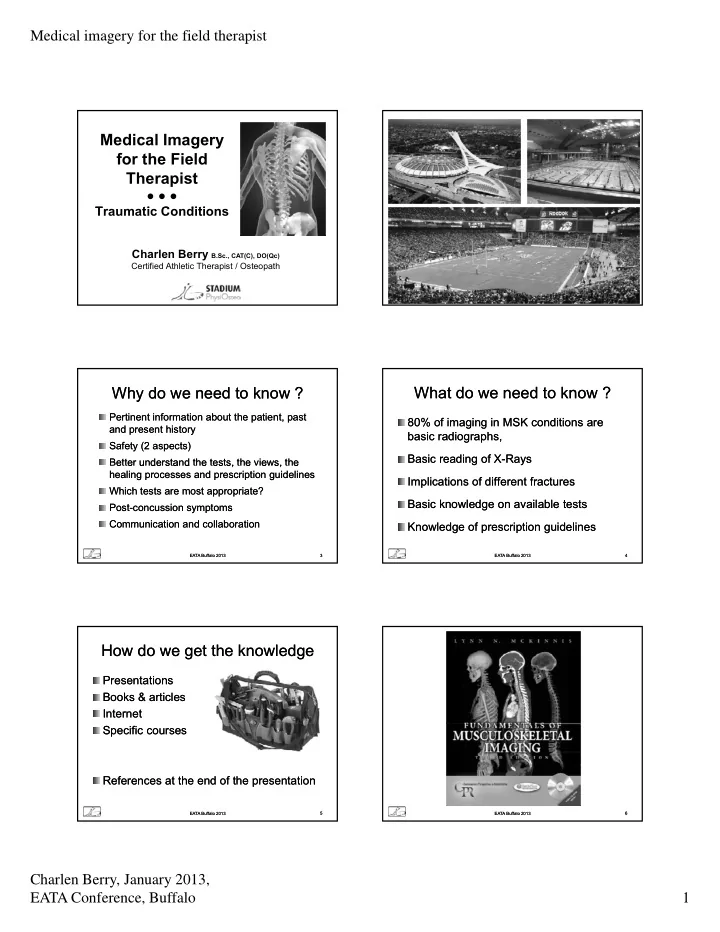
Medical Imagery for the Field Therapist Traumatic Conditions - - PDF document

medical imagery for the field therapist
SMART_READER_LITE
LIVE PREVIEW

Medical Imagery for the Field Therapist Traumatic Conditions - - PDF document

Medical imagery for the field therapist Medical Imagery for the Field Therapist Traumatic Conditions T ti C diti Charlen Berry B.Sc., CAT(C), DO(Qc) Certified Athletic Therapist / Osteopath EATA Buffalo 2013 EATA Buffalo 2013


slide-1
SLIDE 1

Medical imagery for the field therapist Charlen Berry, January 2013, EATA Conference, Buffalo 1

Medical Imagery for the Field Therapist

  • ● ●

T ti C diti Traumatic Conditions

Charlen Berry B.Sc., CAT(C), DO(Qc)

Certified Athletic Therapist / Osteopath

EATA Buffalo 2013 EATA Buffalo 2013 2

Why do we need to know ? Why do we need to know ?

Pertinent information about the patient, past Pertinent information about the patient, past and present history and present history Safety (2 aspects) Safety (2 aspects) Better understand the tests, the views, the Better understand the tests, the views, the e e u de s a d e es s, e e s, e e e u de s a d e es s, e e s, e healing processes and prescription guidelines healing processes and prescription guidelines Which tests are most appropriate? Which tests are most appropriate? Post Post-

  • concussion symptoms

concussion symptoms Communication and collaboration Communication and collaboration

EATA Buffalo 2013 EATA Buffalo 2013 3 3

What do we need to know ? What do we need to know ?

80% of imaging in MSK conditions are 80% of imaging in MSK conditions are basic radiographs, basic radiographs, Basic reading of X Basic reading of X-

  • Rays

Rays Implications of different fractures Implications of different fractures Basic knowledge on available tests Basic knowledge on available tests Knowledge of prescription guidelines Knowledge of prescription guidelines

EATA Buffalo 2013 EATA Buffalo 2013 4

How do we get the knowledge How do we get the knowledge

Presentations Presentations Books & articles Books & articles Internet Internet Specific courses Specific courses References at the end of the presentation References at the end of the presentation

EATA Buffalo 2013 EATA Buffalo 2013 5 5 EATA Buffalo 2013 EATA Buffalo 2013 6

slide-2
SLIDE 2

Medical imagery for the field therapist Charlen Berry, January 2013, EATA Conference, Buffalo 2

Why ? Why ? To have pertinent information in To have pertinent information in the patient file at the beginning the patient file at the beginning

  • f the season
  • f the season

Read the reports Read the reports See the images (radiology) See the images (radiology)

7 7 EATA Buffalo 2013 EATA Buffalo 2013

Patient’s file: Patient’s file:

Read the reports / See the images Read the reports / See the images

EATA Buffalo 2013 EATA Buffalo 2013 8

HISTORY OF THE PAST HISTORY OF THE PAST

Imagery was done Imagery was done W 5 R

W 5 R

Why? What for?

EATA Buffalo 2013 EATA Buffalo 2013 9 9

When? Where? Who?

RESULTS ?

HISTORY OF THE PRESENT HISTORY OF THE PRESENT

Foot or ankle ? Foot or ankle ? Standard views? Standard views?

– What are they? What are they? – Ankle: AP, LAT, Ankle: AP, LAT, – Knee: AP, LAT, Knee: AP, LAT,

Specialised views? Specialised views?

– Oblique views of the fibula? Oblique views of the fibula? – Plantar flexion Plantar flexion – Dorsiflexion Dorsiflexion

EATA Buffalo 2013 EATA Buffalo 2013 10 10

WHAT IS MEDICAL WHAT IS MEDICAL IMAGING IMAGING

11 11 EATA Buffalo 2013 EATA Buffalo 2013

RADIOLOGY RADIOLOGY

Branch of medicine Branch of medicine concerned with concerned with radioactive substances radioactive substances including X including X-

  • Rays,

Rays, radioactive isotopes radioactive isotopes d th li ti f d th li ti f

EATA Buffalo 2013 EATA Buffalo 2013 12 12

and the application of and the application of this information to the this information to the prevention, diagnosis prevention, diagnosis and treatment of and treatment of disease. disease.

slide-3
SLIDE 3

Medical imagery for the field therapist Charlen Berry, January 2013, EATA Conference, Buffalo 3

MEDICAL IMAGING MEDICAL IMAGING

Radiographs (simple films) Radiographs (simple films) Contrast enhanced radiographs Contrast enhanced radiographs Computerized tomography Computerized tomography Nuclear imaging Nuclear imaging Magnetic resonance imaging (MRI) Magnetic resonance imaging (MRI) Sonography Sonography (US) (US)

EATA Buffalo 2013 EATA Buffalo 2013 13 13

RADIODENSITY RADIODENSITY

composite composite shadowgrams shadowgrams representing the sum of the densities representing the sum of the densities SquireLF SquireLF, , Novelline Novelline RA, RA,

Physical qualities of an object Physical qualities of an object that determine how much that determine how much radiation it absorbs from the X radiation it absorbs from the X-

  • Ray beam.

Ray beam. Determined by its composition Determined by its composition (anatomical weight) and (anatomical weight) and thickness thickness Radiopaque Radiopaque / / Radiodense Radiodense Radiotransparent Radiotransparent / / Radioluscent Radioluscent

EATA Buffalo 2013 EATA Buffalo 2013 14 14

MAJOR PHYSICAL DENSITIES MAJOR PHYSICAL DENSITIES

AIR : AIR :

Black (lungs, stomach, digestive tract) Black (lungs, stomach, digestive tract)

FAT: FAT: Gray

Gray-

  • Black (more

Black (more radiodense radiodense than air) than air)

WATER: WATER: Grey (fluids, blood, muscles, tendons…)

Grey (fluids, blood, muscles, tendons…)

BONE: BONE: White (the most

White (the most radiodense radiodense substance of substance of the body, teeth are whiter because to their the body, teeth are whiter because to their calcium content) calcium content)

CONTRAST MEDIA: CONTRAST MEDIA:

Bright white outline Bright white outline

HEAVY METAL: HEAVY METAL:

Solid white Solid white

EATA Buffalo 2013 EATA Buffalo 2013 15 15

MAJOR DENSITIES MAJOR DENSITIES

EATA Buffalo 2013 EATA Buffalo 2013 16 16

EXTERNAL DENSITIES EXTERNAL DENSITIES

BARIUM BARIUM METAL METAL

EATA Buffalo 2013 EATA Buffalo 2013 17 17

SYSTEMATIC APPROACH TO SYSTEMATIC APPROACH TO READING AN X READING AN X-

  • RAY

RAY

A:

Alignment Alignment

B: B:

Bone density Bone density

B: B:

Bone density Bone density

C: C:

Cartilage spaces Cartilage spaces

S: S:

Soft tissues Soft tissues

EATA Buffalo 2013 EATA Buffalo 2013 18 18

slide-4
SLIDE 4

Medical imagery for the field therapist Charlen Berry, January 2013, EATA Conference, Buffalo 4

ALIGNEMENT ALIGNEMENT

General architecture General architecture

Size Size Appearance Appearance Accessory bones Accessory bones Accessory bones Accessory bones Congenital & growth Congenital & growth anomalies anomalies Post Post-

  • traumatic

traumatic modifications modifications

EATA Buffalo 2013 EATA Buffalo 2013 19 19

AP AP-

  • ALIGNEMENT

ALIGNEMENT spinous spinous process process

EATA Buffalo 2013 EATA Buffalo 2013 20 20

1 facet sub-luxation Anterior dislocation

LAT CERVICAL LAT CERVICAL Alignment, 3 lines Alignment, 3 lines

EATA Buffalo 2013 EATA Buffalo 2013 21 21

BONE DENSITY BONE DENSITY

Normality: Normality: Sufficient contrast between the Sufficient contrast between the skeleton and soft tissues and between skeleton and soft tissues and between cortex and cortex and medullary medullary center center cortex and cortex and medullary medullary center center Lost: Lost: osteopenia

  • steopenia, osteoporosis,

, osteoporosis,

  • steomalacia
  • steomalacia

Increase: Increase: osteopoikilosis

  • steopoikilosis,

, osteopetrosis

  • steopetrosis

EATA Buffalo 2013 EATA Buffalo 2013 22 22

DISTORTION DISTORTION shape or size shape or size

The pathology should The pathology should be be right in the middle right in the middle

  • f the film
  • f the film

X-

  • rays will

rays will increase increase the size from 0 to the size from 0 to 30% 30%

EATA Buffalo 2013 EATA Buffalo 2013 23 23

OTHER RADIOLOGIC EXAMINATIONS OTHER RADIOLOGIC EXAMINATIONS With contrast With contrast

– Arthrography Arthrography, , myelography myelography, , arteriography arteriography… …

CAT scan, CT scan CAT scan, CT scan

– Axial tomography assisted by computer Axial tomography assisted by computer

Nuclear imaging Nuclear imaging

– Bone scan, ‘’ Bone scan, ‘’scintigraphie scintigraphie osseuse

  • sseuse’’

’’

EATA Buffalo 2013 EATA Buffalo 2013 24 24

slide-5
SLIDE 5

Medical imagery for the field therapist Charlen Berry, January 2013, EATA Conference, Buffalo 5

WITH CONTRAST WITH CONTRAST

EATA Buffalo 2013 EATA Buffalo 2013 25 25

Myelography Myelography Arteriography Arteriography Arthro MRI

Computer assisted tomography Computer assisted tomography (CAT Scan) (CAT Scan)

X-

  • Ray merged with computer

Ray merged with computer technology technology Provides geography of body structures Provides geography of body structures Provides geography of body structures Provides geography of body structures with much greater sensitivity than plain with much greater sensitivity than plain films films X-

  • Ray beam and detector system is

Ray beam and detector system is housed in a circular scanner (arc of housed in a circular scanner (arc of 360 360º) º)

EATA Buffalo 2013 EATA Buffalo 2013 26 26

CAT Scan / CT Scan CAT Scan / CT Scan

EATA Buffalo 2013 EATA Buffalo 2013 27 27 EATA Buffalo 2013 EATA Buffalo 2013 28 28 EATA Buffalo 2013 EATA Buffalo 2013 29 29

CAT SCAN

EATA Buffalo 2013 EATA Buffalo 2013 30 30

slide-6
SLIDE 6

Medical imagery for the field therapist Charlen Berry, January 2013, EATA Conference, Buffalo 6

BONE SCAN BONE SCAN

Diagnostic use of radioactive Diagnostic use of radioactive isotopes isotopes Nuclear imaging of the skeletal Nuclear imaging of the skeletal system system Radiopharmaceuticals that are Radiopharmaceuticals that are tissue tissue-

  • specific to bone are injected

specific to bone are injected intravenously intravenously intravenously intravenously Patient placed under a scintillation Patient placed under a scintillation camera detecting radioactivity camera detecting radioactivity Recording of the image is on an X Recording of the image is on an X-

  • Ray film

Ray film Highly sensitive but non Highly sensitive but non-

  • specific

specific

EATA Buffalo 2013 EATA Buffalo 2013 31 31

MAGNETIC RESONANCE IMAGING MAGNETIC RESONANCE IMAGING MRI MRI

Does not involve ionizing radiation Does not involve ionizing radiation Images are produced via the interaction of Images are produced via the interaction of tissue with tissue with radiofrequencies radiofrequencies in a in a magnetic field magnetic field Radiowaves Radiowaves are pulsed to the patient, inducing are pulsed to the patient, inducing resonance among nuclei. Different tissues resonance among nuclei. Different tissues resonate at different frequencies. resonate at different frequencies. When When radiowaves radiowaves are turned off, nuclei relax are turned off, nuclei relax and release the resonant energy, receivers and release the resonant energy, receivers transmit the energy released to a computer. transmit the energy released to a computer.

EATA Buffalo 2013 EATA Buffalo 2013 32 32 EATA Buffalo 2013 EATA Buffalo 2013 33 33

WHICH TEST IS THE MOST WHICH TEST IS THE MOST APPROPRIATE APPROPRIATE

34 34 EATA Buffalo 2013 EATA Buffalo 2013

INDICATIONS FOR INDICATIONS FOR CONVENTIONAL RADIOGRAPHY CONVENTIONAL RADIOGRAPHY

Fractures Fractures Periostitis Periostitis Arthropathy Arthropathy Osteochondritis Osteochondritis dissecans dissecans Post Post-

  • traumatic or congenital bony

traumatic or congenital bony deformation deformation Muscular and Muscular and tendinous tendinous calcification calcification

EATA Buffalo 2013 EATA Buffalo 2013 35 35

INDICATIONS FOR COMPUTERISED INDICATIONS FOR COMPUTERISED AXIAL TOMOGRAPHY (CAT Scan) AXIAL TOMOGRAPHY (CAT Scan)

Bone and soft tissue Bone and soft tissue tumors tumors Subtle or complex fractures Subtle or complex fractures Intra Intra-

  • articular

articular abnormalities abnormalities Detection of small bone fragments Detection of small bone fragments g g

Quantitative bone mineral analysis Quantitative bone mineral analysis

– (osteoporosis and metabolic bone disorders (osteoporosis and metabolic bone disorders Disadvantage: A tumour will not be detected in Disadvantage: A tumour will not be detected in presence of same density tissue presence of same density tissue

EATA Buffalo 2013 EATA Buffalo 2013 36 36

slide-7
SLIDE 7

Medical imagery for the field therapist Charlen Berry, January 2013, EATA Conference, Buffalo 7

CAT SCAN CAT SCAN

ALSO USED TO ASSESS: ALSO USED TO ASSESS:

– Disk Disk herniations herniations – Spinal canal in the presence of a fracture Spinal canal in the presence of a fracture – Spinal Spinal stenosis stenosis – Spondylosis Spondylosis

Used for guidance in biopsies and Used for guidance in biopsies and injections injections

EATA Buffalo 2013 EATA Buffalo 2013 37 37

INDICATIONS FOR MRI INDICATIONS FOR MRI

Musculoskeletal system Musculoskeletal system Soft tissue trauma and Soft tissue trauma and tumors tumors Ostéonecrosis Ostéonecrosis Spinal cord oedema Spinal cord oedema Disks Disks

CONTRAINDICATED FOR: CONTRAINDICATED FOR:

– Ferrous metal or mechanical devices implanted Ferrous metal or mechanical devices implanted – Claustrophobia Claustrophobia – Obesity Obesity – Severe pain Severe pain

EATA Buffalo 2013 EATA Buffalo 2013 38 38

INDICATIONS FOR BONE SCAN INDICATIONS FOR BONE SCAN

Indicates an abnormal process between Indicates an abnormal process between production and production and resorption resorption of bone

  • f bone

Can reveal an early bone loss of 7% in Can reveal an early bone loss of 7% in comparison to the conventional X comparison to the conventional X-

  • Ray (25

Ray (25-

  • 30%)

30%) Usefull Usefull to detect: to detect:

– Stress #, Compound # , Stress #, Compound # , Scaphoid Scaphoid # # – Periostitis Periostitis – Primary and metastatic Primary and metastatic tumors tumors – Various Various arthrides arthrides – Infections Infections – Avascular Avascular necrosis necrosis – Metabolic bone disease Metabolic bone disease – Any unexplained bone pain Any unexplained bone pain

EATA Buffalo 2013 EATA Buffalo 2013 39 39

80% of imaging in MSK 80% of imaging in MSK conditions are basic conditions are basic radiographs radiographs radiographs radiographs (X (X-

  • Rays)

Rays)

40 40 EATA Buffalo 2013 EATA Buffalo 2013

More information More information Master class tutorials Master class tutorials

http://radiologymasterclass.co.uk/tutorials/ http://radiologymasterclass.co.uk/tutorials/ musculoskeletal/x musculoskeletal/x musculoskeletal/x musculoskeletal/x- ray_trauma_lower_limb/ankle_fracture_x ray_trauma_lower_limb/ankle_fracture_x-

  • ray.html#top_first_img

ray.html#top_first_img

EATA Buffalo 2013 EATA Buffalo 2013 41 41

SAFETY OF IMAGERY SAFETY OF IMAGERY

42 42 EATA Buffalo 2013 EATA Buffalo 2013

slide-8
SLIDE 8

Medical imagery for the field therapist Charlen Berry, January 2013, EATA Conference, Buffalo 8

RADIATION RADIATION

Annual exposure: 3 Annual exposure: 3 mSv mSv( (mSievert mSievert) / year ) / year Radon,

Radon, airplane, ground, food, construction materials, cosmic airplane, ground, food, construction materials, cosmic rays, altitude, cities+ rays, altitude, cities+

1 / 1000 individual 1 / 1000 individual will develop a cancer with an

will develop a cancer with an exposition of exposition of 10mSv 10mSv (low risk) (low risk) exposition of exposition of 10mSv 10mSv (low risk) (low risk)

420 / 1000 420 / 1000 other causes of cancer

  • ther causes of cancer

Risk ↑ in children and ↓ in elderly Risk ↑ in children and ↓ in elderly CAT SCAN +++ CAT SCAN +++

EATA Buffalo 2013 EATA Buffalo 2013 43 43

Medical Imaging

  • App. dosage

Comparison with environmental (background) Level of irradiation MRI & US

  • Bone density tests

DEXA

0.001 mSv

Less than 1 day

X-Rays, extremities

0.001 mSv

Less than 1 day

X-Rays, vertebral

1.5 mSv

6 months

☼ ☼

X-Rays, Pelvis

0.1-1 mSv

10 days to 6 months

☼ ☼

CT, vertebral

6 mSv

2 years

☼ ☼☼

Bone Scan

1-10 mSv

2 years

☼ ☼☼

EATA Buffalo 2013 EATA Buffalo 2013 44 44

Adapté de http://radiologyinfo.org et ACR Appropriateness Criteria. Radiation Dose Assessment Introduction

Understand the views Understand the views

Anatomical position Anatomical position Standard most common: AP / LAT / OBL Standard most common: AP / LAT / OBL Specific projections Specific projections Routines provide maximum visualization Routines provide maximum visualization with minimal number of radiograph with minimal number of radiograph

EATA Buffalo 2013 EATA Buffalo 2013 45 45

Ankle Ankle AP AP

EATA Buffalo 2013 EATA Buffalo 2013 46 46

Ankle LAT Ankle LAT

EATA Buffalo 2013 EATA Buffalo 2013 47 47

Ankle Mortise Ankle Mortise

EATA Buffalo 2013 EATA Buffalo 2013 48 48

slide-9
SLIDE 9

Medical imagery for the field therapist Charlen Berry, January 2013, EATA Conference, Buffalo 9

http://www.wikiradiography.com/page/Ankle http://www.wikiradiography.com/page/Ankle +Radiographic+Anatomy +Radiographic+Anatomy

Ankle Ankle Links Links Ankle Ankle -

  • Protocols

Protocols Ankle Ankle -

  • Exposures

Exposures Ankle Ankle Positioning Positioning Ankle Ankle -

  • AP

AP Ankle Ankle -

  • Mortise

Mortise Ankle Ankle -

  • AP Oblique (

AP Oblique (Medial Medial rotation) rotation) Ankle Ankle - AP Oblique ( AP Oblique (Lateral Lateral rotation) rotation) Ankle Ankle AP Oblique ( AP Oblique (Lateral Lateral rotation) rotation) Ankle Ankle -

  • Lateral

Lateral Ankle Ankle Radiographic Radiographic Anatomy Anatomy Ankle Ankle -

  • Paediatric

Paediatric Ankle Ankle Miscellaneous Miscellaneous The The Lateral Lateral Ankle Ankle Trap Trap Posterior Posterior Malleolus Malleolus Fractures Fractures Soft Tissue Soft Tissue Signs Signs-

  • The

The Ankle Ankle Ankle Ankle Image Image Interpretation Interpretation Ankle Ankle Trauma 1 ( Trauma 1 (level level 1 1-

  • 10)

10) Ankle Ankle Trauma 2 ( Trauma 2 (level level 1 1-

  • 10)

10) Ankle Ankle Trauma 3 ( Trauma 3 (level level 1 1-

  • 10)

10) Ankle Ankle Trauma 4 ( Trauma 4 (level level 1 1 -

  • 3)

3) Ankle Ankle Trauma 5 ( Trauma 5 (level level 5 5 -

  • 10)

10) EATA Buffalo 2013 EATA Buffalo 2013 49 49

CERVICAL AP CERVICAL AP

EATA Buffalo 2013 EATA Buffalo 2013 50 50

CERVICAL LAT CERVICAL LAT

EATA Buffalo 2013 EATA Buffalo 2013 51 51

CERVICAL OBL CERVICAL OBL

Allows us to visualise the Allows us to visualise the intervertebral intervertebral foramen foramen

EATA Buffalo 2013 EATA Buffalo 2013 52 52 EATA Buffalo 2013 EATA Buffalo 2013 53 53

SPECIALIZED PROJECTIONS SPECIALIZED PROJECTIONS

Ski Ski-

  • line of patella

line of patella Axial view ( Axial view (intercondylar intercondylar fossa fossa) ) Stress test Stress test Weight bearing Weight bearing Axillary Axillary view (GH) view (GH) AP mouth open ( AP mouth open (odontoid

  • dontoid)

) Etc. Etc.

EATA Buffalo 2013 EATA Buffalo 2013 54 54

slide-10
SLIDE 10

Medical imagery for the field therapist Charlen Berry, January 2013, EATA Conference, Buffalo 10

Why ? Why ? T b tt h d th T b tt h d th To better comprehend the To better comprehend the implications implications

55 55 EATA Buffalo 2013 EATA Buffalo 2013 EATA Buffalo 2013 EATA Buffalo 2013 56 56

Weber (Danis-Weber) classification of ankle fractures, based on the location of the fibular fracture. The higher the fibular fracture, the greater the likelihood for ankle mortise insufficiency

EATA Buffalo 2013 EATA Buffalo 2013 57 57

The AP and lateral views do not reveal any obvious fractures.

Subtle widening of the medial aspect of the distal fibular growth plate (physis) on the mortise view. Comparative views

EATA Buffalo 2013 EATA Buffalo 2013 58 58

Comparative views and/or stress views would confirm that this is a fracture versus a normal growth plate closure.

Stress fractures are not Stress fractures are not insignificant insignificant

59 59 EATA Buffalo 2013 EATA Buffalo 2013

Why imagery ? Why imagery ? To understand prescription To understand prescription guidelines followed by physicians guidelines followed by physicians and used for decision making. and used for decision making.

.

Nexus rules Nexus rules Ottawa rules Ottawa rules Canadian C Canadian C-

  • Spine rules

Spine rules

60 60 EATA Buffalo 2013 EATA Buffalo 2013

slide-11
SLIDE 11

Medical imagery for the field therapist Charlen Berry, January 2013, EATA Conference, Buffalo 11

PRESCRIPTION PRINCIPLES PRESCRIPTION PRINCIPLES

ALARA ALARA – A as A as – L low L low – A as A as A as A as – R reasonably R reasonably – A achievable A achievable EQUATION benefits / RISK EQUATION benefits / RISK

EATA Buffalo 2013 EATA Buffalo 2013 61 61

Line of conduct Line of conduct

Non rigid Non rigid Significant acute trauma Significant acute trauma Significant pain / nausea Significant pain / nausea Positive Positive osteophony

  • steophony test (+/

test (+/-)

  • s

e

  • s

e os eop o y

  • s eop o y es ( /

es ( / ) Deformation Deformation Significant oedema Significant oedema

EATA Buffalo 2013 EATA Buffalo 2013 62 62

Pain on specific bony palpation / Pain on specific bony palpation / Crepitus Crepitus Positive tests: Vibration, stress ( Positive tests: Vibration, stress (varus varus, , valgus valgus, , axial compression tests, ultrasound) axial compression tests, ultrasound)

LINE OF CONDUCT LINE OF CONDUCT

Pertinent history / Heard a crack Pertinent history / Heard a crack Reliability of history Reliability of history Non traumatic bony condition of systemic Non traumatic bony condition of systemic

  • rigin (Ex. cancer, osteoporosis …)
  • rigin (Ex. cancer, osteoporosis …)
  • rigin (Ex. cancer, osteoporosis …)
  • rigin (Ex. cancer, osteoporosis …)

Atypical joint biomechanics Atypical joint biomechanics Atypical local palpation Atypical local palpation Validated rules concerning acute trauma: Validated rules concerning acute trauma:

– Ottawa rules for the ankle and knee Ottawa rules for the ankle and knee

EATA Buffalo 2013 EATA Buffalo 2013 63 63

OTTAWA RULES OTTAWA RULES

Rules established in 1996 Rules established in 1996 To reduce of the number of X To reduce of the number of X-

  • rays

rays prescribed by emergency room physicians prescribed by emergency room physicians p y g y p y p y g y p y Have been established for the foot, the Have been established for the foot, the ankle and the knee ankle and the knee Have been validated by many studies Have been validated by many studies worldwide worldwide

EATA Buffalo 2013 EATA Buffalo 2013 64 64

OTTAWA OTTAWA KNEE RULES RULES

Characteristics of Patients Who Should Characteristics of Patients Who Should Undergo radiography After Knee Trauma Undergo radiography After Knee Trauma

Age 55 years or older Age 55 years or older Tenderness at head of fibula Tenderness at head of fibula Isolated tenderness of patella Isolated tenderness of patella Inability to flex knee to 90 degrees Inability to flex knee to 90 degrees Inability to walk four weight Inability to walk four weight-

  • bearing steps

bearing steps immediately after the injury and in the immediately after the injury and in the emergency department emergency department

EATA Buffalo 2013 EATA Buffalo 2013 65 65

OTTAWA OTTAWA ANKLE ANKLE RULES RULES Criteria for ankle radiographs Criteria for ankle radiographs

Bone tenderness at posterior edge of Bone tenderness at posterior edge of distal 6cm or tip of medial or lateral distal 6cm or tip of medial or lateral malleolus malleolus Unable Unable both both to weight bear immediately to weight bear immediately after injury and walk four steps in ER after injury and walk four steps in ER department department

EATA Buffalo 2013 EATA Buffalo 2013 66 66

slide-12
SLIDE 12

Medical imagery for the field therapist Charlen Berry, January 2013, EATA Conference, Buffalo 12

OTTAWA OTTAWA FOOT FOOT RULES RULES

Criteria for ankle radiographs Criteria for ankle radiographs

Bone tenderness at base of 5th metatarsal Bone tenderness at base of 5th metatarsal Bone tenderness over Bone tenderness over navicular navicular Bone tenderness over Bone tenderness over navicular navicular Unable Unable both both to weight bear immediately to weight bear immediately after injury and walk four steps in ER after injury and walk four steps in ER department department

EATA Buffalo 2013 EATA Buffalo 2013 67 67 EATA Buffalo 2013 EATA Buffalo 2013 68 68

CANADIAN C CANADIAN C-

  • SPINE RULE

SPINE RULE

For alert and stable For alert and stable trauma patients trauma patients where cervical spine where cervical spine injury is a concern injury is a concern injury is a concern injury is a concern GCS = 15 GCS = 15

EATA Buffalo 2013 EATA Buffalo 2013 69 69

Predictable rules CCR Predictable rules CCR

X-

  • Rays are indicated if at least one high

Rays are indicated if at least one high risk criteria is present: risk criteria is present: Age > 65 Age > 65 Dangerous mechanism Dangerous mechanism Paresthesia Paresthesia to extremities to extremities

EATA Buffalo 2013 EATA Buffalo 2013 70 70

High risk mechanisms High risk mechanisms

Fall from elevation > 3 feet (90cm) / 5 steps Fall from elevation > 3 feet (90cm) / 5 steps Axial load to the head (diving, football, hockey) Axial load to the head (diving, football, hockey) MVA high speed (> 100Km/h) MVA high speed (> 100Km/h) MVA + rollover or ejection MVA + rollover or ejection Motorized recreational vehicles Motorized recreational vehicles Pedestrian struck by bicycle or collision with Pedestrian struck by bicycle or collision with bicycle bicycle

EATA Buffalo 2013 EATA Buffalo 2013 71 71

C-

  • Spine mobility

Spine mobility

X-

  • Rays are indicated if the patient is

Rays are indicated if the patient is unable to actively rotate neck to 45 unable to actively rotate neck to 45° ° to to right and left. right and left.

EATA Buffalo 2013 EATA Buffalo 2013 72 72

slide-13
SLIDE 13

Medical imagery for the field therapist Charlen Berry, January 2013, EATA Conference, Buffalo 13

Why ? Why ? T b tt d t d T b tt d t d To better understand To better understand the healing process the healing process

73 73 EATA Buffalo 2013 EATA Buffalo 2013

CALCIFICATION CALCIFICATION INTEROSSEOUS MEMBRANE INTEROSSEOUS MEMBRANE

EATA Buffalo 2013 EATA Buffalo 2013 74 74

Why ? Why ? Contribution in understanding Contribution in understanding post post-

  • concussion symptoms of

concussion symptoms of neck origin (positional X neck origin (positional X Rays ) Rays ) neck origin (positional X neck origin (positional X-Rays,) Rays,)

Spasm Spasm Hypo / Hypo / Hypermobility Hypermobility Rotation, side bending Rotation, side bending

75 75 EATA Buffalo 2013 EATA Buffalo 2013

LAT LAT

SPACE BETWEEN ODONTOÏD / C1 SPACE BETWEEN ODONTOÏD / C1

EATA Buffalo 2013 EATA Buffalo 2013 76 76

3mm adultes 5mm enfants

FIXATION FIXATION ROTATION ROTATION C1/C2 C1/C2

EATA Buffalo 2013 EATA Buffalo 2013 77 77

To improve communication To improve communication Why ? Why ? To improve communication To improve communication To improve clinical outcomes To improve clinical outcomes

78 78 EATA Buffalo 2013 EATA Buffalo 2013

slide-14
SLIDE 14

Medical imagery for the field therapist Charlen Berry, January 2013, EATA Conference, Buffalo 14

Don’t trust the report / See the picture Don’t trust the report / See the picture Radiation is radiation; ALARA principle Radiation is radiation; ALARA principle Be curious see the fracture to improve Be curious see the fracture to improve

TAKE HOME MESSAGE TAKE HOME MESSAGE

Be curious, see the fracture to improve Be curious, see the fracture to improve your rehab outcome your rehab outcome Imagery is not only for pathology but also Imagery is not only for pathology but also for positional X for positional X-

  • Rays

Rays

EATA Buffalo 2013 EATA Buffalo 2013 79 79

TAKE HOME MESSAGE TAKE HOME MESSAGE

For safety

For safety

AT’s should know more about AT’s should know more about medical imaging: medical imaging:

For safety

For safety

To answer clinical questions

To answer clinical questions

To improve their communication

To improve their communication

EATA Buffalo 2013 EATA Buffalo 2013 80 80

TAKE HOME MESSAGE TAKE HOME MESSAGE

Guidelines are for hospital Guidelines are for hospital care but they can be an care but they can be an y important tool for the AT’s important tool for the AT’s

81 81 EATA Buffalo 2013 EATA Buffalo 2013

REMEMBER: REMEMBER:

80% of imaging in MSK 80% of imaging in MSK conditions are basic conditions are basic radiographs radiographs

First tool to add to your toolbox First tool to add to your toolbox

82 82 EATA Buffalo 2013 EATA Buffalo 2013

THANK THANK YOU !

YOU !

83 83

cberry@StadiumPO.com

514-259-4553

REFERENCES REFERENCES

An Atlas of An Atlas of radiography radiography for sports injuries, for sports injuries, Jock Jock Anderson Anderson Bone Bone and joint and joint imaging imaging, , Resnick Resnick Fundamentals of Fundamentals of orthopedic

  • rthopedic radiology

radiology, , Lynn N. Lynn N. McKinnis McKinnis Atlas d’anatomie radiologique et d’imagerie du corps humain Atlas d’anatomie radiologique et d’imagerie du corps humain – Weir Weir-

  • Abrahams

Abrahams Accident and emergency radiology Accident and emergency radiology -A survival guide A survival guide – Raby Raby-

  • Berman

Berman-

  • G de

G de Lacey Lacey Merrill’s atlas of radiographic positions and radiologic procedures Merrill’s atlas of radiographic positions and radiologic procedures e s a as o ad og ap c pos o s a d ad o og c p ocedu es e s a as o ad og ap c pos o s a d ad o og c p ocedu es (tomes I (tomes I-

  • II

II-

  • III)

III) – Ballinger Ballinger Acute Knee Injuries: Use of Decision Rules for Selective Radiograph Acute Knee Injuries: Use of Decision Rules for Selective Radiograph Ordering Ordering – HOWARD B. TANDETER, M.D., and PESACH SHVARTZMAN, HOWARD B. TANDETER, M.D., and PESACH SHVARTZMAN, M.D. M.D. Ben Ben-

  • Gurion University of the Negev, Beer

Gurion University of the Negev, Beer-

  • Sheva

Sheva, Israel , MAX , Israel , MAX

  • A. STEVENS, M.D.
  • A. STEVENS, M.D.

University of Iowa Hospitals and Clinics, Iowa City, Iowa University of Iowa Hospitals and Clinics, Iowa City, Iowa

EATA Buffalo 2013 EATA Buffalo 2013 84 84

slide-15
SLIDE 15

Medical imagery for the field therapist Charlen Berry, January 2013, EATA Conference, Buffalo 15

REFERENCES REFERENCES

http://www.acr.org/ http://www.acr.org/ Site internet de l’American Site internet de l’American College College of

  • f Radiology

Radiology pour les pour les critères de choix radiologique (pratique factuelle pour les ‘’ critères de choix radiologique (pratique factuelle pour les ‘’Appropriateness Appropriateness Criterias Criterias’’ ’’ http://www.rad.washington.edu/academics/academic http://www.rad.washington.edu/academics/academic-

  • sections/msk/teaching

sections/msk/teaching-

  • materials/online

materials/online-

  • musculoskeletal

musculoskeletal-

  • radiology

radiology-

  • book/orthopedic

book/orthopedic-

  • hardware

hardware. . http://www.info http://www.info-

  • radiologie.ch

radiologie.ch. . http://www.radpod.org http://www.radpod.org. . http://www radpod org http://www radpod org http://www.radpod.org http://www.radpod.org. . http://www.xray2000.co.uk http://www.xray2000.co.uk. . http://www.aafp.org/afp/991201ap/2599.html http://www.aafp.org/afp/991201ap/2599.html -

  • December 1999

December 1999

EATA Buffalo 2013 EATA Buffalo 2013 85 85