Dysphagia, Aspiration, and Choking Jean Herrick, MA, OTR/L - - PDF document

dysphagia aspiration and choking
SMART_READER_LITE
LIVE PREVIEW

Dysphagia, Aspiration, and Choking Jean Herrick, MA, OTR/L - - PDF document

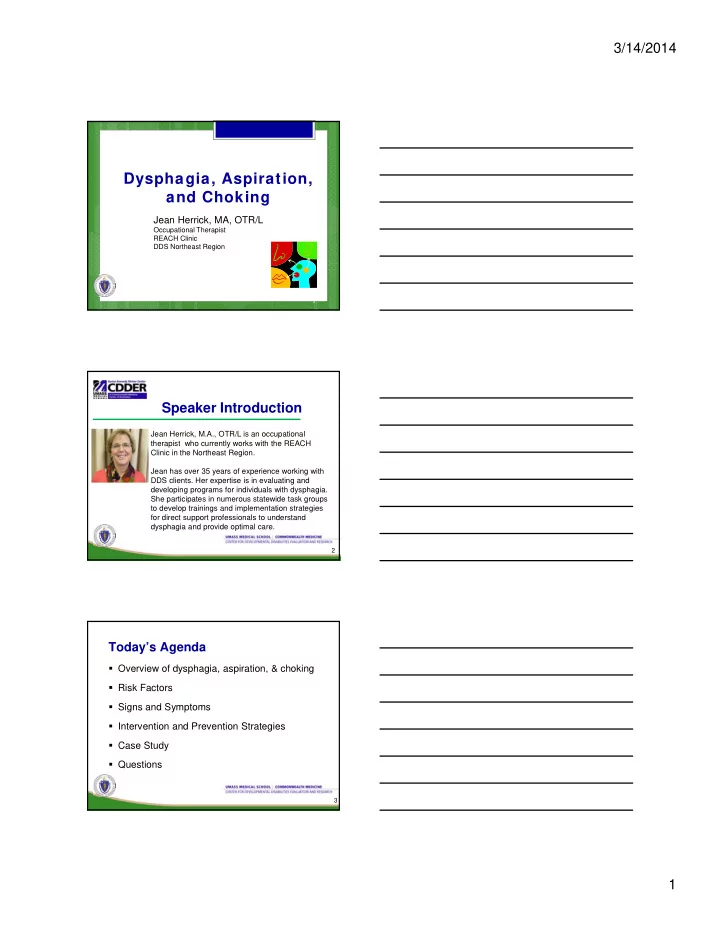
3/14/2014 Dysphagia, Aspiration, and Choking Jean Herrick, MA, OTR/L Occupational Therapist REACH Clinic DDS Northeast Region 3 Speaker Introduction Jean Herrick, M.A., OTR/L is an occupational therapist who currently works with the REACH


slide-1
SLIDE 1

Dysphagia, Aspiration, and Choking

3

Jean Herrick, MA, OTR/L

Occupational Therapist REACH Clinic DDS Northeast Region

3/14/2014 1

Today’s Agenda

  • Overview of dysphagia, aspiration, & choking
  • Risk Factors
  • Signs and Symptoms
  • Intervention and Prevention Strategies
  • Case Study
  • Questions

Speaker Introduction

2

Jean Herrick, M.A., OTR/L is an occupational therapist who currently works with the REACH Clinic in the Northeast Region. Jean has over 35 years of experience working with DDS clients. Her expertise is in evaluating and developing programs for individuals with dysphagia. She participates in numerous statewide task groups to develop trainings and implementation strategies for direct support professionals to understand dysphagia and provide optimal care.

3

slide-2
SLIDE 2

3/14/2014

What is Dysphagia?

  • Dysphagia: Trouble with chewing and
  • swallowing. Food and saliva may go into the

lungs instead of the stomach

  • Aspiration: Food goes into the airway but the

person can still breathe; person may cough

  • Silent aspiration = no coughing
  • Choking: Food is lodged in the airway and

blocks airflow

4

Coughing True or False?

  • Coughing is used to clear the airway

True

  • You can see if someone is aspirating

False

  • A change in coughing frequency or type may

indicate a bigger problem

True

5

How do people swallow?

  • Pre‐Oral: anticipation and

preparation to eat

  • Oral: food is

chewed/processed in mouth and swallowed

  • Food moves into throat

and esophagus

  • What goes wrong with

choking and aspiration?

6

2

slide-3
SLIDE 3

zyxwvutsrqponmlkjihgfedcbaYWVUTSRQPONMLJIHGFEDCBA Rank Diagnosis Oct 2011- Sept 2012 # Incidents % of diagnoses 1. Physical injuries (non-burn) 2129 31.0% 2. Seizures 482 7.0% 3. Respiratory infections 452 6.6% 4. Urinary Tract Infection 365 5.3% 5. G/j-tube related 243 3.5% 6. Skin Infections 186 2.7% 7. Cardiovascular Symptoms 179 2.6% 8. Infection (systemic) 172 2.5% 9. Psychiatric 144 2.1% 10. Gastroenteritis & Other Gastro 141 2.1% 11. Dehydration 127 1.8% 12. Constipation 122 1.8% 13. Choking/Aspiration 86 1.3% 14. Diabetes-related 74 1.1% 15. Anxiety 56 0.8%

3/14/2014

When a person has dysphagia…

  • Poor food & fluid
  • Respiratory

intake infections

  • Malnutrition &
  • Aspiration

Dehydration pneumonia

  • Urinary tract
  • Skin infections/

infections pressure ulcers

  • Renal failure

7

ER Visits and Mortality

Top 15 diagnoses for Emergency Room visits*

  • 434 hospital visits due to

Aspiration, Choking or Aspiration Pneumonia in 2012.

  • Each year, about 10% of all

deaths are due to Choking, Aspiration or Aspiration Pneumonia.

*Adults receiving DDS services and whose incident information is recorded in HCSIS.

8

Risk Factors & Symptoms

9

3

slide-4
SLIDE 4

3/14/2014

What increases a person’s risk for dysphagia?

  • Medication side effects
  • Relaxed muscle tone
  • Increase salivation
  • Cause dry mouth
  • Sedating
  • Neurological Conditions: Parkinson's,

multiple sclerosis, seizure disorders, Dementia, Cerebral Palsy

  • Age
  • GERD
  • Poor Oral hygiene

10

Risk factors for choking

  • Incorrect food texture
  • Medication intervention or

supplemental medication

  • Eating too fast/not chewing adequately
  • Easily distracted at meal time
  • Pica
  • Behavioral issues – grab food and run
  • No texture “holidays”

Risk Factors - Aspiration

  • Poor positioning
  • Guzzling, gulping air
  • Poor airway protection
  • Poor coordination of breathing and

swallowing

4

11 12

slide-5
SLIDE 5

3/14/2014

5 most common reasons a person is referred for a swallowing evaluation

1) Frequent coughing 2) A change in coughing frequency

  • r type

3) Loss of interest in certain foods or textures 4) Losing weight or are dehydrated/malnutrition 5) Reoccurring pneumonia

13

Other signs you might not notice

  • Tired all the time
  • Looks like they have a running nose all the

time

  • Increased agitation – pushing, throwing food
  • Sounds like they have a cold or they get lots
  • f colds
  • Blinking and watering of the eyes

14

Clinical Signs

  • Cyanosis (blue discoloration of the

skin)

  • Chest or throat discomfort, especially

when g-e reflux is present

  • Anemia, low hemoglobin and

hematocrit

  • Low grade fever or spiking

temperature, even as soon as 30 minutes to 1 hour after eating

15

5

slide-6
SLIDE 6

afety net

3/14/2014

What are some prevention and intervention strategies you might try?

Conduct a swallowing evaluation

  • Experienced Occupational Therapist or

Speech Pathologist

  • Modified barium swallow study (MBSS)
  • Helps identify safest food and beverage

textures and dining strategies

  • Communicate changes or concerns
  • Direct support staff and other caregivers

crucial for success: They are the s and last link in chain of care!

Modify Food Textures

  • Regular: Food served in a whole form.
  • Cut-Up: Food is in bite-size pieces.
  • Chopped: Food chopped to pea size, and is very soft.
  • Ground: Small pieces of each food item that has been

processed down to the size of an apple seed. It includes enough liquid to moisten the food and/or bind food items together.

  • Pureed: Foods processed to a pureed consistency. It is

smooth, moist, pudding-like and contains no lumps. All food items should drop off the spoon in globs when the spoon is tilted. They should not run off in a steady stream, or be dry and pasty.

6

16 17 18

slide-7
SLIDE 7

3/14/2014

Food Textures Continued

  • Ensure medication is consistent with diet
  • rders
  • Considerations when going out to a

restaurant:

  • Many restaurants will texturize the food if

you ask

  • May bring a manual food grinder just in

case

19

Modify Diet

  • A Registered Dietitian can make

recommendations for foods for specialized diets e.g. GERD

  • Avoid high risk foods that may cause

problems

  • Sticky foods like peanut butter
  • Particle foods like popcorn or nuts
  • Stringy foods like fried eggs or celery
  • Foods that increase/thicken saliva like milk
  • r yogurt

20

Thicken Beverages

  • Best determined by MBSS
  • Increases weight for better sensory perception
  • Slows flow
  • Gives time to help organize and trigger a

swallow.

  • If necessary, look for low calorie thickener if a

concern,

  • Correct mixing
  • Water for good hydration

21

7

slide-8
SLIDE 8

3/14/2014 8

Meal Strategies

  • Pacing
  • Increase sensory
  • Cue levels

input

  • Divided plate,
  • Cups and Utensils
  • Plating small
  • Small utensils

amounts of food

  • Nosey cups
  • May need to spoon
  • Sippy cups

feed for slow pace

  • Pro-Val cup
  • Alternate
  • Spout cups

food/beverage

  • Travel mugs
  • Utilize the

second/dry swallow

23

Environmental Strategies

  • Quiet, focused meals that minimize

distractions

  • Be aware of access

to kitchen and food (staff food too)

  • In the community, be aware of helpful

third parties, i.e. civic events or parties with many volunteers

  • Light physical activity to aid digestion

Positioning

  • Provide support so individual can focus on

dining and swallowing

  • Consider body and head alignment
  • Consider table height
  • Wheelchair modifications
  • Remain upright after meals 30-45 min.
  • Elevate head of bed

22 24

slide-9
SLIDE 9

3/14/2014

saliva; toothette or cloth to wipe gums/gum line

An important word on oral care

  • Thorough oral care can eliminate bacteria;

mouth care needed at end of meal and after evening medications

  • Tooth brushing
  • Increases salivation
  • Individual may be on thickened fluids
  • Head position
  • Use of toothpaste, peridex
  • Suggestions: good positioning; minimal

toothpaste, use cloth or toothette to absorb

25

Final Thoughts

  • Emergency protocols are in place for

choking – check with your agency

  • Early recognition of signs and symptoms
  • f dysphagia can prevent aspiration
  • Consider g/j tubes as alternate feeding
  • Direct care staff and others who provide

assistance are the last – and most important – link in the chain of care

Case Study

  • 35 year old male with recurrent pneumonia
  • Medical History:
  • Multiple hospitalizations due to recurrent pneumonia
  • Uses oxygen 24/7
  • The MBSS showed normal swallow
  • He is currently on a mechanical soft diet and thin liquids
  • Dining evaluation
  • Eats rapidly
  • Takes large bites
  • Gulps beverages
  • Enjoys extra large iced coffees using a large straw

9

26 27

slide-10
SLIDE 10

3/14/2014

28

The plan

  • Maintain his mechanical soft diet and thin

liquids

  • Pacing program for food and beverages
  • Accurate food texture
  • Very close supervision
  • Beverages in small sips, small straw or

covered travel cup

  • Low distraction setting at meals

The Outcomes

Re-evaluated after one year:

  • Off the oxygen
  • No further pneumonia
  • Support staff continue with the pacing

plan

For more information

  • Contact the Occupational Therapist or Speech

Pathologist for further evaluation, in-services, or assistance with implementing MBSS recommendations.

  • Contact the Area Office nurse for info on local

resources.

  • MA DDS fact sheets and risk management

guidelines available on the DDS website http://www.mass.gov/dds/ by searching for aspiration, dysphagia, or choking in the search box.

30 29

10

slide-11
SLIDE 11

3/14/2014

31 32

Coming Soon…

Coming in April, the next Quality Is No Accident (QINA) Brief focusing on Dysphagia and Aspiration. Will contain additional resources and prevention strategies

Thank you!

  • Questions and Answers

11