1
Systems of Care Systems of Care – – Regional Regional Center and IEP Center and IEP
Josh Mandelberg, M.D., Josh Mandelberg, M.D., F.A.A.P. F.A.A.P. Fellow, Developmental Fellow, Developmental-
- Behavioral Pediatrics, 2009
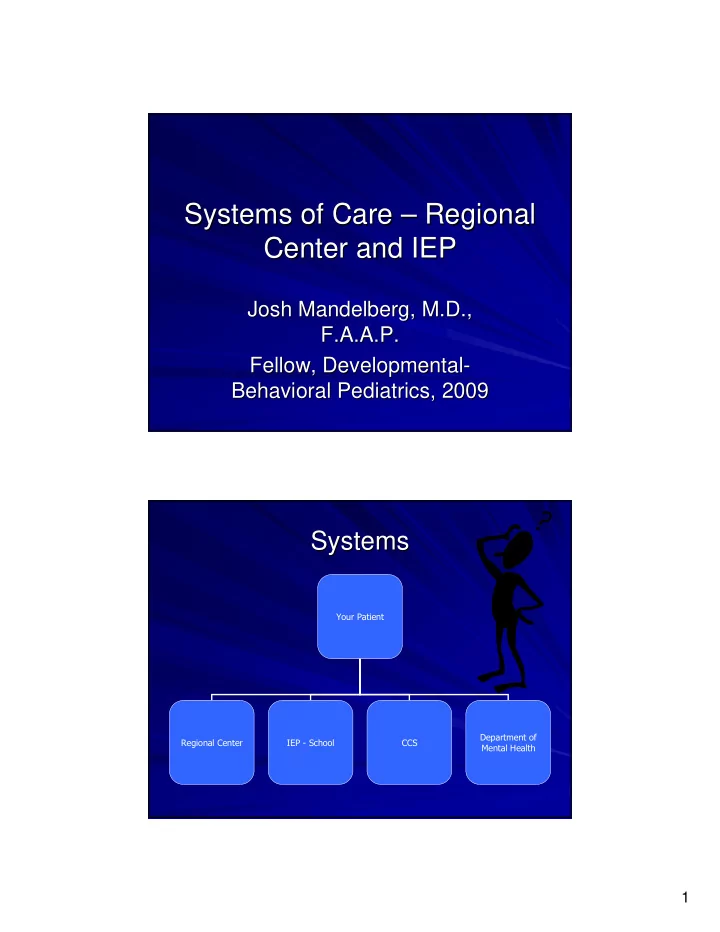
Systems of Care Regional Regional Systems of Care Center and - - PDF document
Systems of Care Regional Regional Systems of Care Center and IEP Center and IEP Josh Mandelberg, M.D., Josh Mandelberg, M.D., F.A.A.P. F.A.A.P. Fellow, Developmental- Fellow, Developmental - Behavioral Pediatrics, 2009
Physical Therapy Physical Therapy Occupational Therapy (including feeding therapy) Occupational Therapy (including feeding therapy) Speech Therapy (after 18 months old) Speech Therapy (after 18 months old) Behavior Therapy (ABA Behavior Therapy (ABA -
applied behavior analysis, discrete trials. Includes educational orientation and discrete trials. Includes educational orientation and parenting course) parenting course) Infant Stimulation (developmental therapist for infant) Infant Stimulation (developmental therapist for infant) Infant Toddler Program (center based Early Infant Toddler Program (center based Early Intervention Program) Intervention Program) Respite Care (child care) Respite Care (child care) – – offered in certain situations
Family Resource Center Family Resource Center
1.
Prevention of disabilities 2.
Early Start Program 3.
Lanterman Act Act
Established risk Established risk High risk High risk Developmental Delay Developmental Delay
– – Congenital / genetic syndromes (Down, Congenital / genetic syndromes (Down, Prader Prader Willi Willi, , Williams, Fragile X, Fetal Alcohol syndrome, Williams, Fragile X, Fetal Alcohol syndrome, Tuberous Sclerosis, congenital rubella) Tuberous Sclerosis, congenital rubella) – – Extreme prematurity (23 Extreme prematurity (23-
25 weeks EGA) – – Grade IV IVH Grade IV IVH – – Multiple non Multiple non-
febrile seizures – – Brain malformation ( Brain malformation (holoprosencephally holoprosencephally, , schizencephaly schizencephaly) ) – – Kernicterus Kernicterus
High risk includes conditions such as: High risk includes conditions such as:
– – Prenatal: Developmentally disabled parent, prenatal exposure to Prenatal: Developmentally disabled parent, prenatal exposure to drug or drug or teratogen teratogen – – Neonatal: <32w EGA or <1500g birth weight, Ventilation x48hrs Neonatal: <32w EGA or <1500g birth weight, Ventilation x48hrs in 1st 28days, SGA (<=3%ile), IUGR, Severe, persistent in 1st 28days, SGA (<=3%ile), IUGR, Severe, persistent metabolic abnormality, Neonatal asphyxia (5min metabolic abnormality, Neonatal asphyxia (5min apgar apgar <6) <6) – – Non Non-
febrile seizures in 1st 3yrs of life, CNS infection, lesion or abnormality (microcephaly) abnormality (microcephaly) – – Biomedical insult (injury, accident, illness) which could Biomedical insult (injury, accident, illness) which could POSSIBLY permanently affect developmental outcome ( POSSIBLY permanently affect developmental outcome (UCLA UCLA patients patients) ) – – Multiple congenital anomalies or genetic Multiple congenital anomalies or genetic d/o d/o that could that could POSSIBLY affect developmental outcome POSSIBLY affect developmental outcome – – Clinically significant failure to thrive (<3%ile) Clinically significant failure to thrive (<3%ile) – – Persistent hypotonia or Persistent hypotonia or hypertonia hypertonia (i.e. risk for CP) (i.e. risk for CP) – – Brain or spinal cord infection (meningitis, encephalitis, etc.) Brain or spinal cord infection (meningitis, encephalitis, etc.)
– – Case Management Case Management – – Developmental Monitoring (?every 6 months) Developmental Monitoring (?every 6 months) – – Westside & North LA Regional Centers trying to turn Westside & North LA Regional Centers trying to turn parent education into group therapy (i.e. PT, OT) parent education into group therapy (i.e. PT, OT) – – If develop significant delays then get services If develop significant delays then get services – – May only cover up to 24 months May only cover up to 24 months
– – Condition of known etiology with high probability of Condition of known etiology with high probability of leading to developmental delays leading to developmental delays – – Need medical record documentation Need medical record documentation – – Example Example – – Down syndrome, cleft palate, PVL Down syndrome, cleft palate, PVL
– – Birth Birth – – 24 months 24 months – – 33% delay in one or more 33% delay in one or more developmental domains developmental domains – – 24 24 – – 35 months* 35 months*
33% delay in 2 or more developmental domains 33% delay in 2 or more developmental domains 50% delay in 1 or more developmental domains 50% delay in 1 or more developmental domains Trying to discourage referral for isolated speech delay Trying to discourage referral for isolated speech delay
– – Mental retardation (onset <18y/o, IQ<=70, adaptive Mental retardation (onset <18y/o, IQ<=70, adaptive dysfunction) dysfunction) – – 10 10-
30 per 1000 – – Autism (usually not autism spectrum disorder, Autism (usually not autism spectrum disorder, Aspergers Aspergers, PDD , PDD-
NOS) -
6 per 1000 – – Epilepsy Epilepsy – – 5 per 1000 5 per 1000 – – Cerebral palsy Cerebral palsy – – 2.5 per 1000 2.5 per 1000 – – Disabling Conditions closely related to Mental Disabling Conditions closely related to Mental retardation retardation
Dx Dx must be likely to continue indefinitely and originate must be likely to continue indefinitely and originate before 18 years old, involve a substantial handicap before 18 years old, involve a substantial handicap – – communication, learning, self communication, learning, self-
care, mobility, self-
direction, independent living, economic self-
sufficiency. Shall not be solely physical, psychiatric or learning Shall not be solely physical, psychiatric or learning disability condition disability condition Regional Center will be last resort payer after school, Regional Center will be last resort payer after school, insurance, CCS. insurance, CCS. Services may include paying for group homes, supported Services may include paying for group homes, supported living in home, medical, nursing, psychiatric care living in home, medical, nursing, psychiatric care
Parent makes initial phone call to Regional Center Parent makes initial phone call to Regional Center Find local regional center by Zip Code Find local regional center by Zip Code Physician note or prescription can be helpful Physician note or prescription can be helpful, can , can provide medical record, indicate rationale for referral provide medical record, indicate rationale for referral Rule is have 45 days from initial call to either: Rule is have 45 days from initial call to either: do do evaluation or determine if eligible evaluation or determine if eligible Evaluation of child done at home or at Regional Center, Evaluation of child done at home or at Regional Center, can be by Regional Center staff or can be by Regional Center staff or vendorized vendorized Evaluation may include hearing or vision testing if Evaluation may include hearing or vision testing if indicated, would be paid for by Regional Center if not indicated, would be paid for by Regional Center if not covered by insurance covered by insurance
Regional Center Regional Center eval eval may make a diagnosis (i.e. MR or may make a diagnosis (i.e. MR or autism) autism) After evaluation completed, set up IFSP (Individualized After evaluation completed, set up IFSP (Individualized Family Service Plan) with goals for child and intervention Family Service Plan) with goals for child and intervention (no mandated timeline but parents can be persistent) (no mandated timeline but parents can be persistent) Services provided by local vendors not by Regional Services provided by local vendors not by Regional Center itself (parents may request or Regional Center Center itself (parents may request or Regional Center may recommend). Services can be in home, at may recommend). Services can be in home, at therapist therapist’ ’s office or center based. Current state push for s office or center based. Current state push for “ “natural setting natural setting” ” (i.e. in (i.e. in-
home) may not be ideal for 18m/o and older and older Transition meeting with Regional Center and local school Transition meeting with Regional Center and local school system at 30 system at 30-
36 months to plan for transition into school system (IEP) system (IEP)
– – Focus on condition Focus on condition’ ’s s impact on education impact on education ( (vs vs Regional Center focus on social & adaptive Regional Center focus on social & adaptive functioning) functioning)
– – Goal of least restrictive environment (LRE) Goal of least restrictive environment (LRE)
Parents make request for IEP assessment at local public Parents make request for IEP assessment at local public school (even if go to private school) school (even if go to private school) School creates an School creates an assessment plan assessment plan that lays out that lays out general plan for the evaluation, parents must sign this general plan for the evaluation, parents must sign this plan to give school consent to evaluate. The plan to give school consent to evaluate. The assessment plan must be given to parents within assessment plan must be given to parents within 15 15 school days school days of the request.
Once assessment plan is signed, school has Once assessment plan is signed, school has 60 school 60 school days days to complete their assessment and hold an IEP to complete their assessment and hold an IEP meeting (assessment may include interviews, meeting (assessment may include interviews,
At At IEP meeting IEP meeting, the school provides their assessment , the school provides their assessment about 1) whether the child is about 1) whether the child is eligible eligible for special for special ed ed services and 2) what services and 2) what services services are recommended are recommended Parents are allowed to disagree with either eligibility or Parents are allowed to disagree with either eligibility or recommended services and may dispute them. They recommended services and may dispute them. They may take them home to review before signing. may take them home to review before signing. Used to have to sign the IEP for Used to have to sign the IEP for any any recommended recommended services to begin. Now can start agreed upon services services to begin. Now can start agreed upon services while dispute others while dispute others Disputes may proceed through mediation or a due Disputes may proceed through mediation or a due process hearing process hearing IEP IEP’ ’s s reviewed annually, fully re reviewed annually, fully re-
assessed every 3 years although parents can request a review of the IEP at any although parents can request a review of the IEP at any time. time.
Specific learning disability (SLD) Specific learning disability (SLD)
– – Discrepancy criteria Discrepancy criteria – – 22 pt difference between IQ and specific 22 pt difference between IQ and specific area of achievement area of achievement – – Response to intervention criteria Response to intervention criteria – – child having trouble despite child having trouble despite non non-
IEP classroom modifications
Emotional Disturbance (ED) Emotional Disturbance (ED) – – disturbance must be disturbance must be
6months), to a marked degree (i.e. medical diagnosis) and adversely affecting degree (i.e. medical diagnosis) and adversely affecting child child’ ’s educational performance. Having IEP of ED may s educational performance. Having IEP of ED may protect child from punishment for acting out behavior (i.e. protect child from punishment for acting out behavior (i.e. get mental health treatment instead of suspension) get mental health treatment instead of suspension) Other Health Impairment (OHI) Other Health Impairment (OHI) – – health problem health problem leading to limited strength, vitality or alertness (ADHD fits leading to limited strength, vitality or alertness (ADHD fits here with impact on vitality and alertness) here with impact on vitality and alertness)
504 Modifications / Plan 504 Modifications / Plan – – does not require an IEP does not require an IEP
– – Examples: ramps for wheelchairs, extended time allowances for Examples: ramps for wheelchairs, extended time allowances for tests, preferential seating in class, class notes provided tests, preferential seating in class, class notes provided – – School may request trying 504 modifications before getting IEP School may request trying 504 modifications before getting IEP at assessment plan stage at assessment plan stage – – Depends on teacher to actually implement the 504 plan Depends on teacher to actually implement the 504 plan
Resource Specialist Program (RSP) Resource Specialist Program (RSP)
– – Pull out special help for specific subject Pull out special help for specific subject – – May be in class or out of class May be in class or out of class
Designated Instruction Services (DIS, aka Designated Instruction Services (DIS, aka “ “Related Related Services Services” ”) )
– – Includes Occupational Therapy (OT), Adaptive PE (APE), Includes Occupational Therapy (OT), Adaptive PE (APE), Language and Speech Therapy (LAS), Counseling (focused on Language and Speech Therapy (LAS), Counseling (focused on school functioning) school functioning) – – 1:1 Aide (generally for autism 1:1 Aide (generally for autism -
deviant learning)
Special Day Class Special Day Class
– – Primary classroom is special Primary classroom is special ed ed but may still have some GE but may still have some GE classes classes – – Can be on general or special Can be on general or special ed ed campus (special campus campus (special campus example example – – Marlton School for deaf, Miller High School for MR) Marlton School for deaf, Miller High School for MR) – – Can get DIS services in addition Can get DIS services in addition
Non Public School (NPS) Non Public School (NPS)
– – Public school will fund if NPS provides services not present in Public school will fund if NPS provides services not present in public school system. public school system. – – Example Example – – HELP Group schools HELP Group schools
Day Treatment Day Treatment – – Department of Mental Health sets up Department of Mental Health sets up Residential Treatment Center Residential Treatment Center – – Department of Mental Department of Mental Health sets up Health sets up
– – still eligible for evaluation at local public school, still eligible for evaluation at local public school, recommended services though will likely be at the recommended services though will likely be at the public school. public school. – – Some private schools do have their own resource Some private schools do have their own resource programs and educational specialists although they programs and educational specialists although they may not advertise this may not advertise this
st come
– – Expensive. Can get 1:1 aide in private preschool but
not private elementary. Other DIS services may be at not private elementary. Other DIS services may be at district preschool district preschool
– – Federal program, low income Federal program, low income
– – Special need & low income, can choose within district Special need & low income, can choose within district
– – Prove services in district not adequate (i.e. HELP Prove services in district not adequate (i.e. HELP group) group)
– – High functioning High functioning
Preschool mixed (10 Preschool mixed (10-
12h) Regional Center Behavior Therapy (10 Regional Center Behavior Therapy (10-
12h) Total = 20 Total = 20-
25h/wk
– – Lower functioning Lower functioning
Preschool intensive (20h) Preschool intensive (20h) Regional Center Behavior Therapy (20h) Regional Center Behavior Therapy (20h) Total = 40h/wk Total = 40h/wk
Insurance system for significant medical condition, Insurance system for significant medical condition, services not covered by other insurance or services not covered by other insurance or Medi Medi-
Cal – – Qualify by specific condition, age (<=21y/o), CA Qualify by specific condition, age (<=21y/o), CA resident & parent income resident & parent income Medical Treatment Unit (MTU) Medical Treatment Unit (MTU) – – clinic for neuromuscular clinic for neuromuscular disorders, includes orthopedics, PT/OT, equipment disorders, includes orthopedics, PT/OT, equipment
equipment like wheelchairs, standers, etc. equipment like wheelchairs, standers, etc. May fund specific follow up care May fund specific follow up care – – for example, mandate for example, mandate NICU NICU’ ’s s have follow up clinic to make sure these high risk have follow up clinic to make sure these high risk babies don babies don’ ’t fall through the cracks t fall through the cracks