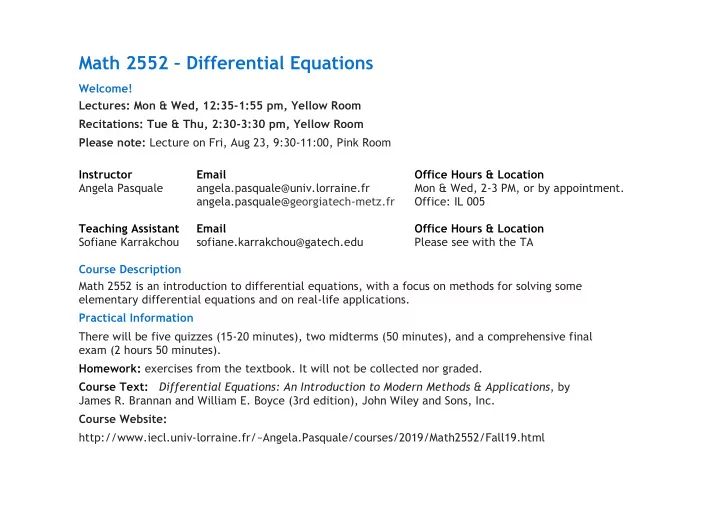
Math 2552 Differential Equations Welcome! Lectures: Mon & Wed, - - PowerPoint PPT Presentation

math 2552 differential equations
SMART_READER_LITE
LIVE PREVIEW

Math 2552 Differential Equations Welcome! Lectures: Mon & Wed, - - PowerPoint PPT Presentation

Math 2552 Differential Equations Welcome! Lectures: Mon & Wed, 12:35-1:55 pm, Yellow Room Recitations: Tue & Thu, 2:30-3:30 pm, Yellow Room Please note: Lecture on Fri, Aug 23, 9:30-11:00, Pink Room Instructor Email Office Hours


slide-1
SLIDE 1

Math 2552 – Differential Equations

Welcome! Lectures: Mon & Wed, 12:35-1:55 pm, Yellow Room Recitations: Tue & Thu, 2:30-3:30 pm, Yellow Room Please note: Lecture on Fri, Aug 23, 9:30-11:00, Pink Room Instructor Email Office Hours & Location Angela Pasquale angela.pasquale@univ.lorraine.fr angela.pasquale@georgiatech-metz.fr Mon & Wed, 2-3 PM, or by appointment. Office: IL 005 Teaching Assistant Email Office Hours & Location Sofiane Karrakchou sofiane.karrakchou@gatech.edu Please see with the TA Course Description Math 2552 is an introduction to differential equations, with a focus on methods for solving some elementary differential equations and on real-life applications. Practical Information There will be five quizzes (15-20 minutes), two midterms (50 minutes), and a comprehensive final exam (2 hours 50 minutes). Homework: exercises from the textbook. It will not be collected nor graded. Course Text: Differential Equations: An Introduction to Modern Methods & Applications, by James R. Brannan and William E. Boyce (3rd edition), John Wiley and Sons, Inc. Course Website: http://www.iecl.univ-lorraine.fr/~Angela.Pasquale/courses/2019/Math2552/Fall19.html

slide-2
SLIDE 2

The rate of change of a differentiable function y = f(t)

The average rate of change of y with respect to t over the interval [t1, t2] is ∆y ∆t = f(t2) − f(t1) t2 − t1 It is the slope of the secant line to the graph of f thorugh P and Q. average rate of change = slope of the secant line By taking the average rate of change over smaller and smaller intervals (i.e. by letting t2 → t1) the secant line becomes the tangent line. We obtain the (instantaneous) rate of change of y with respect to t at t1 : dy dt = lim

∆t!0

∆y ∆t = lim

t2!t1

f(t2) − f(t1) t2 − t1 = f 0(t1) It is the slope of the secant line to the graph of f at P. rate of change at t1= slope of the tangent at P=f 0(t1)

1 / 1

slide-3
SLIDE 3

The rate of change of a differentiable function y = f(t)

The average rate of change of y with respect to t over the interval [t1, t2] is ∆y ∆t = f(t2) − f(t1) t2 − t1 It is the slope of the secant line to the graph of f thorugh P and Q. average rate of change = slope of the secant line By taking the average rate of change over smaller and smaller intervals (i.e. by letting t2 → t1) the secant line becomes the tangent line. We obtain the (instantaneous) rate of change of y with respect to t at t1 : dy dt = lim

∆t!0

∆y ∆t = lim

t2!t1

f(t2) − f(t1) t2 − t1 = f 0(t1) It is the slope of the secant line to the graph of f at P. rate of change at t1= slope of the tangent at P=f 0(t1)

1 / 1

L

slide-4
SLIDE 4

Ü--2(v3)k=2,To