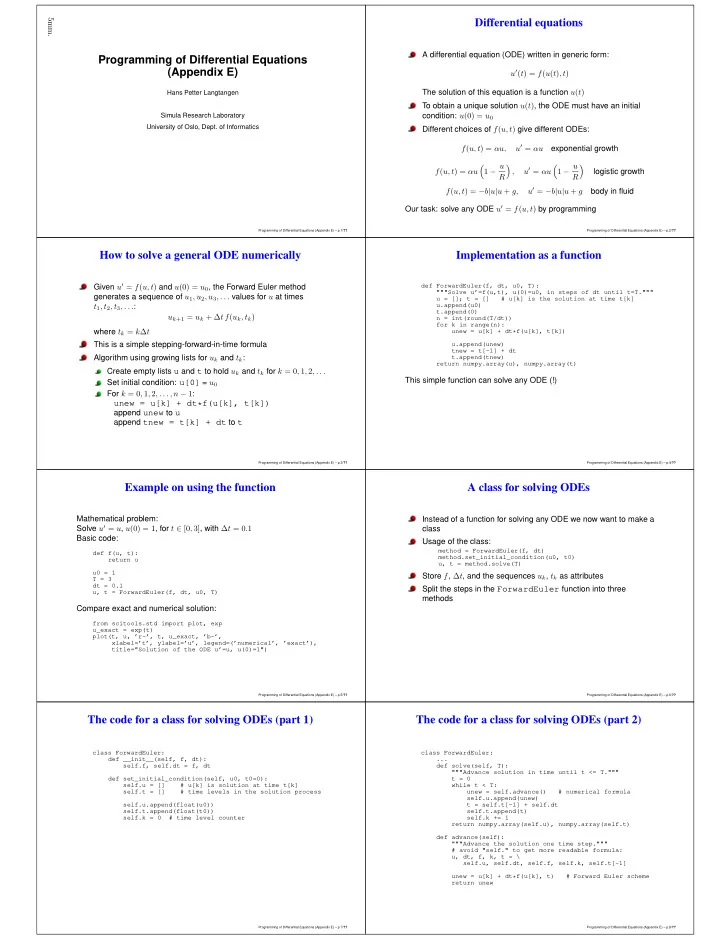

5mm.
Programming of Differential Equations (Appendix E)
Hans Petter Langtangen Simula Research Laboratory University of Oslo, Dept. of Informatics
Programming of Differential Equations (Appendix E) – p.1/??Differential equations
A differential equation (ODE) written in generic form: u′(t) = f(u(t), t) The solution of this equation is a function u(t) To obtain a unique solution u(t), the ODE must have an initial condition: u(0) = u0 Different choices of f(u, t) give different ODEs: f(u, t) = αu, u′ = αu exponential growth f(u, t) = αu
- 1 − u
R
- ,
u′ = αu
- 1 − u
R
- logistic growth
f(u, t) = −b|u|u + g, u′ = −b|u|u + g body in fluid Our task: solve any ODE u′ = f(u, t) by programming
Programming of Differential Equations (Appendix E) – p.2/??How to solve a general ODE numerically
Given u′ = f(u, t) and u(0) = u0, the Forward Euler method generates a sequence of u1, u2, u3, . . . values for u at times t1, t2, t3, . . .: uk+1 = uk + ∆t f(uk, tk) where tk = k∆t This is a simple stepping-forward-in-time formula Algorithm using growing lists for uk and tk: Create empty lists u and t to hold uk and tk for k = 0, 1, 2, . . . Set initial condition: u[0] = u0 For k = 0, 1, 2, . . . , n − 1:
unew = u[k] + dt*f(u[k], t[k])
append unew to u append tnew = t[k] + dt to t
Programming of Differential Equations (Appendix E) – p.3/??Implementation as a function
def ForwardEuler(f, dt, u0, T): """Solve u’=f(u,t), u(0)=u0, in steps of dt until t=T.""" u = []; t = [] # u[k] is the solution at time t[k] u.append(u0) t.append(0) n = int(round(T/dt)) for k in range(n): unew = u[k] + dt*f(u[k], t[k]) u.append(unew) tnew = t[-1] + dt t.append(tnew) return numpy.array(u), numpy.array(t)
This simple function can solve any ODE (!)
Programming of Differential Equations (Appendix E) – p.4/??Example on using the function
Mathematical problem: Solve u′ = u, u(0) = 1, for t ∈ [0, 3], with ∆t = 0.1 Basic code:
def f(u, t): return u u0 = 1 T = 3 dt = 0.1 u, t = ForwardEuler(f, dt, u0, T)
Compare exact and numerical solution:
from scitools.std import plot, exp u_exact = exp(t) plot(t, u, ’r-’, t, u_exact, ’b-’, xlabel=’t’, ylabel=’u’, legend=(’numerical’, ’exact’), title="Solution of the ODE u’=u, u(0)=1")
Programming of Differential Equations (Appendix E) – p.5/??A class for solving ODEs
Instead of a function for solving any ODE we now want to make a class Usage of the class:
method = ForwardEuler(f, dt) method.set_initial_condition(u0, t0) u, t = method.solve(T)
Store f, ∆t, and the sequences uk, tk as attributes Split the steps in the ForwardEuler function into three methods
Programming of Differential Equations (Appendix E) – p.6/??The code for a class for solving ODEs (part 1)
class ForwardEuler: def __init__(self, f, dt): self.f, self.dt = f, dt def set_initial_condition(self, u0, t0=0): self.u = [] # u[k] is solution at time t[k] self.t = [] # time levels in the solution process self.u.append(float(u0)) self.t.append(float(t0)) self.k = 0 # time level counter
Programming of Differential Equations (Appendix E) – p.7/??The code for a class for solving ODEs (part 2)
class ForwardEuler: ... def solve(self, T): """Advance solution in time until t <= T.""" t = 0 while t < T: unew = self.advance() # numerical formula self.u.append(unew) t = self.t[-1] + self.dt self.t.append(t) self.k += 1 return numpy.array(self.u), numpy.array(self.t) def advance(self): """Advance the solution one time step.""" # avoid "self." to get more readable formula: u, dt, f, k, t = \ self.u, self.dt, self.f, self.k, self.t[-1] unew = u[k] + dt*f(u[k], t) # Forward Euler scheme return unew
Programming of Differential Equations (Appendix E) – p.8/??