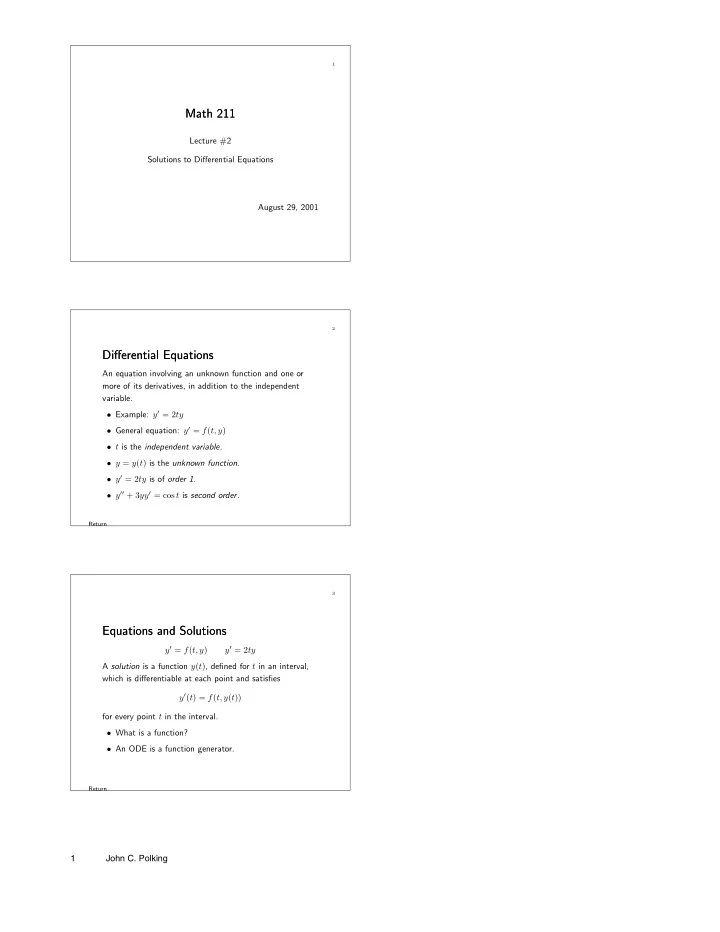
Math 211 Math 211 Lecture #2 Solutions to Differential Equations - - PDF document

math 211 math 211
SMART_READER_LITE
LIVE PREVIEW

Math 211 Math 211 Lecture #2 Solutions to Differential Equations - - PDF document

1 Math 211 Math 211 Lecture #2 Solutions to Differential Equations August 29, 2001 2 Differential Equations Differential Equations An equation involving an unknown function and one or more of its derivatives, in addition to the independent


slide-1
SLIDE 1

1

Math 211 Math 211

Lecture #2 Solutions to Differential Equations August 29, 2001

Return

2

Differential Equations Differential Equations

An equation involving an unknown function and one or more of its derivatives, in addition to the independent variable.

  • Example: y′ = 2ty
  • General equation: y′ = f(t, y)
  • t is the independent variable.
  • y = y(t) is the unknown function.
  • y′ = 2ty is of order 1.
  • y′′ + 3yy′ = cos t is second order.

Return

3

Equations and Solutions Equations and Solutions

y′ = f(t, y) y′ = 2ty A solution is a function y(t), defined for t in an interval, which is differentiable at each point and satisfies y′(t) = f(t, y(t)) for every point t in the interval.

  • What is a function?
  • An ODE is a function generator.

1 John C. Polking

slide-2
SLIDE 2

Return Definition of ODE

4

Example: y′ = 2ty Example: y′ = 2ty

Claim: y(t) = et2 is a solution.

  • Verify by substitution.

Left-hand side: y′(t) = 2tet2 Right-hand side: 2ty(t) = 2tet2

  • Therefore y′(t) = 2ty(t), if y(t) = et2.
  • Verification by substitution is always available.

Definition of ODE Example

5

Is y(t) = et a solution to the equation y′ = 2ty?

  • Check by substitution.

Left-hand side: y′(t) = et Right-hand side: 2ty(t) = 2tet

  • Therefore y′(t) = 2ty(t), if y(t) = et.
  • y(t) = et is not a solution to the equation y′ = 2ty.

Return

6

Types of Solutions Types of Solutions

For the equation y′ = 2ty

  • y(t) = 1

2et2 is a solution. It is a particular solution.

  • y(t) = Cet2 is a solution for any constant C. This is a

general solution. General solutions contain arbitrary constants. Particular solutions do not. 2 John C. Polking

slide-3
SLIDE 3

7

Initial Value Problem (IVP) Initial Value Problem (IVP)

A differential equation & an initial condition.

  • Example: y′ = −2ty

with y(0) = 4.

  • General solution:

y(t) = Ce−t2.

  • Plug in the initial condition:

y(0) = 4, Ce0 = 4, C = 4 Solution to the IVP: y(t) = 4e−t2.

8

An ODE is a Function Generator An ODE is a Function Generator

Example: y′ = y2 − t, y(0) = 0

  • There is no solution to this IVP which can be given

using a formula.

  • Nevertheless, there is a solution. We can find as many

terms in the power series for y(t) as we want. y(t) = −1 2t2 + 1 20t5 − 1 160t8 + . . .

9

Normal Form of an Equation Normal Form of an Equation

y′ = f(t, y) Example: (1 + t2)y′ + y2 = t3

  • This equation is not in normal form.
  • Solve for y′ to put the equation into normal form:

y′ = t3 − y2 1 + t2 3 John C. Polking

slide-4
SLIDE 4

10

Interval of Existence Interval of Existence

The largest interval over which a solution can exist.

  • Example: y′ = 1 + y2

with y(0) = 1

General solution: y(t) = tan(t + C) Initial Condition: y(0) = 1 ⇔ C = π/4.

  • Solution: y(t) = tan(t + π/4) exists and is continuous

for −π/2 < t + π/4 < π/2

  • r for

−3π/4 < t < π/4.

11

Geometric Interpretation of y′ = f(t, y) Geometric Interpretation of y′ = f(t, y)

If y(t) is a solution, and y(t0) = y0, then y′(t0) = f(t0, y(t0)) = f(t0, y0).

  • The slope to the graph of y(t) at the point (t0, y0) is

given by f(t0, y0).

  • Imagine a small line segment attached to each point of

the (t, y) plane with the slope f(t, y).

12

The Direction Field The Direction Field

−2 2 4 6 8 10 −4 −3 −2 −1 1 2 3 4 t x x ’ = x2 − t

4 John C. Polking

slide-5
SLIDE 5

Return

13

Autonomous Equations Autonomous Equations

General equation: dy dt = f(t, y) dy dt = t − y2 Autonomous equation: dy dt = f(y) dy dt = y(1 − y) In an autonomous equation the right-hand side has no explicit dependence on the independent variable.

Return

14

Equilibrium Points Equilibrium Points

Autonomous equation: dy dt = f(y) dy dt = y(2 − y)/3

  • Equilibrium point:

f(y0) = 0 y0 = 0

  • r

2

  • Equilibrium solution:

y(t) = y0 y(t) = 0 and y(t) = 2

Equilibrium point

15

Between Equilibrium Points Between Equilibrium Points

  • dy

dt = f(y) > 0 ⇒ y(t) is increasing.

  • dy

dt = f(y) < 0 ⇒ y(t) is decreasing. Example: dy dt = y(2 − y)/3 5 John C. Polking

slide-6
SLIDE 6

Return

16

Separable Equations Separable Equations

General differential equation: dy dt = f(t, y) dy dt = t − y2 Separable differential equation: dy dt = g(y)h(t) dy dt = t sec y In a separable equation the right-hand side is a product of a function of the independent variable (t) and a function

  • f the unknown function (y).
  • Autonomous equations are separable.

Return Separable

17

Solving Separable Equations Solving Separable Equations

dy dt = t sec y

  • Step 1: Separate the variables:

dy sec y = t dt

  • r

cos y dy = t dt We have to worry about dividing by 0, but in this case sec y is never equal to 0.

Return Step 1

18

Step 2: Integrate both sides Step 2: Integrate both sides

  • cos y dy =
  • t dt

sin(y) + C1 = 1 2t2 + C2

  • r

sin(y) = 1 2t2 + C where C = C2 − C1. 6 John C. Polking

slide-7
SLIDE 7

Return Step 1 Step 2

19

Step 3: Solve for y(t) Step 3: Solve for y(t)

sin(y) = 1 2t2 + C y(t) = arcsin

  • C + 1

2t2

  • .

This is the general solution to dy dt = t sec y.

Return

20

Solving Separable Equations Solving Separable Equations

dy dt = g(y)h(t) The three step solution process: 1. Separate the variables. dy g(y) = h(t) dt 2. Integrate both sides.

  • dy

g(y) =

  • h(t) dt

3. Solve for y(t).

Solution procedure Return

21

Examples Examples

  • y′ = ry
  • R′ = sin t

1 + R with R(0) = 1, −2, −1

  • x′ =

3t2x 1 + 2x2 with x(0) = 1, 0

  • y′ = 1 + y2

with y(0) = −1, 0, 1 7 John C. Polking