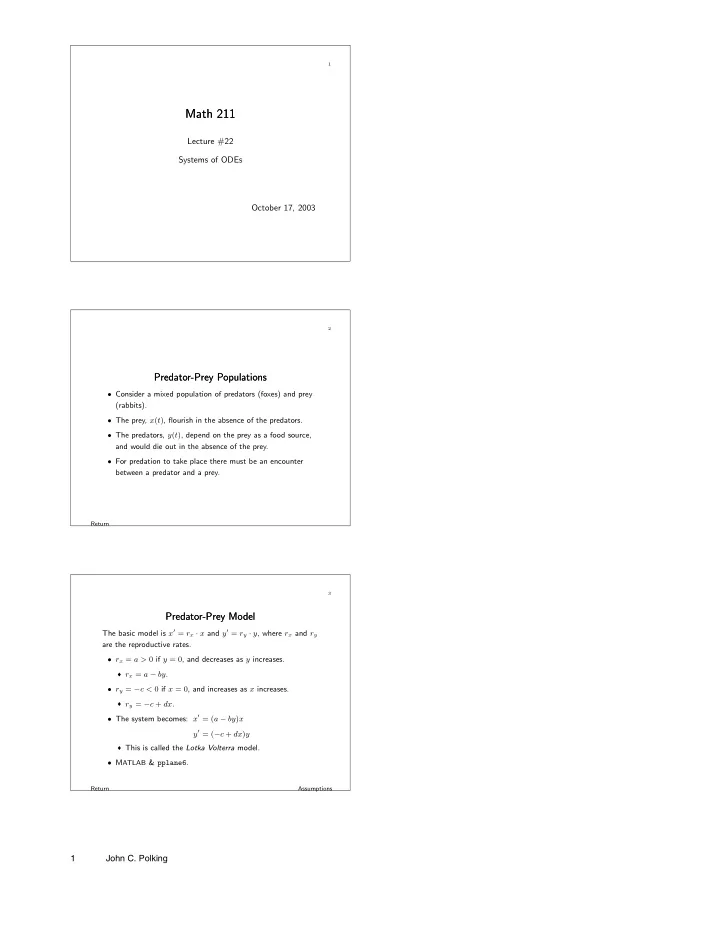
Math 211 Math 211 Lecture #22 Systems of ODEs October 17, 2003 2 - - PDF document

math 211 math 211
SMART_READER_LITE
LIVE PREVIEW

Math 211 Math 211 Lecture #22 Systems of ODEs October 17, 2003 2 - - PDF document

1 Math 211 Math 211 Lecture #22 Systems of ODEs October 17, 2003 2 Predator-Prey Populations Predator-Prey Populations Consider a mixed population of predators (foxes) and prey (rabbits). The prey, x ( t ) , flourish in the absence


slide-1
SLIDE 1

1

Math 211 Math 211

Lecture #22 Systems of ODEs October 17, 2003

Return

2

Predator-Prey Populations Predator-Prey Populations

  • Consider a mixed population of predators (foxes) and prey

(rabbits).

  • The prey, x(t), flourish in the absence of the predators.
  • The predators, y(t), depend on the prey as a food source,

and would die out in the absence of the prey.

  • For predation to take place there must be an encounter

between a predator and a prey.

Return Assumptions

3

Predator-Prey Model Predator-Prey Model

The basic model is x′ = rx · x and y′ = ry · y, where rx and ry are the reproductive rates.

  • rx = a > 0 if y = 0, and decreases as y increases.

rx = a − by.

  • ry = −c < 0 if x = 0, and increases as x increases.

ry = −c + dx.

  • The system becomes: x′ = (a − by)x

y′ = (−c + dx)y

This is called the Lotka Volterra model.

  • MATLAB & pplane6.

1 John C. Polking

slide-2
SLIDE 2

Return Predator Prey

4

General System in 2D General System in 2D

x′ = f(t, x, y) y′ = g(t, x, y)

  • Example 2:

x′ = y y′ = −x

  • Solution 1: x1(t) = sin t and y1(t) = cos t

Verify by direct substitution.

  • Solution 2: x2(t) = cos t and y2(t) = − sin t

Verify by direct substitution.

Return Planar system

5

General System in Higher D General System in Higher D

x′

1 = f1(t, x1, x2, . . . , xn)

x′

2 = f2(t, x1, x2, . . . , xn)

. . . = . . . x′

n = fn(t, x1, x2, . . . , xn)

  • The dimension of a system is the number of unknown

functions = the number of equations.

The predator-prey model has dimension 2.

  • Example: A food chain.

Return

6

Vector Notation — 2D Vector Notation — 2D

  • In 2D set u1(t) = x(t) & u2(t) = y(t). Then

u(t) =

  • u1(t)

u2(t)

  • and

u′(t) =

  • u′

1(t)

u′

2(t)

  • .
  • For the right-hand side, set

F(t, u) =

  • f(t, u1, u2)

g(t, u1, u2)

  • .
  • Then

x′ = f(t, x, y) y′ = g(t, x, y) ⇔ u′ = F(t, u)

2 John C. Polking

slide-3
SLIDE 3

Return

7

2D Examples 2D Examples

  • The predator-prey model system can be written

u′ =

  • u′

1

u′

2

  • =
  • (a − bu2)u1

(−c + bu1)u2

  • .
  • Example 2:

x′ = y y′ = −x ⇔ u′ =

  • u′

1

u′

2

  • =
  • u2

−u1

  • .
  • These are autonomous systems.

The RHS has no explicit dependence on t.

Return

8

Vector Notation — General Vector Notation — General

  • In higher dimensions, set

x(t) =

⎛ ⎜ ⎜ ⎜ ⎝

x1(t) x2(t) . . . xn(t)

⎞ ⎟ ⎟ ⎟ ⎠

f(t, x) =

⎛ ⎜ ⎜ ⎜ ⎝

f1(t, x) f2(t, x) . . . fn(t, x)

⎞ ⎟ ⎟ ⎟ ⎠ .

  • The general system can be written

x′ = f(t, x).

  • Example: A food chain.

Return

9

Initial Value Problem Initial Value Problem

x′ = f(t, x) x(t0) = x0.

  • Each component of x(t0) must be specified.
  • Example 2:

x′ = y y′ = −x with x(0) = 2 y(0) = 13

  • PP model: Both the initial prey population and the initial

predator population must be specified.

3 John C. Polking

slide-4
SLIDE 4

Return

10

Reduction of Higher Order Equation to a System Reduction of Higher Order Equation to a System

For any higher order equation there is a first order system which is equivalent to it, in the sense that solutions of the system lead easily to solutions of the equation, and vice versa.

  • Reduces the study of higher order equations to the study of

systems

  • Useful for the computation of solutions of higher order

equations.

Return

11

Example of Reduction Example of Reduction

  • Third-order equation: y′′′ + 2yy′ = 3 cos t
  • Set x1 = y, x2 = y′, and x3 = y′′.
  • Then

x′

1 = x2

x′

2 = x3

x′

3 = 3 cos t − 2x1x2

  • This system is not autonomous.

12

Geometric Interpretation of Solutions Geometric Interpretation of Solutions

  • Parametric plot

Tangent vectors

  • Vector fields
  • Phase plane
  • pplane6 for planar autonomous systems.

4 John C. Polking