Math 211 Math 211 Lecture #18 October 31, 2000 2 Complex Numbers - - PDF document

math 211 math 211
SMART_READER_LITE
LIVE PREVIEW

Math 211 Math 211 Lecture #18 October 31, 2000 2 Complex Numbers - - PDF document

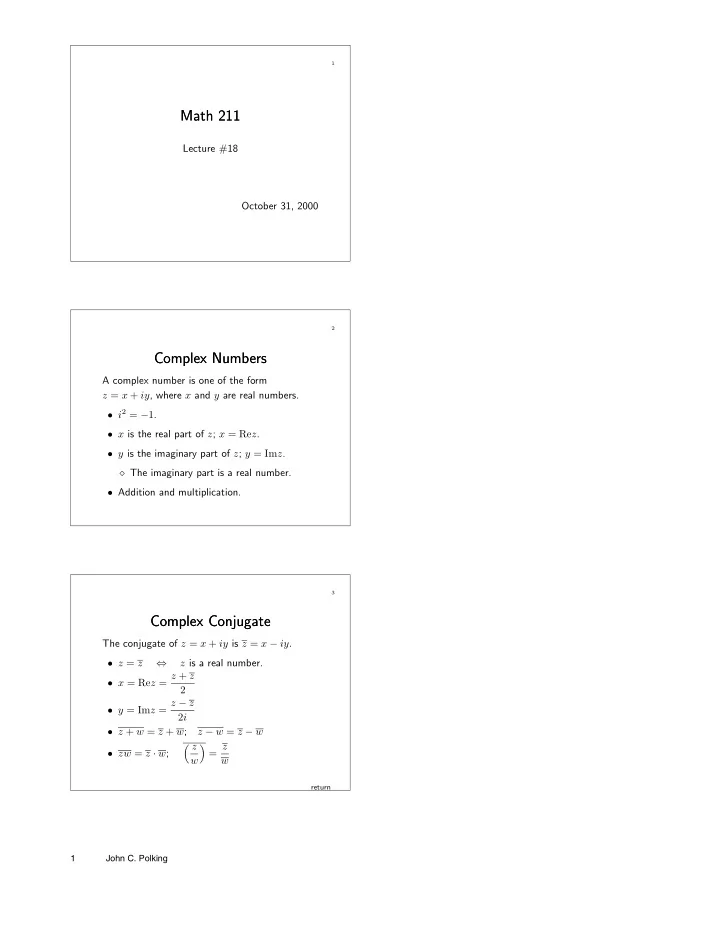
1 Math 211 Math 211 Lecture #18 October 31, 2000 2 Complex Numbers Complex Numbers A complex number is one of the form z = x + iy , where x and y are real numbers. i 2 = 1 . x is the real part of z ; x = Re z . y is the


slide-1
SLIDE 1

1

Math 211 Math 211

Lecture #18 October 31, 2000

2

Complex Numbers Complex Numbers

A complex number is one of the form z = x + iy, where x and y are real numbers.

  • i2 = −1.
  • x is the real part of z; x = Rez.
  • y is the imaginary part of z; y = Imz.

⋄ The imaginary part is a real number.

  • Addition and multiplication.

return

3

Complex Conjugate Complex Conjugate

The conjugate of z = x + iy is z = x − iy.

  • z = z

⇔ z is a real number.

  • x = Rez = z + z

2

  • y = Imz = z − z

2i

  • z + w = z + w;

z − w = z − w

  • zw = z · w;

z w

  • = z

w

1 John C. Polking

slide-2
SLIDE 2

4

Absolute Value Absolute Value

The absolute value of z = x + iy is the real number |z| =

  • x2 + y2.
  • z · z = |z|2 = x2 + y2.
  • |zw| = |z||w|
  • z

w

  • = |z|

|w|

5

Quotients Quotients

  • Reciprocal of z = x + iy

1 z = 1 z · z z = z zz = z |z|2 . 1 x + iy = x − iy x2 + y2

  • Quotient z/w

z w = z · 1 w = zw |w|2

6

Geometric Representation Geometric Representation

  • Complex plane.
  • Addition
  • Polar representation z = r[cos θ + i sin θ].

⋄ θ is the argument of z: tan θ = y/x. ⋄ r = |z|.

  • Euler’s formula eiθ = cos θ + i sin θ.

⋄ z = |z|eiθ

  • Multiplication

2 John C. Polking

slide-3
SLIDE 3

7

Complex Exponential Complex Exponential

For z = x + iy define ez = ex+iy = ex · eiy = ex[cos y + i sin y]. Properties:

  • ez+w = ez · ew;

ez−w = ez · e−w = ez/ew

  • ez = ez
  • |ez| = eRez
  • If λ is a complex number, then d

dteλt = λeλt

Conjugate return

8

Complex Matrices Complex Matrices

Matrices (or vectors) with complex entries inherit many of the properties of complex numbers.

  • M = A + iB where A = ReM and

B = ImM are real matrices.

  • M = A − iB;

M = M ⇔ M is real.

  • ReM = 1

2(M + M);

ImM = 1

2i(M − M)

  • M + N = M + N
  • Mz = Mz

Complex Matrices return

9

Consequences Consequences

A a real matrix; complex eigenvalue λ; associated eigenvector w, so Aw = λw

  • Aw = Aw = Aw.
  • λw = λw.

Aw = λw ⇒ λ is an eigenvalue of A with associated eigenvector w

  • λ = λ

⇒ w and w are linearly independent.

3 John C. Polking

slide-4
SLIDE 4

Complex Matrices Consequences

10

Solutions Solutions

z(t) = eλtw and z(t) = eλtw.

  • z and z are linearly independent complex

solutions to x′ = Ax.

  • z(t) = x(t) + iy(t)

& z(t) = x(t) − iy(t)

  • x(t) = 1

2(z(t)+z(t)) & y(t) = 1 2i(z(t)−z(t))

  • x(t) and y(t) are real valued solutions.
  • x(t) and y(t) are linearly independent.

return

11

Example Example

x′ = Ax where A = −5 20 −2 7

  • p(λ) = λ2 − 2λ + 5.
  • Eigenvalue: λ = 1 + 2i
  • Eigenvector: w =

3 − i 1

  • System

return

12

Complex Solutions Complex Solutions

z(t) = eλtw = e(1+2i)t 3 − i 1

  • z(t) = eλtw = e(1−2i)t

3 + i 1

  • 4

John C. Polking

slide-5
SLIDE 5

return Complex

13

Real Solutions Real Solutions

x(t) = Re(z(t)) = et 3 cos 2t + sin 2t cos 2t

  • y(t) = Im(z(t)) = et

3 sin 2t − cos 2t sin 2t

  • 14

Initial Value Problem Initial Value Problem

Solve x′ = Ax where A = −5 20 −2 7

  • with the intial condition

x(0) = 5 3

  • .

Real solutions

15

Initial Value Problem Initial Value Problem

Solution is u(t) = 3et 3 cos 2t + sin 2t cos 2t

  • + 4et

3 sin 2t − cos 2t sin 2t

  • = et

5 cos 2t + 15 sin 2t 3 cos 2t + 4 sin 2t

  • 5

John C. Polking

slide-6
SLIDE 6

return

16

Summary Summary

Suppose A is a real 2 × 2 matrix with

  • complex conjugate eigenvalues λ and λ, and
  • associated nonzero eigenvectors w and w.

Then

  • z(t) = eλtw and z(t) = eλtw form a complex

valued fundamental set of solutions, and

  • x(t) = Re(z(t)) and y(t) = Im(z(t)) form a

real valued fundamental set of solutions.

return

17

Double Real Root Double Real Root

λ = T ± √ T 2 − 4D 2 = T 2 .

  • T 2 − 4D = 0
  • Eigenspace has dimension 2: ⇒ A = λI.
  • Every vector is an eigenvector. Every solution

has the form x(t) = eλtv.

Degenerate return

18

Double Real Root Double Real Root

  • Eigenspace has dimension 1.
  • Standard procedure gives only one solution.

If v1 = 0 is an eigenvector, then x1(t) = eλtv1 is a solution.

  • The solution to the initial value problem

x′ = Ax with x(0) = x0 is x(t) = eλt[I + t(A − λI)]x0

6 John C. Polking

slide-7
SLIDE 7

return

19

Example Example

x′ = Ax where A = 1 9 −1 −5

  • p(λ) = λ2 + 4λ + 4 = (λ + 2)2;

λ = −2

  • A − λI =

3 9 −1 −3

  • ;

v1 = −3 1

  • One solution

x1(t) = eλtv1 = e−2t −3 1

  • .

Solution Example

20

Example (cont.) Example (cont.)

I + t(A − λI) = 1 + 3t 9t −t 1 − 3t

  • Solution with initial value x0 is

x(t) = e−2t 1 + 3t 9t −t 1 − 3t

  • x0.
  • Easy fundamental set of solutions

y1(t) = e−2t 1 + 3t −t

  • & y2(t) = e−2t
  • 9t

1 − 3t

  • .

Solution Example

21

Example (cont.) Example (cont.)

  • Fundamental set including x1(t)

⋄ Find v2 with (A − λI)v2 = v1. v2 = −1

x2(t) = eλt[v2 + tv1] = e−2t −1

  • + t

−3 1

  • 7

John C. Polking

slide-8
SLIDE 8

22

Summary Summary

Suppose A is a real 2 × 2 matrix with

  • a double real eigenvalue λ, and
  • the dimension of the eigenspace is one.

If v1 is an eigenvector, and if v2 satisfies (A − λI)v2 = v1, then

  • x1(t) = eλtv1 and x2(t) = eλt[v2 + tv1]

form a fundamental set of solutions.

  • the general solution is

x(t) = eλt[(C1 + C2t)v1 + C2v2].

8 John C. Polking