Marine Bird Impact Assessment Workshop 11.00-12.45 Collision Risk - - PowerPoint PPT Presentation

marine bird impact assessment workshop
SMART_READER_LITE
LIVE PREVIEW

Marine Bird Impact Assessment Workshop 11.00-12.45 Collision Risk - - PowerPoint PPT Presentation

Marine Bird Impact Assessment Workshop 11.00-12.45 Collision Risk Modelling Session Dr Alex Robbins Marine Ornithology Advisor 20 th February 2020 CRM Session Outline 1. Stochastic CRM - SNH 2. Stochastic CRM Worked Example - SNH 3.


slide-1
SLIDE 1

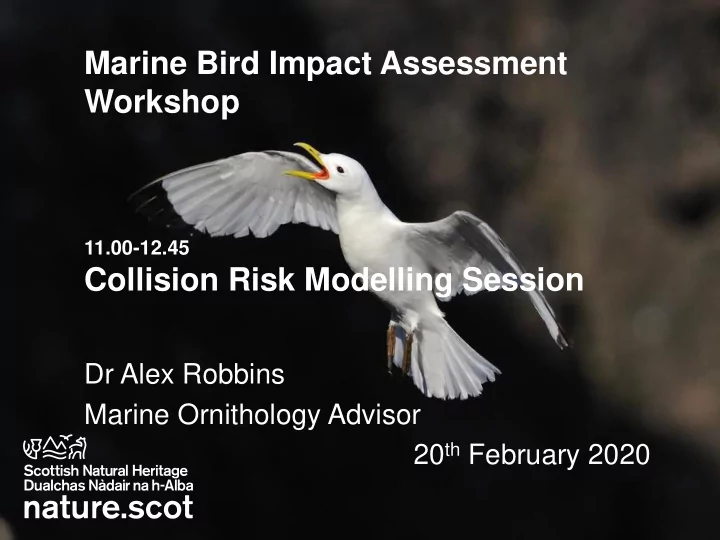
Marine Bird Impact Assessment Workshop

11.00-12.45

Collision Risk Modelling Session

Dr Alex Robbins Marine Ornithology Advisor 20th February 2020

slide-2
SLIDE 2

CRM Session Outline

  • 1. Stochastic CRM - SNH
  • 2. Stochastic CRM Worked Example - SNH
  • 3. Research update - MSS
  • 4. Issues and knowledge gaps – SNH/MSS
  • 5. Introduction to breakout session
slide-3
SLIDE 3

Stochastic CRM

− Preference to move to using a stochastic version

  • f the Band (2012) method e.g. MacGregor et al.

(2018). − A range of collision figures should be presented based on the confidence around input parameters. − The outputs from the basic Band model are always presented. − The extended model is not applied to species except black-legged kittiwake, herring gull, lesser and great black-backed gulls.

slide-4
SLIDE 4

https://dmpstats.shinyapps.io/avian_stochcrm/

Stochastic CRM – Worked Example

slide-5
SLIDE 5

Stochastic CRM – Worked Example

slide-6
SLIDE 6

Wind farm input parameters:

  • 1. MW per turbine not previously presented.
  • 2. Tidal correction - flight height is MSL and turbine

calculations are HAT.

  • 3. Monthly operational values now called wind

availability.

  • 4. Downtime and SD not previously presented.
  • 5. Rotational speed now one annual value with SD.
  • 6. Pitch SD not previously presented.

Stochastic CRM – Worked Example

slide-7
SLIDE 7

Stochastic CRM – Worked Example

slide-8
SLIDE 8

Stochastic CRM – Worked Example

slide-9
SLIDE 9

Stochastic CRM – Worked Example

slide-10
SLIDE 10

Stochastic CRM – Worked Example

slide-11
SLIDE 11

Bird Input parameters:

  • 1. How to calculate SD for monthly density estimates

(between years, transects)?

  • 2. Nocturnal activity scores…
  • 3. Currently no capacity to calculate species specific

seasons within shiny app

Stochastic CRM – Worked Example

slide-12
SLIDE 12

Species Band version Avoidance Rates Previous SNCB advice1 Band (2012) spreadsheet2 MacGregor et al. 2018 sCRM tool (mean ±SD)3 Northern gannet Basic 0.989 0.995 0.997 (± 0.002) Extended NA NA NA Black-legged kittiwake Basic 0.989 0.991 0.992 (± 0.007) Extended NA 0.980 0.967 (± 0.027) Lesser black-backed Basic 0.995 0.995 0.997 (± 0.002) gull Extended 0.990 0.993 0.992 (± 0.005) Herring gull Basic 0.995 0.995 0.997 (± 0.002) Extended 0.989 0.993 0.992 (± 0.005) Great black-backed Basic 0.995 0.995 0.997 (± 0.002) gull Extended 0.989 0.993 0.992 (± 0.005) Little gull (and other Basic 0.992 0.992 NA small gulls) Extended NA NA NA All other species Basic 0.980 0.980 NA Extended NA NA NA

1Joint Response from the Statutory Nature Conservation Bodies to Marine Scotland Science Avoidance Rate Review, 2014 2 Band, W. 2012.Using a collision risk model to assess bird collision risks for offshore windfarms. Report to the Crown Estate

Strategic Ornithological Support Services. Project SOSS-02. Thetford, British Trust for Ornithology.

3 Bowgen, K. & Cook, A., (2018), Bird Collision Avoidance: Empirical evidence and impact assessments, JNCC Report No. 614,

JNCC, Peterborough

Stochastic CRM – Avoidance Rates

slide-13
SLIDE 13

Stochastic CRM – Worked Example

Combined Outputs

slide-14
SLIDE 14

Stochastic CRM – Worked Example

slide-15
SLIDE 15

Stochastic CRM – Worked Example

slide-16
SLIDE 16

Stochastic CRM – Worked Example

slide-17
SLIDE 17

Stochastic CRM – Worked Example

slide-18
SLIDE 18

Collision Risk Modelling: Update on Marine Scotland Science projects Tom Evans

slide-19
SLIDE 19

Development of a stochastic collision risk model

  • Masden, E. (2015) Developing an avian collision risk model

to incorporate variability and uncertainty

– Developed from SOSS Band 2012 model – Implemented the Band model in R (based on code from Aonghais Cook) – Incorporates variation and uncertainty in input parameters – Produces collision estimates with uncertainty by running model many times and sampling from parameter distributions – Requires a good knowledge or R

https://data.marine.gov.scot/dataset/developing-avian-collision-risk- model-incorporate-variability-and-uncertainty

slide-20
SLIDE 20

Development of a user friendly tool: sCRM

  • R.M. McGregor, S. King, C. R. Donovan, B. Caneco, and
  • A. Webb (2018). A Stochastic Collision Risk Model for

Seabirds in Flight

– Based on Masden, E. (2015) R Code – Added user friendly interface (Shiny) – Code improvements – Web based interface available: http://dmpstats.shinyapps.io/avian_stochcrm/

https://www2.gov.scot/Topics/marine/marineenergy/mre/current/ StochasticCRM

slide-21
SLIDE 21

Recent refinements to the sCRM tool

  • C. R. Donovan, B. Caneco, and R.M. McGregor (2019/2020)

– Various issues raised via the GitHub page:

  • Update to Masden code to fix issues with how up and downwind

calculations used in option 3

  • Error in how flight height distribution was used (shifted by 1m)
  • Uploading a user-supplied bootstrap flight height distribution

– New facility to compare outputs directly with Band (2012) spreadsheet

  • Runs sCRM suppressing stochastic calculations
  • Requires running app locally – see GitHub page
  • Option 1 and 2 within 0.05% of Band estimates
  • Option 3 is within approximately 0.4%

https://github.com/dmpstats/stochCRM https://github.com/dmpstats/Masden_stochCRM

slide-22
SLIDE 22

Improving estimation of parameters used to estimate collision risk of seabirds with offshore wind farms

  • Marine Scotland with Crown Estate Scotland
  • Under procurement
  • …consider how existing data from GPS tracking of seabird species

may be analysed to improve estimation of key parameters in collision risk modelling: these are flight speed, flight height, and nocturnal activity rates

ab

slide-23
SLIDE 23

Study to examine how seabird collision risk, displacement and barrier effects could be integrated for assessment of offshore wind developments

Francis Daunt, Kate Searle, Deena Mobbs (CEH), Adam Butler (BioSS) Contributing via workshop: Aonghais Cook (BTO), Mark Trinder (MacArthur Green), Aly McCluskie (RSPB), Ross McGregor (HiDef), Carl Donovan & Bruno Caneco (DMP Statistical Solutions)

Summary

To develop a conceptual framework for simultaneous assessment of seabird collision risk, displacement and barrier effects when considering the potential impacts of offshore wind farm developments

Stage: Underway Funding:

Marine Offshore Renewable Energy branch (Marine Scotland Policy)

Collision & Displacement

slide-24
SLIDE 24

Current Issues and Knowledge Gaps

  • 1. New species in ScotWind DPO’s?
  • 2. Update required to the migratory CRM
  • 3. Provision of seasonal outputs
  • 4. Input parameters (as per this morning’s talk)
  • 5. Commercial roll out will require multiple inputs for

different scenarios – this is currently labour intensive.

  • 6. Some bug catching still ongoing within the Shiny

app.

slide-25
SLIDE 25