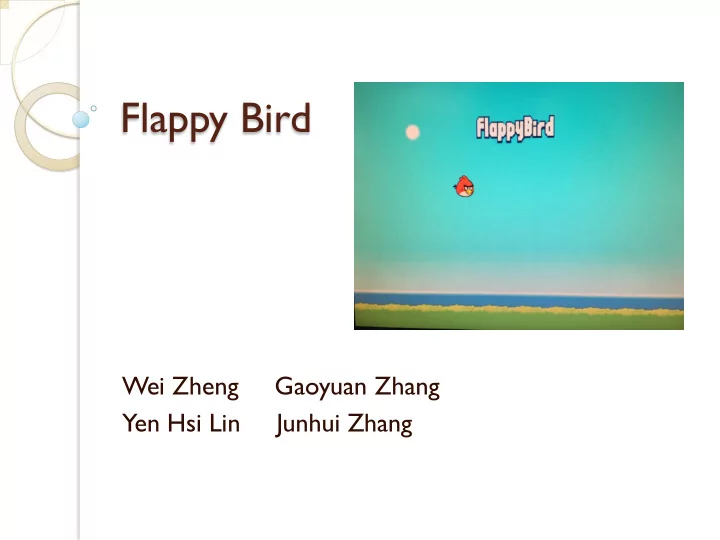
Flappy Bird Wei Zheng Gaoyuan Zhang Yen Hsi Lin Junhui Zhang - - PowerPoint PPT Presentation

flappy bird
SMART_READER_LITE
LIVE PREVIEW

Flappy Bird Wei Zheng Gaoyuan Zhang Yen Hsi Lin Junhui Zhang - - PowerPoint PPT Presentation

Flappy Bird Wei Zheng Gaoyuan Zhang Yen Hsi Lin Junhui Zhang Overview and Objectives Motivated by the flappy bird on cell phone Strategies: press the key to fly the bird the bird automatically falls down control the bird


slide-1
SLIDE 1

Flappy Bird

Wei Zheng Gaoyuan Zhang Yen Hsi Lin Junhui Zhang

slide-2
SLIDE 2

Overview and Objectives

— Motivated by the flappy bird on cell phone — Strategies:

press the key to fly the bird the bird automatically falls down control the bird through the pipes with random heights fly as far as possible to get high scores

— Combine the elements of other games — Objectives:

make all things work together without bugs

slide-3
SLIDE 3

Overview and Objectives

slide-4
SLIDE 4

Overview and Objectives

— Image processing

pre-process the images to use Generate a memory initialization file for each image Single-port ROM memory blocks 24-bit index color

— Audio processing

pre-process the audios Generate a memory initialization file for each audio Single-port ROM memory blocks 44100Hz sampling rate 16-bit quantization

slide-5
SLIDE 5

Architecture

slide-6
SLIDE 6

VGA DISPLAY MODULE

slide-7
SLIDE 7

Audio Controller

slide-8
SLIDE 8

Keyboard Controller

— Use libusb C library to communicate with

USB keyboard

— Spawn one thread to receive signal from

Keyboard, leaving the main program to handle the sprite control

slide-9
SLIDE 9

Game Logic

— Interaction between user and hardware

  • User: keyborad
  • Hardware: vga and audio controller

— Do the computation and control the

game

  • Generate the height of pipes randomly
  • Control the up and down of bird
  • Control when the game is over
slide-10
SLIDE 10

Experience and issues in implementation

— Sprite background elimination

(when displaying scores, bird, and sun)

  • Simple color: check RGB value in ROM if it is

equal to background value.

  • Complex color: No efficient way to eliminate

the background color.

slide-11
SLIDE 11

Experience and issues in implementation

— Sprite for pillars

  • In order to realize pillars with different length using only one

sprite, we capture a sprite of “partial pillar”, with relatively small height, and combine a certain number of such sprites to form a pillar whose length is what we want.

— Priority of sprites

  • We set the priority of each sprites so that the screen will show

the correct image when sprites overlap with each other.

— Frame update synchronization

  • Receive and update coordination during synchronization

vcount>480

slide-12
SLIDE 12

Experience and issues in implementation

— Control signal to display the title

We use one bit (first bit) of the 8-bit input as the signal to control if the title “flappy bird” is displayed or not, so that we can add more control signals by only introducing one input signal.

— Problem

  • Don’t have enough space of RAM to add

more signals.

slide-13
SLIDE 13

Experience and issues in implementation

— Game logic :

Time

  • System clock data type is not available in

calculation, ex: clock()

  • Implement counter: loop number as time unit

collaborating with delay, ex: usleep()

— Game logic : Status

  • Status variable: record jumping and falling
  • Status variable cooperates with initial velocity

supporting continuous jumping without multi- thread

slide-14
SLIDE 14

Experience and issues in implementation

— Game logic : pillar display

  • We combine the display of pillar with the check

condition ( whether the pillar is on the screen or not ), and reset the coordinate of the pillar once the condition is triggered.

slide-15
SLIDE 15

Lesson learned

— Sprite implementation — Hardware and software collaboration — Time management — Architecture design of SoCKit board