Managing Stress On and Off The Field How to Shut It Off and Go Home - - PowerPoint PPT Presentation

managing stress on and off the field
SMART_READER_LITE
LIVE PREVIEW

Managing Stress On and Off The Field How to Shut It Off and Go Home - - PowerPoint PPT Presentation

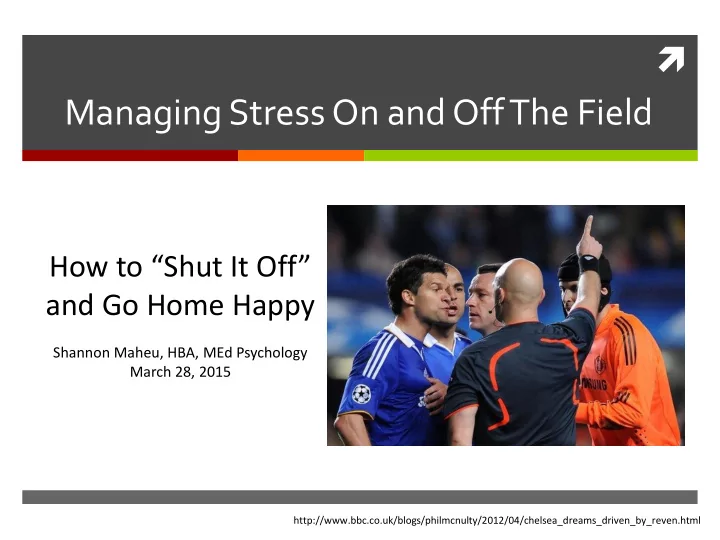
Managing Stress On and Off The Field How to Shut It Off and Go Home Happy Shannon Maheu, HBA, MEd Psychology March 28, 2015 http://www.bbc.co.uk/blogs/philmcnulty/2012/04/chelsea_dreams_driven_by_reven.html Qualities of an Effective

slide-1
SLIDE 1

Managing Stress On and Off The Field

How to “Shut It Off” and Go Home Happy

Shannon Maheu, HBA, MEd Psychology March 28, 2015

http://www.bbc.co.uk/blogs/philmcnulty/2012/04/chelsea_dreams_driven_by_reven.html

slide-2
SLIDE 2

Qualities of an Effective Referee

  • 1. Reliability
  • 2. Communication
  • 3. Decisive thinking
  • 4. Elegance
  • 5. Integrity
  • 6. Common sense
  • 7. Confidence
  • 8. Motivation

Based on FIFA Standards & sport psychology research

slide-3
SLIDE 3

The Reality of Refereeing…???

 A referee is a necessary evil in the world of sports &

recreation?

 Refereeing is the worst job in sport, yet provides the

best seat in the house?

 Few people opt to take up the whistle and be the

‘person’ in the middle? WHY?

slide-4
SLIDE 4

 Stress is our body’s response

to any demand made on it

 The physical and mental

arousal to circumstances that we perceive as threatening or challenging

 The trigger that prompts the

stressful reaction is called a ST STRESS SSOR

What is Stress?

slide-5
SLIDE 5

Why talk about stress?

Stress from officiating has profound impacts on a referee’s mental health, attentional focus, performance, satisfaction with their profession & dropout intentions.

(Goldsmith & Williams, 1992)

“The stress level among referees is the same as for players and coaches or other top athletes”

(Associate Professor Bjørn Tore Johansen, U of Agder)

slide-6
SLIDE 6

Let’s have at it…

  • 1. Prior to a match, do you have a set routine that you

do?

  • 2. During the match, list some causes that might raise

your stress or anxiety?

  • 3. On a scale of 1-10 (1=low; 10=high), rate your post

game stress levels (on average).

  • 4. What do you do to combat stress in your refereeing?
slide-7
SLIDE 7

Pressure…Pressure…Pressure…

 There is so much pressure!

Players Coaches Spectators Administrators Other referees Previous results Weather Yourself

Photo source: http://rsrc.psychologytoday.com/files/imagecache/article-inline- full/article/2011/12/81766-74127.jpg

slide-8
SLIDE 8

Co Cogn gnit itiv ive e Th Theory ry of St Stre ress

A person’s appraisal of a situation determines whether

  • r not it will be stressful

Personal Stress Organizational Stress Competitive Stress

Sources of Stress: ON & OFF the Field

Causal Agent

  • Good?
  • Bad?

Appraisal

  • Challenge?
  • Threat?

Response

  • Cope – yes?
  • Cope – no?

Image source:http://www.lightbearers.org/fight-or-flight/

slide-9
SLIDE 9

 Stress if coping resources are inadequate  Our stress responses can be seen as:

 Physiological – increased blood pressure, flushed

cheeks, headache

 Emotional – anxiety, fear, grief, excitement  Behavioural – ways to behave in order to resolve

the conflict

How do we know we are stressed?

slide-10
SLIDE 10

Top Stressors for Sport Referees?

 Making incorrect/controversial calls,  Positional concerns,  Abuse from coaches, players  Pressure of game  Conflict between their officiating and life outside

refereeing (i.e. family and/or work)

Voight, M. (2008) Sources of Stress & coping strategies of US soccer officials. Stress & Health 25, 91-101.

79% of soccer referees (UK) experienced physical

  • r verbal threats on

at least one occasion during their

  • fficiating?
slide-11
SLIDE 11

Why is stress so difficult to deal with?

ON THE FIELD

 Lack of time to deal  Fatigue  Need to focus on tasks  Lack of knowledge of stress  Lack of coping skills  Denial

OFF THE FIELD

slide-12
SLIDE 12

How do You Cope with Stress?

slide-13
SLIDE 13

Stress-Training for Officiating

 Time Management Skills Training – focuses on getting

  • rganized, prioritization of tasks

 Checklists, prioritizing & saying ‘no’

 Cognitive/Mental Skills Training – focuses on changing

negative and irrational thoughts; focuses on preparation, coping & decision-making abilities

 Imagery, self talk, relaxation breathing

Weinberg & Richardson (1990), Psychology of Officiating

slide-14
SLIDE 14

Stress-Busting Techniques

“Effective coping with stressful situations in officiating can serve as a buffer against burnout”

Have a pre-game routine Relaxation breathing & imagery Psyching up – It’s crunch time! Humour Socialize with Stressors

(if they are people)

Have a post-game routine

slide-15
SLIDE 15

Wrap – Up!