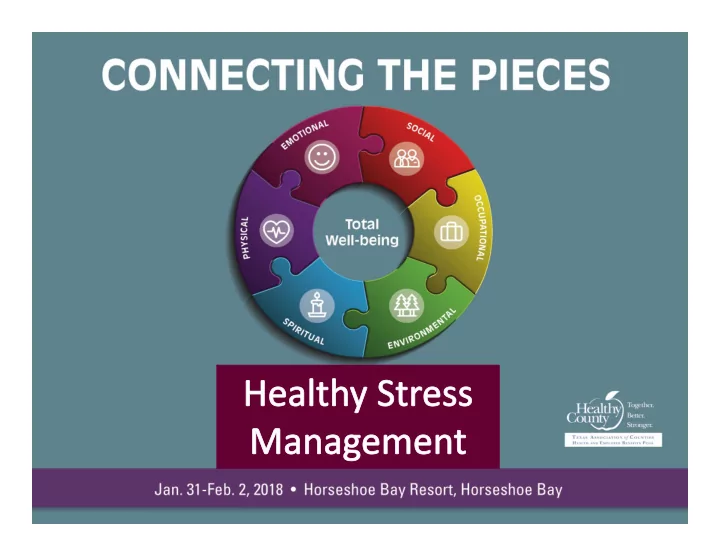
Objectives 1. Define Stress and Occupational Stress 2. Learn the - - PowerPoint PPT Presentation

objectives
SMART_READER_LITE
LIVE PREVIEW

Objectives 1. Define Stress and Occupational Stress 2. Learn the - - PowerPoint PPT Presentation

Objectives 1. Define Stress and Occupational Stress 2. Learn the Importance of Healthy Stress Management 3. Identify Strategies and Skills to Promote Healthy Stress Management 4. Identify Ways to Implement Policies that will Promote and Support a


slide-1
SLIDE 1
slide-2
SLIDE 2

Objectives

  • 1. Define Stress and Occupational Stress
  • 2. Learn the Importance of Healthy Stress Management
  • 3. Identify Strategies and Skills to Promote Healthy Stress

Management

  • 4. Identify Ways to Implement Policies that will Promote

and Support a Culture of Healthy Stress Management in the workplace

slide-3
SLIDE 3

What is Stress?

  • Definition:
  • 1c. a physical, chemical, or emotional factor that

causes bodily or mental tension and may be a factor in disease causation (Merriam Webster Dictionary)

slide-4
SLIDE 4

What is Occupational Stress?

  • Definition:
  • Job‐related stress, which comes from occupational

duties for which people perceive themselves as having a great deal of responsibility, yet little to no authority or decision making latitude (Rosch, 1991)

  • All time high nationally
  • $200 billion/year
  • 90% of workers comp claims can be attributed to

stress

slide-5
SLIDE 5
slide-6
SLIDE 6
  • 2013 Harris Survey: 83% of American Workers claim

to be stressed out (Perman, 2013)

  • Reasons:
  • Low Pay
  • Unreasonable Workloads
  • Annoying Co‐Workers
  • Poor Work‐Life Balance
  • Fear of Being Fired or Laid off

BURNOUT

slide-7
SLIDE 7
slide-8
SLIDE 8
slide-9
SLIDE 9
slide-10
SLIDE 10
slide-11
SLIDE 11

Why is Healthy Stress Management Important?

  • 1. Links between Stress and Health Disorders
  • Target Organs
  • Nervous System Disorders
  • Immune System Disorders
  • Type 2 Diabetes
slide-12
SLIDE 12

Target Organs

  • Any organ or tissue that receives excess neural or

hormonal stimulation increase in metabolic function or abnormal cell growth  dysfunction or

  • rgan or tissue
  • One or multiple organs can be targeted
slide-13
SLIDE 13
slide-14
SLIDE 14

Target Organs

  • Any organ or tissue that receives excess neural or

hormonal stimulation increase in metabolic function or abnormal cell growth  dysfunction or

  • rgan or tissue
  • One or multiple organs can be targeted
  • Theory: connection between genetics, emotions,

personality, and culture

slide-15
SLIDE 15

Nervous System

  • Organs are unable to rest due to excessive

secretion of stress hormones

  • Excessive secretion can cause dysfunction of the
  • rgan
slide-16
SLIDE 16
slide-17
SLIDE 17

Immune System

  • Body becomes vulnerable because cortisol (stress

hormone) decreases the effectiveness of white blood cells

slide-18
SLIDE 18
slide-19
SLIDE 19

Type 2 Diabetes

  • Many chronic emotional problems are associated

with the cause or causes of the disease

  • How?
  • 1. Stress response, blood sugar levels increase. The ability to

absorb blood glucose in compromised

  • 2. Chronic stress can serve as a distraction to self‐care
slide-20
SLIDE 20
slide-21
SLIDE 21

Type 2 Diabetes

  • Many chronic emotional problems are associated

with the disease etiology

  • How?
  • 1. Stress response, blood sugar levels increase. The ability to

absorb blood glucose in compromised

  • 2. Chronic stress can serve as a distraction to self‐care
  • Solution
  • Effective coping skills and relaxation techniques
slide-22
SLIDE 22
slide-23
SLIDE 23
slide-24
SLIDE 24

Why is Healthy Stress Management Important?

  • 1. Links between Stress and Health Disorders
  • Target Organs
  • Nervous System Disorders
  • Immune System Disorders
  • Type 2 Diabetes
  • 2. Lifestyle Disruptions
slide-25
SLIDE 25
slide-26
SLIDE 26
slide-27
SLIDE 27

Strategies to Promote Healthy Stress Management

  • Know the underlying emotion related to stressor
  • Anger
  • Fear
  • Know your coping style
  • Avoidance vs Confrontation
  • Combative vs Preventive
slide-28
SLIDE 28

Skills to Promote Healthy Stress Management

  • Know the underlying emotion related to stressor
  • Anger
  • Fear
  • Know your coping style
  • Avoidance vs Confrontation
  • Combative vs Preventive
  • Determine a coping strategy for each stressor
  • Coping strategies are either action‐oriented or self‐

reflection

slide-29
SLIDE 29

Action‐Oriented Coping Strategies

  • Time Management
  • Prioritizing
  • Urgent vs. Important
  • Money Management
  • Boundaries‐ when to say no
  • Relationship Skills
  • Communication skills
slide-30
SLIDE 30

Strategies to Promote Healthy Stress Management

  • Journal Writing
  • Expressive Art Therapy
  • Humor
  • Creative Problem Solving
  • Communication Skills
  • Communicate Expectations
  • Conflict Resolution
slide-31
SLIDE 31
slide-32
SLIDE 32

Healthy Stress Management in the Workplace

slide-33
SLIDE 33
slide-34
SLIDE 34
slide-35
SLIDE 35
slide-36
SLIDE 36

Name the issue/Put it on the table Jointly identify possible drivers

  • f the conflict

Identify common interests and goals Together, brainstorm possible solutions Make sure the solution addresses each parties’ interest Determine how to effectively execute the solution

Conflict Resolution Model

slide-37
SLIDE 37
slide-38
SLIDE 38
slide-39
SLIDE 39

So Next Time….

slide-40
SLIDE 40

Sources

  • Managing Stress: Principles and Strategies for Health and Well Being (2015), Brian Luke Seward.
  • Burnout: https://www.concorde.edu/wp‐content/uploads/2016/04/overcoming_burnout.jpg
  • Fear: http://www.rich‐hansen.com/wp‐content/uploads/2016/02/FEAR.jpg
  • Anger: http://www.midtownmarriageandfamilytherapy.com/wp‐content/uploads/2012/04/hulk‐large.jpg
  • Migraine: https://greatist.com/sites/default/files/styles/article_main/public/Overshare_Migraine_Vice.gif?itok=DYUK9fqP
  • Common Cold: http://rs945.pbsrc.com/albums/ad294/doctorravindra/Common‐cold‐remedy_flu.jpg?w=280&h=210&fit=crop
  • Type 2 Diabetes: https://www.diabetes.co.uk/body/
  • Stress and the Body: http://peaandthepodchiropractic.com/wp‐content/uploads/2015/12/stress4.png
  • Hair Loss: http://beyondgoodhealthclinics.com.au/wp‐content/uploads/2016/02/hair‐loss‐stress‐alternative‐medicine‐practitioner‐brisbane.jpg
  • Sleep: https://azonelife.files.wordpress.com/2010/01/stresscycle.jpg
  • Weight Gain: https://ultra106five.com/2016/11/15/emotional‐eating‐the‐vicious‐cycle/
  • Pain: https://sepitajima.com/wp‐content/uploads/2015/08/Letting‐go‐300x300.png
  • Investment in People: http://jeffkortes.com/wp‐content/uploads/2015/04/people‐are‐your‐best‐investment.jpg
  • Policies: https://www.cuboardmembers.com/images/large_policies.jpg
  • Conflict Resolution: http://slideplayer.com/slide/7101134/24/images/23/Conflict+Resolution+Model.jpg
  • Time Management: https://www.wanderlustworker.com/wp‐content/uploads/2015/06/TIME‐MANAGEMENT.jpg
  • Boundaries: https://sepitajima.com/wp‐content/uploads/2015/04/Set‐Healthy‐Boundaries‐Quote.png