SLIDE 1 Ludgate’s Analytical Machine: Irish Logarithms
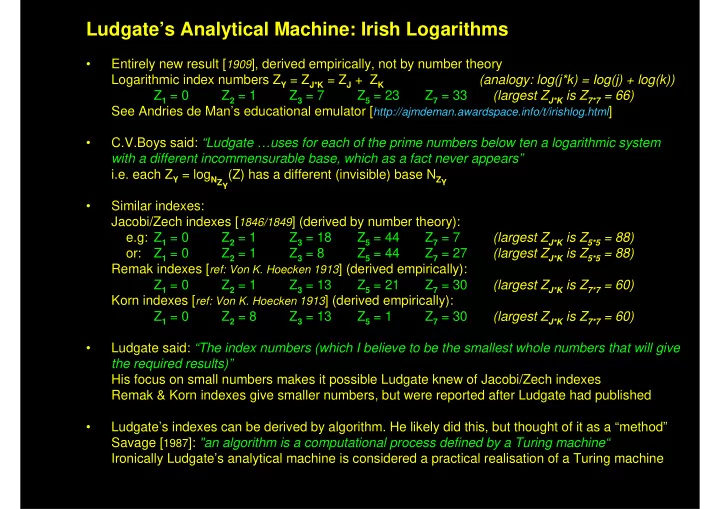
- Entirely new result [1909], derived empirically, not by number theory
Logarithmic index numbers ZY = ZJ*K = ZJ + ZK (analogy: log(j*k) = Iog(j) + log(k)) Z1 = 0 Z2 = 1 Z3 = 7 Z5 = 23 Z7 = 33 (largest ZJ*K is Z7*7 = 66) See Andries de Man’s educational emulator [http://ajmdeman.awardspace.info/t/irishlog.html]
- C.V.Boys said: “Ludgate …uses for each of the prime numbers below ten a logarithmic system
with a different incommensurable base, which as a fact never appears” i.e. each ZY = logNZY(Z) has a different (invisible) base NZY
Jacobi/Zech indexes [1846/1849] (derived by number theory): e.g: Z1 = 0 Z2 = 1 Z3 = 18 Z5 = 44 Z7 = 7 (largest ZJ*K is Z5*5 = 88)
Z1 = 0 Z2 = 1 Z3 = 8 Z5 = 44 Z7 = 27 (largest ZJ*K is Z5*5 = 88) Remak indexes [ref: Von K. Hoecken 1913] (derived empirically): Z1 = 0 Z2 = 1 Z3 = 13 Z5 = 21 Z7 = 30 (largest ZJ*K is Z7*7 = 60) Korn indexes [ref: Von K. Hoecken 1913] (derived empirically): Z1 = 0 Z2 = 8 Z3 = 13 Z5 = 1 Z7 = 30 (largest ZJ*K is Z7*7 = 60)
- Ludgate said: “The index numbers (which I believe to be the smallest whole numbers that will give
the required results)” His focus on small numbers makes it possible Ludgate knew of Jacobi/Zech indexes Remak & Korn indexes give smaller numbers, but were reported after Ludgate had published
- Ludgate’s indexes can be derived by algorithm. He likely did this, but thought of it as a “method”
Savage [1987]: "an algorithm is a computational process defined by a Turing machine“ Ironically Ludgate’s analytical machine is considered a practical realisation of a Turing machine
SLIDE 2
- All these products derive ultimately from primes, so start with first prime J=1 by assigning Z1=0
Index [0] is now used, so for next prime p=2 the indexes Z2+[0] must be free All indexes above 0 are free, so assign Z2=1
- Then recursively for all products ≤ 9*9=81 for which an index exists, assign a logarithmic index ZJ*K = ZJ + ZK
Z4=Z2*2=Z2+Z2=1+1=2 Z8=Z2*4=Z2+Z4=1+2=3 Z16=Z4*4=Z4+Z4=2+2=4 Z32=Z4*8=Z4+Z8=2+3=5 Z64=Z8*8=Z8+Z8=3+3=6
- Indexes [1,2,3] are now used for 1<Y<9
So for next prime p=3 the indexes Z3+[0,1,2,3] must be free All indexes above 6 are free, so assign Z3=7
- Then recursively for all products ≤ 9*9=81 for which an index exists, assign a logarithmic index ZJ*K = ZJ + ZK
Z6=Z3*2=Z3+Z2=7+1=8 Z9=Z3*3=Z3+Z3=7+7=14 Z12=Z3*4=Z3+Z4=7+2=9 Z18=Z3*6=Z3+Z6=7+8=15 Z24=Z3*8=Z3+Z8=7+3=10 Z27=Z3*9=Z3+Z9=7+14=21 Z36=Z6*6=Z6+Z6=8+8=16 Z48=Z6*8=Z6+Z8=8+3=11 Z54=Z6*9=Z6+Z9=8+14=22 Z72=Z8*9=Z8+Z9=3+14=17 Z81=Z9*9=Z9+Z9=14+14=28
- Indexes [1,2,3,7,8,14] are now used for 1<Y<9
So for next prime p=5 the indexes Z5+[0,1,2,3,7,8,14] must be free The next free index for which this is so is Z5=23+[1,2,3,7,8,14], i.e. 23,24,25,26,30,31,37, the indexes are all free, so assign Z5=23
- Then recursively for all products ≤ 9*9=81 for which an index exists, assign a logarithmic index ZJ*K = ZJ + ZK
Z10=Z5*2=Z5+Z2=23+1=24 Z15=Z5*3=Z5+Z3=23+7=30 Z20=Z5*4=Z5+Z4=23+2=25 Z25=Z5*5=Z5+Z5=23+23=46 Z30=Z5*6=Z5+Z6=23+8=31 Z40=Z5*8=Z5+Z8=23+3=26 Z45=Z5*9=Z5+Z9=23+14=37
- Indexes [1,2,3,7,8,14,23] are now used for 1<Y<9
So for next prime p=7 the indexes Z7+[0,1,2,3,7,8,14,23] must be free The next free index for which this is so is Z7=33+[1,2,3,7,8,14,23], i.e. 33,34,35,36,40,41,47,56, the indexes are all free, so assign Z7=33
- Then recursively for all products ≤ 9*9=81 for which an index exists, assign a logarithmic index ZJ*K = ZJ + ZK
Z14=Z7*2=Z7+Z2=33+1=34 Z21=Z7*3=Z7+Z3=33+7=40 Z28=Z7*4=Z7+Z4=33+2=35 Z35=Z7*5=Z7+Z5=33+23=56 Z42=Z7*6=Z7+Z6=33+8=41 Z49=Z7*7=Z7+Z7=33+33=66 Z56=Z7*8=Z7+Z8=33+3=36 Z63=Z7*9=Z7+Z9=33+14=47
- So for 1<Y<9, Indexes [1,2,3,7,8,14,23,33] are now used
The only unused integer is Y=0, and although log(0) does not exist, here multiply by 0 must be valid, so Z0+[1,2,3,7,8,14,23,33] must be free The next free index for which this is so is Z0=50+[1,2,3,7,8,14,23,33], i.e. 50,51,52,53,57,58,64,73,83 the indexes are all free, so assign Z0=50
- Then recursively for all products ≤ 9*9=81 for which an index exists, assign a logarithmic index ZJ*K = ZJ + ZK
Z02=Z0*2=Z0+Z2=50+1=51 Z03=Z0*3=Z0+Z3=50+7=57 Z04=Z0*4=Z0+Z4=50+2=52 Z05=Z0*5=Z0+Z5=50+23=73 Z06=Z0*6=Z0+Z6=50+8=58 Z07=Z0*7=Z0+Z7=50+33=83 Z08=Z0*8=Z0+Z8=50+3=53 Z09=Z0*9=Z0+Z9=50+14=64 Z00=Z0*0=Z0+Z0=50+50=100
How to derive Ludgate’s simple index numbers:
For all products Y = (1<J<9) * (1<K<9) assign logarithmic index numbers ZY = ZJ*K = ZJ + ZK (ANALOGY: log(j*k) = Iog(j) + log(k))
SLIDE 3
How to derive Ludgate’s simple index numbers:
For all products Y = (1<J<9) * (1<K<9) assign logarithmic index numbers ZY = ZJ*K = ZJ + ZK (ANALOGY: log(j*k) = Iog(j) + log(k))
#!/usr/bin/env python import sys # initialise variables Z=[-1]*200 # table of complex indexes PP=[-1]*200 # table of partial products i = 0; for p in (1,2,3,5,7,0): if Z[p]==-1: # prime not indexed yet free=False while free==False and i<=100: free=True for j in (1,2,3,4,5,6,7,8,9): if free==True: if Z[j]<>-1: # for existing indexes for k in range (1,100): if Z[k]==(i+Z[j]): # check if complex index exists free=False i=i+1 if free==True: # OK, found a desired free set of indexes Z[p]=i # create new simple index PP[i]=p # create new partial product i=i+1 for j in (1,2,3,4,5,6,7,8,9,0): if Z[j]<>-1: # multiplicand simple index exists for k in (1,2,3,4,5,6,7,8,9,0): if Z[k]<>-1: # multiplier simple index exists if PP[Z[j]+Z[k]]==-1: # product not indexed yet if Z[j*k]==-1: Z[j*k]=Z[j]+Z[k] # create new complex index PP[Z[j]+Z[k]]=j*k # create new partial product
SLIDE 4 How to derive Ludgate’s simple index numbers:
For all products Y = (1<J<N) * (1<K<N) assign logarithmic index numbers ZY = ZJ*K = ZJ + ZK (ANALOGY: log(j*k) = Iog(j) + log(k))
#!/usr/bin/env python import sys def create_primes(n): # simple Sieve of Eratosthenes
sieve = set(sum([range(q*q, n+1, q+q) for q in odds],[])) return [1,2] + [p for p in odds if p not in sieve] # initialise variables size=10 sizesq=size*size arraysize=2*sizesq Z=[-1]*arraysize # table of complex indexes PP=[-1]*arraysize # table of partial products primes=create_primes(size-1) primes_and_zero=primes + [0] integers=range(1,size) integers_and_zero=integers + [0] i = 0; for p in primes_and_zero: if Z[p]==-1: # prime not indexed yet free=False while free==False and i<=sizesq: free=True for j in integers: if free==True: if Z[j]<>-1: # for existing indexes for k in range (1,sizesq): if Z[k]==(i+Z[j]): # check if complex index exists free=False i=i+1 if free==True: # OK, found a desired free set of indexes Z[p]=i # create new simple index PP[i]=p # create new partial product i=i+1 for j in integers_and_zero: if Z[j]<>-1: # multiplicand simple index exists for k in integers_and_zero: if Z[k]<>-1: # multiplier simple index exists if PP[Z[j]+Z[k]]==-1: # product not indexed yet if Z[j*k]==-1: Z[j*k]=Z[j]+Z[k] # create new complex index PP[Z[j]+Z[k]]=j*k # create new partial product
Irish Logarithms exist for the range up to any N, not just for 0-9 as in Ludgate’s paper
SLIDE 5
final Ludgate Simple Index for each Unit (Table 1): 0: 50 1: 0 2: 1 3: 7 4: 2 5: 23 6: 8 7: 33 8: 3 9: 14 final Ludgate Complex Index for each Partial Product (Table 2): 1: 0 2: 1 3: 7 4: 2 5: 23 6: 8 7: 33 8: 3 9: 14 10: 24 12: 9 14: 34 15: 30 16: 4 18: 15 20: 25 21: 40 24: 10 25: 46 27: 21 28: 35 30: 31 32: 5 35: 56 36: 16 40: 26 42: 41 45: 37 48: 11 49: 66 54: 22 56: 36 63: 47 64: 6 72: 17 81: 28 final Ludgate Partial Product for each Complex Index (Table 3): 0: 1 1: 2 2: 4 3: 8 4: 16 5: 32 6: 64 7: 3 8: 6 9: 12 10: 24 11: 48 12: 13: 14: 9 15: 18 16: 36 17: 72 18: 19: 20: 21: 27 22: 54 23: 5 24: 10 25: 20 26: 40 27: 28: 81 29: 30: 15 31: 30 32: 33: 7 34: 14 35: 28 36: 56 37: 45 38: 39: 40: 21 41: 42 42: 43: 44: 45: 46: 25 47: 63 48: 49: 50: 0 51: 0 52: 0 53: 0 54: 55: 56: 35 57: 0 58: 0 59: 60: 61: 62: 63: 64: 0 65: 66: 49 67: 68: 69: 70: 71: 72: 73: 0 74: 75: 76: 77: 78: 79: 80: 81: 82: 83: 0 84: 85: 86: 87: 88: 89: 90: 91: 92: 93: 94: 95: 96: 97: 98: 99: 100: 0
How to derive Ludgate’s simple index numbers:
For all products Y = (1<J<9) * (1<K<9) assign logarithmic index numbers ZY = ZJ*K = ZJ + ZK (ANALOGY: log(j*k) = Iog(j) + log(k))
SLIDE 6 Ludgate’s Analytical Machine: performance
Assume it takes 1 tick to rotate a counting wheel by a 1/10 turn
- For Babbage: to multiply two n-digit numbers takes:
- max. 9n adds, each taking max. 9 ticks
- max. n carryadds, each taking max. 9 ticks
So to multiply two n-digit numbers takes max. (90n) ticks To multiply two 20-digit numbers takes max. (1800) ticks
- According to Ludgate: to multiply two n-digit numbers takes:
n multiplies, each taking TM ticks 2n adds, each taking max. 9 ticks n carryadds, each taking max. 1 tick So to multiply two n-digit numbers takes max. (n*TM + 19n) ticks To multiply two 20-digit numbers takes max. (n*TM + 380) ticks
- Note: 2n adds would require 2n carryadds and max. n*TM + 20n) ticks
BUT only 1 carryadd (for units) is visible !
- The timing implies overlapping tens carryadds with following multiplies !
i.e. PIPELINING 30 years before its simple use in Zuse’s Z1 & Z3 computers 60 years before its use in supercomputers
- Fast for 1909. Ludgate said:
add/sub: 3 sec, mul: 20sec, div: 90sec, log: 120sec, an: 210sec NB: this all ignores time taken shifting the Mill carriage
SLIDE 7 Ludgate’s Analytical Machine: data format (1)
- Are numbers left or right justified ?
- Ludgate said [where iLog(8132)=3071 and iLog(0)=50]:
“the first four slides will therefore move 3, 0, 7, and 1 units respectively, the remainder of the slides indicating zero by moving 50 units."
- Does “first four” imply numbers are right-justified?
NO:- since if “remainder” was all leading zeroes, why say “first four” ? (5th wouldn’t exist)
“Another slide moves … to the simple index number of the first digit of the multiplier” This (and more) says long multiply starts with the multiplier left digit
- But does that imply numbers are left-justified?
MAYBE:- since then both the multiply and its data are left-justified
- BUT there is a problem with left-justification:
decimal point position must be known !!!
- therwise “1” means any of 100 to 1020
SLIDE 8 Ludgate’s Analytical Machine: data format (2)
- There are three situations where decimal point position must be known:
(a) if numbers are floating-point (b) if numbers are fixed-point (c) if numbers are left-justified
"the position of the decimal point in a product is determined by special mechanism which is independent of both mill and index." Hence decimal point WAS an issue for Ludgate !
- BUT Ludgate also said only digits and sign were stored in a shuttle:
“rods for every figure of the Variable, and one to indicate the sign” Hence no rod was used for decimal point
- Without rods for decimal point, floating-point or left-justified numbers cannot be used
Hence numbers must be FIXED-POINT
- This implies the decimal point was assumed in sources and determined in results
For example, assuming decimal point at digit 10 would allow a good exponent range: ±1000000000.0000000000+8 = ±1.0x10+17 ±0000000000.0000000001-8 = ±1.0x10⁻¹⁸ In this case Ludgate’s “first four” digits are the first of 14 significant digits
- Ludgate’s “special mechanism” must skip leading zeroes and shift results as needed
SLIDE 9 Ludgate’s Analytical Machine: arithmetic instruction format
"Each row of perforations across the formula-paper directs the machine in some definite step in the process of calculation—such as, for instance, a complete multiplication, including the selection of the numbers to be multiplied together." Hence each row of the formula tape specifies one instruction
- And the arithmetic instruction format must contain:
- pcode = ADD | SUB | MUL | DIV
6-bit inner shuttle source operand addresses 7-bit outer shuttle source operand addresses
- Ludgate also said: “I have also introduced a logarithmic cylinder which has the power of
working out the logarithmic formula, just as the dividing cylinder directs the dividing process. This system of auxiliary cylinders and tables for special formulae may be indefinitely extended.” While LOG could act on Mill contents, that could not be “indefinitely extended” to an etc To do that, “special formulae” instructions must be able to address operand shuttles Hence for each “special formulae”, a separate instruction must exist:
6-bit inner shuttle source operand addresses 7-bit outer shuttle source operand addresses
SLIDE 10 Ludgate’s Analytical Machine: divide, log
- Divide very novel for 1909:
Approximate the answer Then use algorithm to successively converge to correct answer
SHOW HOW !!!
- This algorithm uses just multiply & add
- Approximate answers were stored on a special “divider cylinder”
- This approach is common in modern computing, although the algorithms are different
- Ludgate said:
“extended this system to the logarithmic series … also introduced a logarithmic cylinder”
SLIDE 11 Ludgate’s Analytical Machine: store instruction format
"until the whole product A*B is found. The shuttles are afterwards replaced in the shuttle-boxes, the latter being then rotated until the second shuttles of both boxes are opposite to the shuttle-
- race. These shuttles are brought to the index, as in the former case, and the product of their
Variables (21893 x 823) is obtained, which, being added to the previous product (that product having been purposely retained in the mill)“ [21893 x 823 == product C*D] Hence arithmetic instructions do not include a result destination address
“The product can be transferred from thence to any shuttle, or to two shuttles simultaneously, provided that they do not belong to the same shuttle-box.” Hence there must be a separate STO instruction to store the MILL contents
- “provided that they do not belong to the same shuttle-box” indicates the 2 shuttles can have the
same address, but also they can have different addresses So there must two result destination addresses, one each for inner & outer shuttle boxes
- Hence the store instruction format must contain:
- pcode = STO
6-bit inner shuttle result destination address 7-bit outer shuttle result destination address So the address fields are consistent with those for arithmetic instructions
SLIDE 12 Ludgate’s Analytical Machine: conditional instruction format
"It can also “feel” for particular events in the progress of its work—such, for instance, as a change
- f sign in the value of a function, or its approach to zero or infinity; and it can make any pre-
arranged change in its procedure, when any such event occurs."
- Hence a conditional instruction format must contain:
- pcode = BN | BZ | BV
13-bit target, where target associates to a program location BUT Ludgate did not discuss location, or form of addressing There are 3 obvious options: target uses relative, absolute, object identifiers, hybrid i.e. nth-order addressing with n=0,1,2
- target == relative offset
Simplest, need temporary counter (TC), and must specify direction Load target → TC and step formula-paper fwd/rev, counting down TC until zero
- target == absolute location
Most complex, need program counter (PC), temporary register (TR) & comparator Load target → TR and step formula-paper & PC fwd/rev until PC=TR
- target == object ID in target instruction, e.g. NOP(ID)
Variable complexity, need temporary register (TR) & comparator ), and must specify direction Complexity is ƒ(no.IDs), simplest is hole per ID Load target → TR and step formula-paper fwd/rev until ID=target
- hybrid == relative offset + halt on error (e.g. if target must be NOP)
(since comparison every step risks wear, while no comparison risks missed steps)
SLIDE 13 Ludgate’s Analytical Machine: instruction set summary
- So the instruction set is:
- These are sufficient for Turing Completeness
ADD Inner Shuttle Outer Shuttle
16 15 14 13 12 11 10 9 8 7 6 5 4 3 2 1 0
SUB Inner Shuttle Outer Shuttle MUL Inner Shuttle Outer Shuttle DIV Inner Shuttle Outer Shuttle LOG Inner Shuttle Outer Shuttle STO Inner Shuttle Outer Shuttle BN Target Dir BZ Target Dir BV Target Dir NOP
SLIDE 14 Ludgate’s Analytical Machine: preemption
- Ludgate said: “Among other powers with which the machine is endowed is that of changing
from one formula to another as desired … work of the tabulation can be suspended at any time to allow of the determination by it of one or more results of greater importance or urgency.”
- But then Ludgate immediately referred to p.131 of Babbage’s memoirs:
“Babbage dwells on these and similar points, and explains their bearing on the automatic solution (by approximation) of an equation of the nth degree 1” [1] treats conditional end formula1 + start formula2 in one program. Formula1 is not resumed BUT “suspended” for “results of greater importance or urgency” implies resume lesser work
- Preemption involves save/restore context = (shuttle box + Mill + program & number tapes)
“at any time” precludes restricting preemption to specific circumstances, or interrupts If only one active set of these, then some or all must be physically switched
- Ludgate said: “has also the power of recording its results by a system of perforations on a sheet
- f paper, so that when such a number-paper (as it may be called) is replaced in the machine,
the latter can “read” the numbers indicated thereon, and inscribe them in the shuttles”
- To suspend, halt execution and run a SUSPEND program:
Records all shuttle contents to backup number-paper Records MILL contents to backup number-paper Mark formula tape position P with pencil or sticker
- To resume, run a RESUME program:
Reads MILL contents from backup number-paper Reads all shuttle contents from backup number-paper Replace formula tape at position P and resume execution
Manual preemption just like for early electronic computers
SLIDE 15 Ludgate’s Analytical Machine: storage
- Ludgate’s arrangement for storage was novel
- Numbers represented as rod for sign & every digit protruding 1-10 units
Square rods with notches likely, retained via spring steel sign + 20 digits rods stored in shuttles
- Two concentric cylinders (one inner & one outer) held shuttles
i.e. inner cylinder was inside outer cylinder Assume all shuttles were identical in size Geometric calculations show 64 in inner & 128 in outer cylinder
- To access shuttle S, rotate cylinder to line up S with the INDEX
- Multiplying X * Y was done by:
Rotate the inner cylinder to shuttle X Rotate outer cylinder to shuttle Y Instruct INDEX to multiply X * Y Instruct the MILL to accumulate the answer The answer is the result in the MILL
- The result could then be stored back to up to two shuttles
If two, one must be inner and one outer shuttles (but it was not specified)
SLIDE 16 Ludgate’s Analytical Machine: storage write
- Ludgate says: "ordinals are not mathematically important, but refer to a special mechanism
which cannot be described in this paper“ There is no indication that the shuttles hold ordinals rather than numerical digits
- Operands are spatially mapped for input to the Index
So the mapping can be from either digits or ordinals However, the Mill holds digits So if shuttles held digits then write-back could be direct (unmapped) to the shuttles.
- Shuttles are oriented in-line when in the races
This means the Index sliders must be contorted into C-shape This is unweildy and adds weight
- However, if shuttles are rotated 90 degrees then sliders can be straight up-and-down
They can then act exactly as sliderules. Ludgate only says: "the two shuttles are then drawn along the race to a position near the index“ So some license can be taken.
(a) Index slides could map X-axis digits → Y-axis S.indexes (b) Sliders could sum Y-axis S.indexes → C.index results, like sliderules (c) Index blades could map Y-axis C.indexes → Mill wheels on a 90deg axis (d) The Mill wheels could be on the Z axis (e) BUT if they were on the X axis then write-back could be quite simple (f) Just withdraw sliders/blades so Mill wheels can drive shuttle rods (g) Then write to shuttle by rotating each Mill wheel back to Zero
SLIDE 17 Ludgate’s Analytical Machine: features
- Base operation is multiply not addition
- Multiply is done with Irish Logarithms by INDEX
- Long multiply starts at left digit of multiplier
- Numbers must be fixed-point ¥
- Multiply result accumulation units first, then tens by MILL
- Timing implies pipelining tens carryadds with following multiplies ¥
- Instruction set: ADD, SUB, MUL, DIV, LOG, STO, BN, BZ, BV, NOP ¥
- Two-operand addressing for load
- Two-operand addressing for store ¥
- Fast for 1909: add/sub 3 sec, mul 20sec, div 90sec
- Storage of 192 variables implies (64 inner + 128 outer) shuttles equi-spaced ¥
- Hence storage size implies binary storage addressing ¥
- Numbers stored via rod for sign & every digit protruding 1-10 units
- Data input/output via punched number-paper (or upper keyboard)
- Program input/output punched formulae-paper (or lower keyboard), one instruction per row
- Manual preemption ¥
- Small size: 0.5m H x 0.7m L x 0.6m W
¥
deduced by analysis of Ludgate’s 1909 paper
SLIDE 18 Ludgate’s Analytical Machine: unknowns
- How numbers were stored on rods (digits or ordinals)
- How storage cylinders were rotated to select a shuttle
- How a shuttle was moved to the processing unit
- Exactly how the INDEX logarithmic mechanism worked
- Exactly how the MILL add/sub mechanism worked
- Where fixed-point decimal point was
- How pipelining carryadds was done
- Exactly how the result was written back to a shuttle
- Whether divide/log cylinders interfaced with INDEX or MILL
- The timing of substeps in executing instructions
- How many number-paper rows per variable
- Almost everything about program control (controlpath)
- Almost everything else about Input & Output
- The shape and size of anything
- And most other details …