Logarithms 2-1 Definition of Logarithms - - PDF document

logarithms
SMART_READER_LITE
LIVE PREVIEW

Logarithms 2-1 Definition of Logarithms - - PDF document

Logarithms 2-1 Definition of Logarithms If x = b y then y = log b x where x and b are positive numbers and b 1 log b x is read as logarithm of x to the base of b . 2 - 2


slide-1
SLIDE 1

Logarithms

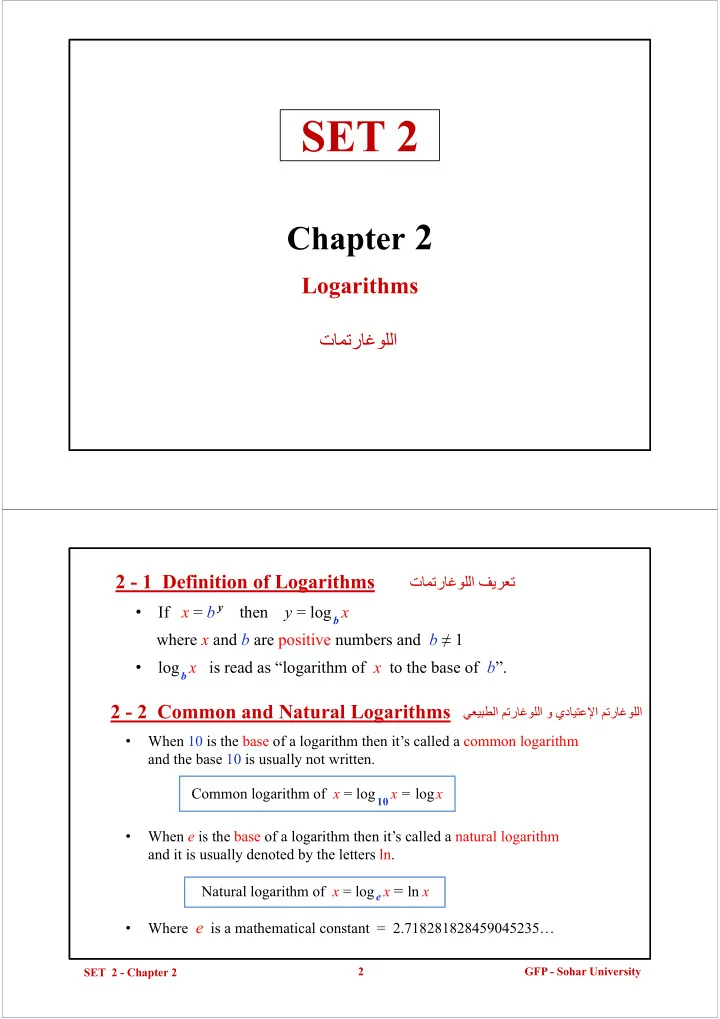
تامتراغوللا 2-1 Definition of Logarithms تامتراغوللا فيرعت

  • If x = b y

then y = log b x where x and b are positive numbers and b ≠ 1

  • logbx is read as “logarithm of x to the base of b”.

2

2 - 2 Common and Natural Logarithmsيعيبطلا متراغوللا و يدايتعلئا متراغوللا

  • When 10 is the base of a logarithm then it’s called a common logarithm

and the base 10 is usually not written.

  • When e is the base of a logarithm then it’s called a natural logarithm

and it is usually denoted by the letters ln. Common logarithm of x = log 10 x = logx Natural logarithm of x = loge x = ln x

  • Where e is a mathematical constant = 2.718281828459045235…

SET 2 - Chapter 2 GFP - Sohar University

slide-2
SLIDE 2

2 - 3 Laws of Logarithms تامتراغوللا نيناوق

  • The fundamental laws of logarithms are:

3 SET 2 - Chapter 2 GFP - Sohar University

Example 1: Change the following from exponential form to logarithmic form:

4

Solution:

SET 2 - Chapter 2 GFP - Sohar University

slide-3
SLIDE 3

Example 2: Change the following from logarithmic form to exponential form:

5

Solution:

SET 2 - Chapter 2 GFP - Sohar University

Example 3: Evaluate the following expressions, rounded to 3 decimal places:

6

Solution:

SET 2 - Chapter 2 GFP - Sohar University

slide-4
SLIDE 4

Example 4: Solve the following logarithmic equations:

7

Solution:

SET 2 - Chapter 2 GFP - Sohar University

Example 5: Solve the following logarithmic equations:

8

Solution:

SET 2 - Chapter 2 GFP - Sohar University

slide-5
SLIDE 5

Example 6: Solve the following exponential equations:

9

Solution:

By taking the log10 for both side: Taking the log10 for both side gives:

SET 2 - Chapter 2 GFP - Sohar University

Example 7: Express each of the following expressions as a single logarithm:

10

Solution:

SET 2 - Chapter 2 GFP - Sohar University

slide-6
SLIDE 6

2 - 4 Population Growth تاعمتجملا ومن

  • The model of many kinds of population growth, whether it be a

population of people, bacteria, cellular phones, or money is represented by the following function: P(t) = P0e k t Where: P0 = the population at time 0, P(t) = the population after time t, k = exponential growth rate, and k > 0

11 SET 2 - Chapter 2 GFP - Sohar University

Example 8: In 2002, the population of India was about 1034 million and the

exponential growth rate was 1.4% per year. (a) Find the exponential growth function. (b) Estimate the population in 2008. (c) After how long will the population be double what it was in 2002?

12

Solution:

(a) At t = 0 (2002), the population was 1034 million, then P0 =1034. k = 1.4%, or 0.014 Therefore, the exponential growth function for this population is: P(t) = 1304e 0.014 t Where t is the number of years after 2002 and P(t) is in millions.

SET 2 - Chapter 2 GFP - Sohar University

slide-7
SLIDE 7

13

(b) In 2008, t = 6 (c)

We are looking for the time T for which P(T) = 2  1034 = 2068. To find T, we solve the equation:

SET 2 - Chapter 2 GFP - Sohar University

2 - 5 Interest Compounded Continuously

ةرمتسملا ةبكرملا ةدئافلا

  • If an amount P0 is invested in a savings account at interest rate k

compounded continuously, then the amount P(t) in the account after t years is given by the exponential function: P(t) = P0e k t where: P0 = the amount at time 0, P(t) = the amount after time t, k = continuously compounded interest rate.

14 SET 2 - Chapter 2 GFP - Sohar University

slide-8
SLIDE 8

Example 9: Suppose that $2000 is invested at interest rate k, compounded

continuously, and grows to $2504.65 in 5 years. (a) What is the interest rate? (b) Find the exponential growth function. (c) What will the balance be after 10 years? (d) After how long will the $2000 be doubled?

15

Solution:

(a) P(0) = P0 = $2000 Thus, the exponential growth function is: P(t) = 2000e kt Since P(5) = $2504.65, Then 2504.65 = 2000 e k(5) 2504.65 = 2000 e 5k

SET 2 - Chapter 2 GFP - Sohar University 16

(b) Substituting 0.045 for k in the function P(t) = 2000e kt gives: P(t) = 2000e 0.045t So, the interest rate is 0.045 or 4.5%. (c) The balance after 10 years is: P(10) = 2000e 0.045(10) = 2000e 0.45 = $3136.62

SET 2 - Chapter 2 GFP - Sohar University

slide-9
SLIDE 9

17

So, the original investment of $2000 will double in about 15.4 years (d) To find the time T needed for doubling the $2000, we set P(T) = 2 × P0 = 2 × $2000 = $4000 and solve for T. 4000 = 2000e 0.045T

SET 2 - Chapter 2 GFP - Sohar University