
SLIDE 1
The Old Irish Goat Society
“To preserve and promote the Old Irish Goat"
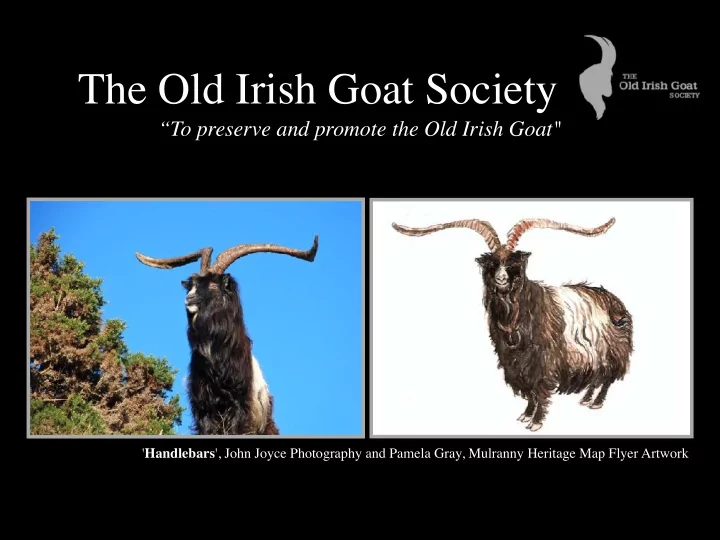
'Handlebars', John Joyce Photography and Pamela Gray, Mulranny Heritage Map Flyer Artwork
The Old Irish Goat Society To preserve and promote the Old Irish - - PowerPoint PPT Presentation
The Old Irish Goat Society To preserve and promote the Old Irish Goat" ' Handlebars ', John Joyce Photography and Pamela Gray, Mulranny Heritage Map Flyer Artwork Old Irish Goat Heritage Value in Context Colin Johnston, Old Irish Goat
“To preserve and promote the Old Irish Goat"
'Handlebars', John Joyce Photography and Pamela Gray, Mulranny Heritage Map Flyer Artwork
Colin Johnston, Old Irish Goat Society Member Famine Reenactment, Mulranny
Nora Drummond (1862 - 1949) Edgar Hunt (1876–1953) ‘Augustus Burke, Connemara Girl’, 1880 ‘A Mountain Goat’, Early 20th Century
'A Hospitable Home in Ireland', 1909 Nanny Goat Market, Athlone, Ireland Travelling Herd, Wiltshire, England Travelling Herd, Surrey, England
“There is a very compelling and urgent need to preserve the Old Irish Goat breed as a genetic and cultural resource. The Old Irish Goat is the ancient breed of the nation and the symbol of its past.” Raymond Werner, 2009 “The Irish goat, we maintain, is the best we have for the purpose, and it should be kept pure in type… to graft Nubian or Swiss blood into this breed does not add to its beauty, and, to our mind, impairs its usefulness.” Walter Paget, 1918
“The Old Irish Goat has a distinct regal image, with it’s long beard, oversized side-burns, flamboyant coiff, long coat and of course… it is ostentatiously adorned with a crown of impressive horns”
Contrast between Old Irish and British Alpine Breeds
“…they moved off and then strung out like a neck-lace of multicoloured beads” -
Ray Werner, Heritage Outlook, 2009.
This unimproved landrace breed, has a range of colour patterns including:
The Old Irish Goat Society aims to identify all colour patterns and preserve them in it’s captive breeding programs
'The loss of genetic resources in Europe is such that 16 of the 19 extinct goat breeds worldwide are European' (Garcia et al. 2012).
Mulranny & Burrishoole (Estate) Westport Achill Inisbofin Killary Inishmore The Burren Lough Ree Islands Clonmany, Kindrum, Fanad, Kerry and Murin Hill Knockalla Bilberry Askeaton Killorgan Killarney Gort Goat Island and Long Island, Roaring Water Bay Castlefin Rossa Nature Reserve
The Old Irish Goat Society's National Survey is part funded by Mayo, Galway and Longford Agenda 21 and the Department of Agriculture's Genetic Resources Grant Scheme
Kilcash Adrigole Newtowncashel Ballyvaughan Brannock Letterfrack Drumsnauv Rossbeigh Camlough, Slieve Gullion & Glendesha
Killarney National Park, Kerry Lough Ree
The Old Irish Goat Society recently organised a facilitated workshop to explore the possibility of securing the Old Irish breed of goat in a conservation grazing initiative on the Lough Ree Islands for Irish Curlew habitat creation, whilst promoting ecclesiastical heritage conservation and responsible tourism creation.
a distinct type of goat, seemingly unique…" Old Irish Goat Society in partnership with Smurfit Genetic Institute and Trinity College Dublin, 2013.
Old Irish Goat Society in partnership with University College Dublin and Weatherbys DNA laboratory, 2014
predominantly distinct clusters…" Old Irish Goat Society in partnership with Weatherbys DNA laboratory, 2015
Lough Ree, Longford Bilberry, Waterford F i n n i s h L a n d r a c e Dutch Landrace Killorglin, Kerry Mulranny, Mayo Aran, Galway Killary, Galway Icelandic Old English Goat Bagot Goat
Mulranny OIG Mulranny 'Cross' Cross Arran Bilberry 'Cross' Bilberry OIG English Bagot Longford
with Swiss Saanen and Italian Ciociara Grigia as outgroups Fig.1 - Clusterings of the most related animals within Irish and English cold-weather goats
Cheviot, Old English Longford, Old Irish Mulranny, Old Irish Italian Cioccara Grigia Sannen / Swiss Goat Exportation
Old Irish Goat Flyer
The
www.oldirishgoatsociety.com
Marian Harkin MEP, Irish Rare Breeds Conference The Old Irish Goat Society organised and hosted the event and were encouraged by the interest and support shown.
Proposed Categorisation of Irish Breeds
A.Landrace or Native Breeds
B.Foreign Imports
C.Recent Offshoots of Landrace and Foreign Imports
D.Feral Breeds
Plural Breed Origin
"Animal Genetic Resources are the most valuable and strategically important assets a country
breeder’s raw material and amongst the farmer’s most essential inputs."
Organisation of the United Nations (2009)
with unique attributes for adaptation, disease resistance and specific uses and should be preserved
capacities should be strengthened so that stakeholders can be enabled to implement programmes that take preventive action and guarantee their survival
kept for preservation of type and not for development
UN Earth Summit County Council Fund Agenda 21, Chapter 14
The conservation and sustainable utilisation of Animal Genetic Resources for Sustainable Agriculture
the significant ongoing loss of livestock breeds
integrating Animal Genetic Resources into National Biodiversity and Agricultural Programmes for humanity, the environment and our cultural heritage.
develop, manage and conserve genetic resources rests with national governments. International and national capacities must now demonstrate sustained political will and mobilise the considerable resources needed
Interlaken Conference Global Plan
Dep.
Fund
The National Biodiversity Plan's (2011 - 2016 ) Precautionary Principle states that: "If there is a threat of significant loss of biological diversity, lack of scientific certainty should not be used as a reason for postponing measures to avoid
The National Biodiversity Plan was developed through Ireland ratifying the Convention on Biological Diversity in at the 1992 Earth Summit, Rio de Janeiro
Mason's World Dictionary of Livestock Breeds informed the preparation of the World Watch List for Domestic Animal Diversity. These important baseline documents acknowledge the Old Irish Goat as a breed but, quite alarmingly, the World Watch List incorrectly classifies the Old Irish Goat as ‘not at risk’ and the latest edition of the Dictionary declares it as ‘extinct’. These major gaps and weaknesses need to be addressed by rare breed societies to enable effective population monitoring and early warning systems.
"In the innovation age, a deep sense of the past is central to creativity, contributing to wholeness, integrity, civic responsibility, aesthetic sensibility and ecological stewardship"
Conservation Grazing with the Kerry Bog Pony, 'Goats from Howth' and the Cheviot Goat
The Old Irish Goat Society are working to develop a grazing scheme that utilises Old Irish Goats to conserve a Dublin Bay Biosphere, UNESCO-Designated Site
'Milking Old Irish Goats on Howth Head' c. 1990 The last Old Irish Goat on Howth Head Old Irish Goat and Aideen's Dolmen on Howth Head' c. 1760
Old Irish Goats have been shown to control and even eradicate Gorse, given time and sufficient stocking rates
In addition to the top wire being electrified, an
stepping up onto the non-electrified wires below
The Old Irish Goat Society is ensuring to learn from models such as the previous 'Goats for Howth' grazing initiative
would like to acknowledge and thank the individuals and institutions that have lent us support and encouragement