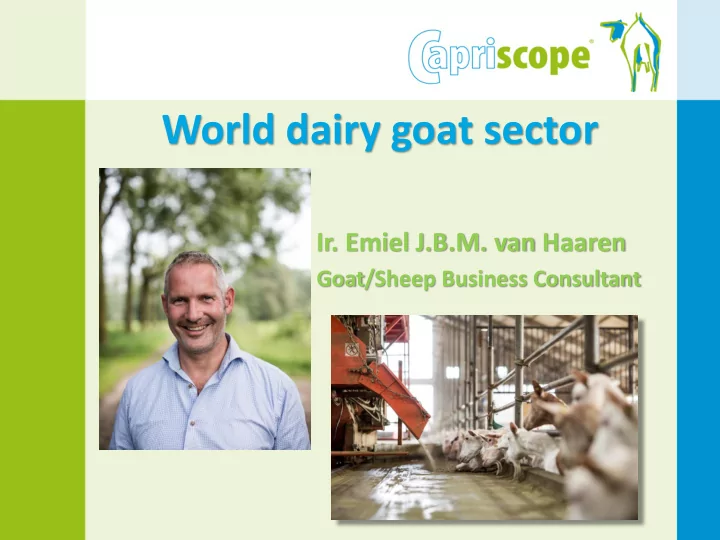
World dairy goat sector Ir. Emiel J.B.M. van Haaren Goat/Sheep - - PowerPoint PPT Presentation

world dairy goat sector
SMART_READER_LITE
LIVE PREVIEW

World dairy goat sector Ir. Emiel J.B.M. van Haaren Goat/Sheep - - PowerPoint PPT Presentation

World dairy goat sector Ir. Emiel J.B.M. van Haaren Goat/Sheep Business Consultant Presentation Set-Up Production systems Capriscope Intensive systems Activities: Extensive systems Farm design The Netherlands

slide-1
SLIDE 1

World dairy goat sector

  • Ir. Emiel J.B.M. van Haaren

Goat/Sheep Business Consultant

slide-2
SLIDE 2

Presentation Set-Up

Capriscope

  • Activities:
  • Farm design
  • Management guidance
  • Business plan development
  • Nutritional advise
  • Feasibility study
  • Projects
  • Overview
  • Sequence

World Dairy Goat Sector

  • Goat milk versus cow milk
  • Goat dairy world wide
  • Share
  • Production growth
  • Continents
  • Production systems
  • Intensive systems
  • Extensive systems
  • The Netherlands
  • Factors influencing milk production
  • Climate and season
  • Feed
  • Housing
  • Breeds
  • European Dairy breeds
  • Asian Dairy Breeds
  • African Dairy Breeds
  • Genetics
  • Heritability
  • Genomic selection
  • Artificial insemination
  • Management
  • Prolonged Lactations

2

slide-3
SLIDE 3

Capriscope

3

slide-4
SLIDE 4

4

Activities: Farm Design

slide-5
SLIDE 5

5

Activities: Management Guidance

slide-6
SLIDE 6

6

Activities: Business plan Development

slide-7
SLIDE 7

7

Activities: Nutritional advise

slide-8
SLIDE 8
  • Market research
  • Infrastructure requirements
  • Budgets
  • Herd flow tables
  • Building designs

8

Activities: Feasibility Study

slide-9
SLIDE 9

9

Projects: Overview

slide-10
SLIDE 10
  • 1. Healthy goats
  • 2. Budget, market
  • 3. Size of the farm
  • 4. Feeding system
  • 5. Milking system
  • 6. Breeding system
  • 7. Farm design
  • 8. Education
  • 9. Management control

10

Projects: Sequence

slide-11
SLIDE 11

11

Woldwide Dairy Goat Sector

slide-12
SLIDE 12

Goat milk vs cow milk

Goat milk Cow Milk (full fat) Energy (kcal) 67 64 Lactose (g) 4.2 4.6 Protein (g) 3.7 3.3 Caseine (g) 2.9 2.7 Fat (g) 3.9 3.6 Sodium (mg) 42 45 Calcium (mg) 127 120 Phosphor (mg) 109 92 Potassium (mg) 181 141 Zinc (mg) 0.26 0.36 Vitamin B2 (mg) 0.15 0.18 Vitamin B12 (µg) 0.07 0.41 Vitamin A (µg) 74 31 Vitamin D (µg) 0.25 0.174

1 1

Source: Nutrinews (2005)

12

slide-13
SLIDE 13

Goat milk vs cow milk (2)

  • Lightly digestible
  • Better fat content (digestibility and use)
  • Better mineral use (calcium, magnesium, copper and iron)
  • Good alternative in case of cow-milk allergy

13

slide-14
SLIDE 14

Goat dairy worldwide: Consumption

  • Fresh milk
  • Milk dried
  • Cheese (523.040 tonnes)
  • Yoghurt
  • Ice cream
  • Butter

14

slide-15
SLIDE 15

Goat dairy world wide: Share

Milk production Cow Buffalo Goat Sheep Camel Total Amount (tonnes) 600 826 92 473 17 367 10 091 2365 723 123 Share (%) 83.1 12.8 2.4 1.4 0.3 100

Source: FAOSTAT (2012)

Worldwide milk yearly milk production

15

slide-16
SLIDE 16

Goat dairy world wide: Production growth

2000 4000 6000 8000 10000 12000 14000 16000 18000 20000 200 400 600 800 1000 1200 2000 2002 2004 2006 2008 2010 2012 2014 Milk production (x 1.000.000 kg) Number of all goats (x 1.000.000) Year Number of goats Milk production

Source: FAOSTAT (2014)

16

slide-17
SLIDE 17

Total number of goats (%)

Africa Northern America Asia Europe

Milk production (%)

Africa Northern America Asia Europe

Source: FAOSTAT (2014)

Goat dairy world wide: Continents

17

slide-18
SLIDE 18

Total national milk production

1. India (28%) 2. Bangladesh (15%) 3. Sudan (6%) 4. Pakistan (4%) 5. France (3%)

Milk production per goat

Southern Asia contributes to ± 50% of goat milk production world wide 1. Luxembourg 2. Germany 3. Netherlands 4. France 5. Israel

Source: FAOSTAT (2014)

Goat dairy world wide: Top countries

18

slide-19
SLIDE 19

Goat dairy world wide: The Netherlands

19

Number of farms Number of goats (right axis)

Source: ABN AMRO (2015)

slide-20
SLIDE 20

Goat dairy world wide: The Netherlands (2)

20

year price Average 2006-2014 price Netherlands price France

Source: ABN AMRO (2015)

slide-21
SLIDE 21

Production systems: extensive

A goat is a poor (wo)man’s cow

  • Multipurpose animal (meat, milk, skin,

fibre and manure)

  • Easy adaptable to housing conditions,

diets and climate

  • Easy to be raised in landless systems
  • Small size (little aliments + young

slaughter age)

  • Milk is easy digestible and nutritious
  • Little quantity of milk and meat, so no

storage problems (home consumption)

21

slide-22
SLIDE 22

Production systems: Intensive

  • Growing world market for goat dairy
  • Positive sector image
  • Large variety of goat dairy products
  • Easy digestible and nutritious milk
  • Lesser allergic problems of goat milk

22

slide-23
SLIDE 23

Production systems: The Netherlands

Conventional (83%)

  • 500-4000 goats
  • Many first generation farms
  • Large variation between

farms

  • Intern/extern roughage

production

  • Housed indoors

23

Organic (17%)

  • 400-800 goats
  • Grazing
  • At least 60% roughage
slide-24
SLIDE 24

Factors influencing milk production per goat

Breeds and genetics (Udder) Health Housing Climate Age and parity Season Management system Feed

24

slide-25
SLIDE 25

Climate & Season

  • Goats are adaptable to extreme climates
  • Use local breeds and or cross breeds
  • Seasonal breeders versus a-seasonal breeders (tropical breeds)
  • Winter dip (cold climates)

25

slide-26
SLIDE 26

Feed

Intensive systems:

  • Total mixed ration
  • Concentrates + forage

Extensive systems: Forages and by-products:

  • Grazing/browsing
  • Cut and carry

26

slide-27
SLIDE 27

Housing: Indoors

  • Deep litter stables
  • Slatted floors
  • Animal density
  • Hygiene
  • Stable climate

27

slide-28
SLIDE 28

Breeds

  • 570 goat breeds world wide
  • Single dairy purpose: 69 breeds
  • Originating from:
  • Europe (50%)
  • Asia (27%)
  • Africa (11%)
  • Dual purpose
  • Meat

28

slide-29
SLIDE 29

Dairy breeds: European

Saanen: The “Holstein Friesian” of dairy goats Toggenburg Alpine

  • Widely exported around the world

*1000-1200 kg/year in top producing

countries ** Long lactations are common Year production 300-2000 kg* Daily yield 1-6 kg Lactation length 150-300 days**

29

slide-30
SLIDE 30

Dairy breeds: Asian

Originating from India and Pakistan Seasonal breeders or a-seasonal breeders (tropics and subtropics) Jamnapari goat

Year production 200-600 kg Daily yield 1.5-3.5 kg Lactation length 170-200 days

30

slide-31
SLIDE 31

Dairy breeds: African

Dual purpose or dairy breed Seasonal breeders or a-seasonal breeders (tropics and subtropics) Boer goat: Widely exported for meat production Red Sokoto

Year production 100-500 kg Daily yield 0.5-2 kg Lactation length 100-200 days

31

slide-32
SLIDE 32

Genetics

Up to 50 % of the variation is found WITHIN breeds

  • Milk yield
  • Milk quality (fat & protein)
  • Longevity
  • Udder conformation and health
  • Animal health
  • Legs & feet
  • Feed conversion efficiency
  • Reproductive efficiency

32

slide-33
SLIDE 33

Genetics: Heritability

Heritability of traits varies between breeds

*A heritability of 1 = purely due to genetic factors A heritability of 0 = due to non-genetic factors

Genetic improvement of goat herd

  • (Genomic) selection of goats
  • AI or ET

Saanen Trait Heritability* Milk yield 0.20 Protein yield 0.30 Fat yield 0.29

33

slide-34
SLIDE 34

Genetics: Genomic Selection

Identifying genomic markers for production traits

  • Rapid identification of (un)desirable traits
  • Accurate selection of elite breeding stock
  • Shorten generation interval
  • Accelerate genetic improvement

34

slide-35
SLIDE 35

Genetics: Artificial insemination

  • Practiced on small-scale
  • Only possible in multiparous goats

Advantages:

  • Genetic improvement of next generation (does or bucks!)
  • Introduction of new genes in your herd
  • No disease transmission from buck to goat

35

slide-36
SLIDE 36
  • Estrus synchronization
  • Sperm collection
  • Sperm analysis, dilution and storage
  • Insemination

36

Genetics: Artificial insemination (2)

slide-37
SLIDE 37

Management: Prolonged lactations

Lactations from 2-7 years

  • Less problems around kidding
  • No drop in milk-production before milking
  • More homogenous milk-production year round
  • Less disease occurrence
  • Stable milk quality
  • Stable feed rations
  • Longevity
  • Lower replacement rate (<30%)
  • Higher lifetime production (>14%)

37

slide-38
SLIDE 38

Management: Prolonged lactations

Source: Rapport 97 (2007), Duurmelken bij geiten, Animal Science Group, Wageningen UR

38

No dry period Standard Prolonged lactations

slide-39
SLIDE 39

Conclusion

  • Dairy goat sector is growing
  • Traditionally associated with less developed regions
  • Becoming of larger importance in developed countries
  • Fast professionalization in intensive systems

39

slide-40
SLIDE 40

Th Thank you for your attention!

40