Long-term monitoring of LLGHGs & SLCPs in Asia and Oceania using - - PowerPoint PPT Presentation

long term monitoring of llghgs slcps in asia and oceania
SMART_READER_LITE
LIVE PREVIEW

Long-term monitoring of LLGHGs & SLCPs in Asia and Oceania using - - PowerPoint PPT Presentation

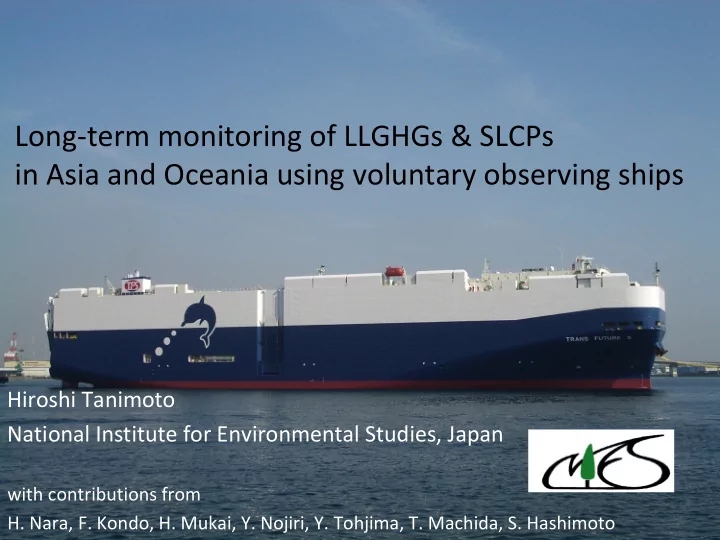
Long-term monitoring of LLGHGs & SLCPs in Asia and Oceania using voluntary observing ships Hiroshi Tanimoto National Institute for Environmental Studies, Japan with contributions from H. Nara, F. Kondo, H. Mukai, Y. Nojiri, Y. Tohjima, T.


slide-1
SLIDE 1

Long-term monitoring of LLGHGs & SLCPs in Asia and Oceania using voluntary observing ships

Hiroshi Tanimoto National Institute for Environmental Studies, Japan

with contributions from

  • H. Nara, F. Kondo, H. Mukai, Y. Nojiri, Y. Tohjima, T. Machida, S. Hashimoto
slide-2
SLIDE 2

NIES – VOS program started in 1995 for pCO2 (Y. Nojiri)

 Four commercial cargoships over the Pacific Ocean

 Japan – the United States (west coast & east coast)  Japan – Australia/New Zealand, Japan – Southeast Asia

Closed in 2010

2

slide-3
SLIDE 3

Focus on Asia & Oceania: New project since 2005

BC (FF) 6% Halocarbons 10% CH4 15% CO2 44% Solar 9%

  • Trop. O3

11% N2O 5%

CO2 CH4 N2O Halocarbons BC (FF)

  • Trop. O3

Solar

 Rapidly developing economy & severe biomass burning in Asia  Long-term, comprehensive monitoring of non-CO2 trace

atmospheric constituents – greenhouse gases and aerosols

 CH4, N2O, halocarbons (HFC, PFC, SF6) (long-lived greenhouse gases, LLGHGs)  Tropospheric O3, BC (short-lived air pollutants, SLCPs)  CO, CO2 (references for emissions ratios)

Radiative Forcing Emissions Inventory Σnon-CO2 ~ CO2 SE Asia

3

slide-4
SLIDE 4

Focus on Asia & Oceania: Combining two routes

regionally polluted air (more info. on emission sources)

Japan – Southeast Asia Japan – Australia / New Zealand

background clean air (reference data)

4

4 weeks 6 weeks

slide-5
SLIDE 5

Air sampling at M/V Fuji-transworld

Observation room Air intake for reactive species Air intake for long- lived species

5

slide-6
SLIDE 6

M/V TF5 detected high-CO plumes

Abnormally high CO in October 2006 (El Nino) over the tropical Pacific Ocean Nara et al., Environ. Chem., 2011

6

slide-7
SLIDE 7

CO-vs-CO2 correlation in BB plumes

Nara et al., Environ. Chem., 2011

Indonesian peatland: 143, 194-279 Tropical forest: 103 (+/-21) Savanna & glassland: 63 (+/-20)

Observed CO/CO2 ratio (171 ppb/ppm) is higher than in GFEDv2 (~110 ppb/ppm)

Uncertainty in CO emissions by GFEDv2 in Southeast Asia associated with emission factors of peatland fires

GFEDv2

7

slide-8
SLIDE 8

Variations of CH4, N2O, & CO (Flasks)

CH4 is high in winter due to continental outflow

High-events coincident with N2O and CO; extra-sources like BB?

CH4 CO N2O 7-20N 10S-Eq Eq-7N Western Pacific Southeast Asia

  • H. Mukai

8

slide-9
SLIDE 9

Continuous CH4 with Picarro CRDS

high conc. & variability October 2009 NH – SH gradient

9

slide-10
SLIDE 10

Variability of CH4 in Southeast Asia

 CH4 peaks in northern tropical area

  • East coast of Malay Peninsula: 5.5 - 8°N
  • West coast of Borneo Island: 4.5 - 7°N

1 min-mean CH4 latitudinal distribution (ppb)

Hideki Nara et al., in preparation To be presented at GGMT 2013

10

slide-11
SLIDE 11

Samplings by NIWA

Established by Dr Yukihiro Nojiri (NIES) & Dr Dave Lowe (NIWA) in 2004

Species of interest

CH4 & stable carbon isotopic composition

CO & its isotopic composition

Manual collection of clean air by Tony Bromley or Ross Martin

04 05 06 07 08 09 10 11 12 13 Jan X Feb Mar X X Apr May X X X X Jun X X Jul Aug X Sep X Oct Nov Dec X X X X

Bromley et al., JGR, 2012

11

slide-12
SLIDE 12

PI: Howard Diamond, US GCOS, NOAA PI: Ed Dlugokencky, NOAA CMDL

 Measurement of essential climatic variables, &

components of GAW across Western Pacific

 Location proving valuable for examination of inter-

hemispheric trace-gas mixing & meteorological influence on trace gas & aerosol transport and distribution, relatively uncontaminated by local sources

 Provides essential direct comparison for NIWA

(same airline, same pump, different lab)

 Species:

CO2, N2O, SF6, CH4, H2, CO, 13-CO2, CO2-18 [World Data Centre for Greenhouse Gases]

NOAA-GCOS flasks

Courtesy: Tony Bromley, Gordon Brailsford (NIWA)

12

slide-13
SLIDE 13

Summary & acknowledgments

NIES VOS Program started in 1995, focusing on CO2 (air and seawater)

It has expanded to non-CO2 long- and short-lived trace gas and aerosols

Long-term records of LLGHGs (CH4, N2O, CO, halocarbons, etc) based on flask sampling

Challenges toward continuous measurements onboard ships

QA/QC activity for CO based on flask and in situ measurements (Nara et al. AMT 2011)

Picarro CRDS successfully installed for CO2 & CH4 (Nara et al. AMT 2012)

Ongoing effort to measure SLCP (O3, Black Carbon) onboard ships

Biomass burning event in southeast Asia

Importance of peat burning in Southeast Asia (Nara et al. Environ Chem 2011)

Feedback to emission inventory (GFED) in this region

Great thanks to:

Toyofuji Shipping Co. & Kagoshima Shipping Co. – offer of cargo ships

  • S. Kariya & T. Yamada (Global Environmental Forum) – technical support

Ministry of the Environment, Japan – core funding

13