PART III Trading Partners CHAPTER 11-1. ASIA AND OCEANIA FDM 471 - - PowerPoint PPT Presentation

part iii
SMART_READER_LITE
LIVE PREVIEW

PART III Trading Partners CHAPTER 11-1. ASIA AND OCEANIA FDM 471 - - PowerPoint PPT Presentation

PART III Trading Partners CHAPTER 11-1. ASIA AND OCEANIA FDM 471 Youngjin Bahng OBJECTIVES Comprehend the magnitude of Asia as a political and economic trading bloc Appreciate the economic and political positions of individual


slide-1
SLIDE 1

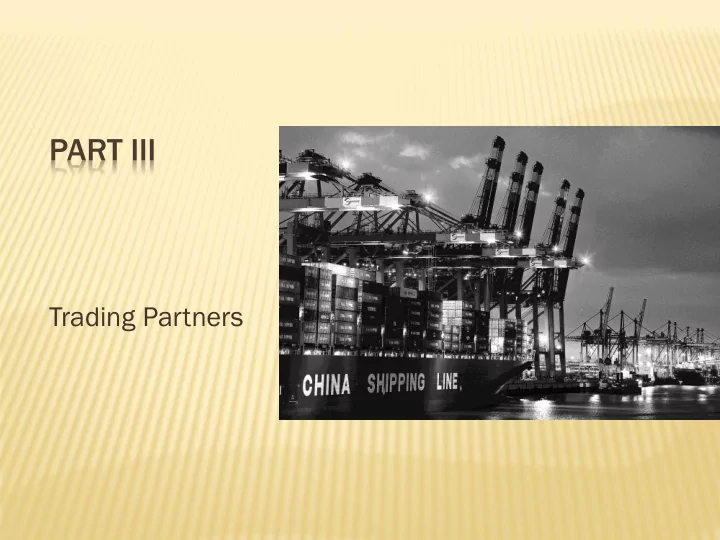
PART III

Trading Partners

slide-2
SLIDE 2

CHAPTER 11-1. ASIA AND OCEANIA

FDM 471 Youngjin Bahng

slide-3
SLIDE 3

OBJECTIVES

Comprehend the magnitude of Asia as a political and economic

trading bloc

Appreciate the economic and political positions of individual

countries within Asia

Examine the status of the textile and apparel business in

selected Asian and Oceania countries

Project textile and apparel trading trends for Asian countries into

the period following the phase-out of the quota system

3

slide-4
SLIDE 4

INTRODUCTION

Asia is the largest continent;

countries range from fully developed to least developed

Contains the world’s two

most populous nations, China and India

Half of the Asian continent’s

countries have populations smaller than New York City

Oceania consists primarily of

two developed island countries, Australia and New Zealand

4

slide-5
SLIDE 5
slide-6
SLIDE 6

POLITICAL AND ECONOMIC OVERVIEW

Asia and Oceania have been subdivided into the

following four groups of nations:

East Asia: China, South Korea, Taiwan, and Japan Southeast Asia: Hong Kong and eight of the ten ASEAN

(Association of Southeast Asian Nations) countries

South Asia: Pakistan to Bangladesh Oceania: Australia and New Zealand

6

slide-7
SLIDE 7

ASIAN REGIONAL COLLABORATION

The As

Asia-Pacif acific c Ec Economic

  • nomic Cooperation
  • operation (A

(APEC) PEC), established in 1989 as a forum for facilitating economic growth, cooperation, trade, and investment in the Asia-Pacific region

Across-the-border connectivity in the form of

regional and bilateral trade agreements is already in place, with many more on the horizon

7

slide-8
SLIDE 8
slide-9
SLIDE 9

9

slide-10
SLIDE 10

ECONOMIC AND INDUSTRIAL STANDING OF COUNTRIES IN REGIONS OF ASIA AND OCEANIA

China has the largest population; India is

second

East Asia and Oceania have longer life

expectancies and higher literacy rates than do Southeast Asia and South Asia

Based on GDP, China has the second largest

economy in the world, followed by Japan, Germany, and India

Japan, Australia, and New Zealand rank

among the most fully developed nations in the world

Overall, Oceania is rich; East Asia is relatively

rich, except for China; Southeast Asia is relatively poor, except for Singapore; and South Asia is poor

10

slide-11
SLIDE 11
slide-12
SLIDE 12
slide-13
SLIDE 13

OVERVIEW OF ASIAN TEXTILE AND APPAREL TRADE

Migration of textile and apparel

production to Asia began over 60 years ago

At peak in the early 1980s, Hong

Kong, Taiwan, and South Korea (the “big three”) supplied almost 30 percent of world exports of textile and apparel

China exports tripled to nearly

$120 billion, overtaking the EU, with “only” $112 billion

Developed countries Australia and

New Zealand both have increasing textile and apparel imports

13

slide-14
SLIDE 14
slide-15
SLIDE 15