Loch Fleet Site of f Special Scientific In Interest and National - - PowerPoint PPT Presentation

loch fleet site of f special scientific
SMART_READER_LITE
LIVE PREVIEW

Loch Fleet Site of f Special Scientific In Interest and National - - PowerPoint PPT Presentation

Loch Fleet Site of f Special Scientific In Interest and National Nature Reserve Habitat Damage About Loch Fleet National Nature Reserve Owned by Sutherland Estates Managed in partnership between Scottish Natural Heritage (SNH),


slide-1
SLIDE 1

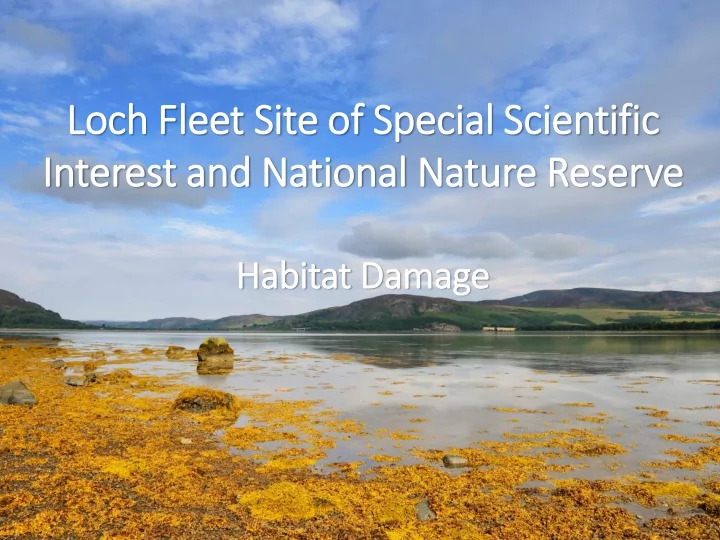
Loch Fleet Site of f Special Scientific In Interest and National Nature Reserve

Habitat Damage

slide-2
SLIDE 2
slide-3
SLIDE 3

About Loch Fleet National Nature Reserve

  • Owned by Sutherland Estates
  • Managed in partnership between Scottish Natural

Heritage (SNH), Scottish Wildlife Trust (SWT) and Sutherland Estates

  • Approximately 12,000 visitors per year, but increasing.
  • No permanent staff on the reserve
  • Site management carried out by SNH, SWT and team
  • f volunteers
slide-4
SLIDE 4

Internationally and Nationally Important Wildlife and Habitats

  • Dornoch Firth and Loch Fleet Special Protection Area

(SPA) (European designation)

  • Dornoch Firth and Loch Fleet RAMSAR
  • Loch Fleet Site of Special Scientific Interest (SSSI)
  • Loch Fleet National Nature Reserve (NNR)
  • Seal Haul-out Site - Section 117 of the Marine

(Scotland) Act 2010

  • Loch Fleet and Dornoch Firth and Cuthill Sands

Nature Conservation Order (NCO)

slide-5
SLIDE 5

So what does that mean?

  • Site of Special Scientific Interest Operations Requiring

Consent (ORCs)

– Certain activities require consent from SNH before they can take place; AND requires landowner or occupiers permission.

  • Special Protection Area (SPA)

– SNH required to consider impacts on SPA before SSSI consent it can be granted.

slide-6
SLIDE 6

Drones Fly tipping and dumping Off road vehicles

Main Issues at Loch Fleet

Breaches of Nature Conservation Order

slide-7
SLIDE 7

Drones

  • Increasing frequency of use within site;
  • Poor practice often reported, although probable

under reporting;

  • Typically relating to seal haul-outs, over wader and

waterfowl roosts and osprey nests also reported;

  • Challenges
  • Frequently reported after the event, lack of witnesses or

being able to identify individuals

  • Increasing popularity of Loch Fleet due to NC500
  • Currently no code for drone use on NNRs
slide-8
SLIDE 8

Drones Disturbance over Seal haul-out

slide-9
SLIDE 9

Action taken

  • Considered ‘reckless disturbance’ by WCO.
  • Owner of the video traced by Police Scotland and

WCO visited individual

  • Video removed from YouTube
slide-10
SLIDE 10

Off-road vehicles

  • Regular occurrence of unauthorised motor vehicle

access to site

  • Use of vehicles requires SSSI consent
  • Reckless damage and occasional deliberate damage
  • Typical damage

– Vehicle ruts, skidding, wheel spinning, do-nuts – Damage to NNR infrastructure

slide-11
SLIDE 11
slide-12
SLIDE 12
slide-13
SLIDE 13
slide-14
SLIDE 14

Signs and control measures are not are always effective deterrent

slide-15
SLIDE 15

Free running dogs

  • Disturbance to waders, waterfowl and seals at

haul out locations.

  • Not compliant with Scottish Outdoor Access

Code;

  • Can be difficult to manage and identify

individuals responsible;

slide-16
SLIDE 16

Loch Fleet Nature Conservation Order

  • Prohibits marine invertebrate and shellfish collection

and use of vehicle and craft to collect

  • Signs erected to warn of Nature Conservation Order

around reserve

– mitigate against ignorance claims – recklessness

  • Active police support and generally rapid response

from local police and occasionally road traffic officers

  • Typically caution given and told to leave site by police
  • Residents encouraged to report breaches to Police
  • n 101
slide-17
SLIDE 17

Fly-tipping and dumping

  • Typically household, garden and building waste

– Phantom Leylandi dumper!

  • Potential release of invasive species onto site
  • Increasing problem of campervan waste disposal
  • Vigilance around ‘hotspots’
  • Signs – promoting responsible behaviour and nearest

licenced recycling centre (6 miles away)

slide-18
SLIDE 18

What can be done and what works?

  • Balancing act between promoting outdoor and

restricting outdoor access

  • Don’t delay reporting it!

– Encourage reporting of any crime to Police Scotland at the time of the incident

  • Importance of local community engagement and

involvement in sites

  • Good relationship with Police Scotland, particularly

with local officers

– Local knowledge is often key!

slide-19
SLIDE 19

What can be done and what works?

  • Education!
  • Increasing social awareness of wildlife crime
  • Signs

– Temporary signs can be very effective if targeted; – Permanent signs seldom effective eventually ignored. – Help to raise awareness. – Can be required mitigate against ignorance claims – Are occasionally vandalised or simply ‘go-missing’

  • Physical barriers

– Vehicle bollards – Gates and fencing

slide-20
SLIDE 20

Any Questions