2020 FLEET MANAGEMENT PLAN PRESENTATION TO GCTD BOARD OF DIRECTORS - - PowerPoint PPT Presentation

2020 fleet management plan
SMART_READER_LITE
LIVE PREVIEW

2020 FLEET MANAGEMENT PLAN PRESENTATION TO GCTD BOARD OF DIRECTORS - - PowerPoint PPT Presentation

2020 FLEET MANAGEMENT PLAN PRESENTATION TO GCTD BOARD OF DIRECTORS March 4, 2020 Fleet Management Plan Fleet Replacement Needs Non-Revenue Fleet Paratransit Fleet Fixed-Route Fleet Zero Emission - Innovative Clean Transit Rule (ICT)


slide-1
SLIDE 1

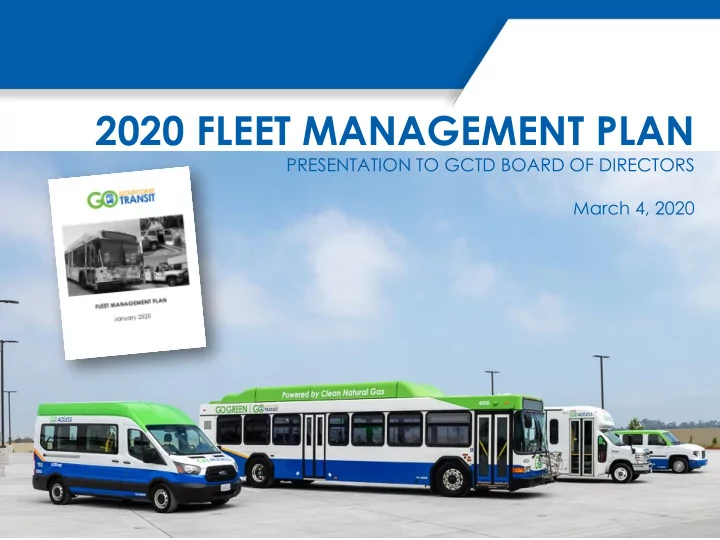
2020 FLEET MANAGEMENT PLAN

PRESENTATION TO GCTD BOARD OF DIRECTORS March 4, 2020
slide-2
SLIDE 2

Fleet Replacement Needs

  • Non-Revenue Fleet
  • Paratransit Fleet
  • Fixed-Route Fleet

Zero Emission - Innovative Clean Transit Rule (ICT)

  • Hydrogen VS Electric
  • Funding Needs

Fleet Management Plan

slide-3
SLIDE 3

Fleet Management Plan

Updates since 2016 Plan

  • 2018 - GCTD Completed Transit Asset Management Plan (TAM)
  • 2018- Board adopted a “Zero/Near Zero Emissions Policy”
  • 2019 - CARB Adopted Innovative Clean Transit (ICT) rule

requiring agencies set a goal of zero emissions fleets by 2040

  • 2019- Purchased 5 new Gillig 40’ buses, and 5 Ford Transits
  • 2019/2020 - GCTD completed “near zero” engine

replacements

  • 2020 - Purchased 9 electric sedans (relief cars)
slide-4
SLIDE 4

Repower Project Complete

New exhaust system burns hotter = 9 x better emissions New L9N Cummins Engine

slide-5
SLIDE 5

Repower Exhaust Ventilation

Before Repower

After Repower: Exhaust venting for heat dissipation

slide-6
SLIDE 6

Electric Nissan Leaf

  • 2020 Nissan Leaf
  • 10 charging stations.

Preparation for future fleet needs.

  • Existing conduit from

facility build reduced cost tremendously.

  • Reduction in CO2

and noise pollution.

slide-7
SLIDE 7

Non-Revenue Fleet

Non-Revenue Acquisition Forecast

  • 5 Electric Nissan

Leaf’s delivered.

  • 4 more on the way.

These 9 vehicles will drastically reduce the carbon footprint for GCTD’s non-revenue fleet. GCTD’s first Zero-Emission Vehicles (ZEV).

slide-8
SLIDE 8

Paratransit Fleet

Current Paratransit Fleet

g

Paratransit Fleet Acquisition Forecast

slide-9
SLIDE 9

GCTD Replacement Plan:

  • 3 CNG Buses 2020-21
  • 9 CNG Buses 2021-22
  • 9 CNG Buses 2022-23
  • 8 CNG Buses 2023-24
  • 14 Zero-Emission 2024-25

(Hydrogen Fuel Cell Buses & Infrastructure)

NEEDS: By 2025, 43 buses will reach or surpass the Useful Life Benchmark (ULB).

Fixed Route Fleet

slide-10
SLIDE 10

CARB: Innovative Clean Transit Regulation

  • 2026: Innovative Clean Transit (ICT) regulation states 25% of all buses

purchased by GCTD must be zero-emission.

  • 2029: All purchases must be 100% zero-emissions for small transit

agencies (Fewer than 100 buses).

  • 2040: All transit agencies transition to 100% zero-emissions fleets.

2020 2040 2029 2026

slide-11
SLIDE 11

Fixed Route Fleet Forecast

Make

Age at Replace Yr

Useful Life

Size 2019 2020 2021 2022 2023 2024 2025 2026 2027 2028 2029

Fuel Type

CNG CNG CNG CNG CNG ZERO CNG CNG CNG

# of Replacement Vehicles

3 9 9 8 14 4 4

Expansion Vehicles by Year

8

New Flyer 2006 (3)

14-yrs 14-yrs

40' 3 3

New Flyer 2006 (9)

15-yrs 14-yrs

40' 9 9 9

NABI 2008 (9)

14-yrs 14-yrs

35' 9 9 9 9

NABI 2009 (8)

14-yrs 14-yrs

35' 8 8 8 8 8

NF RP ‘06 (14)

18-yrs 18-yrs

40' 14 14 14 14 14 14

Gillig 2015 (4)

12-yrs 14-yrs

40' 4 4 4 4 4 4 4 4 4

Gillig 2015 (4)

13-yrs 14-yrs

40' 4 4 4 4 4 4 4 4 4 4

Gillig 2016 (5)

12-yrs 14-yrs

40' 5 5 5 5 5 5 5 5 5 5 5

Gillig 2019 (5)

14-yrs 14-yrs

40' 5 5 5 5 5 5 5 5 5 5 5

Replace (3)

tbd 14-yrs

40' 3 3 3 3 3 3 3 3 3 3

Replace (9)

tbd 14-yrs

40' 9 9 9 9 9 9 9 9 9

Replace (9)

tbd 14-yrs

40' 9 9 9 9 9 9 9 9

Replace (8)

tbd 14-yrs

40' 8 8 8 8 8 8 8

Replace (14)

tbd 14-yrs

40'

Apply for Grants

14 14 14 14 14 14

EXPANSION (8)

tbd 14-yrs

40' 8 8 8 8

Replace (4)

tbd 14-yrs

TBD 4 4 4

Replace (4)

tbd 14-yrs

TBD 4 4

Replace (5)

tbd 14-yrs

TBD Fixed Route Fleet Size 61 61 61 61 61 61 61 69 69 69 69

slide-12
SLIDE 12

ICT Reg & GCTD Fleet Replacement Timelines

25% of GCTD VEHICLE PURCHASE MUST BE ZEB

2020 2026 2025 2023 2024 2022 2021

slide-13
SLIDE 13
  • Fleet Mobility: Average range of hydrogen bus higher than electric.

Hydrogen: 300-340 miles per fill up. Electric: 125-175 miles per full charge.

  • Weight Reduction: Less battery weight in hydrogen bus.

Battery weight has caused issues for manufacturers.

  • Down time of vehicles: Hydrogen fill-up similar to CNG (7-10 minutes)

Electric 8-10 hours to fully charge batteries (Battery degradation issues)

  • Hydrogen buses 1 for 1 replacement ratio.

Hydrogen vs. Electric

slide-14
SLIDE 14

Range Issues Familiar

slide-15
SLIDE 15
  • How Hydrogen Works

1 minute 17 second video

Hydrogen Fuel

https://youtu.be/EgFCLBDn2es

slide-16
SLIDE 16

Hydrogen Fuel Cell Bus

slide-17
SLIDE 17
  • Hydrogen Fuel Cell Bus Price Trends

Hydrogen Fuel Cell Bus

slide-18
SLIDE 18
  • Cost to Produce Hydrogen Fuel forecasted to fall

(up to 80% by 2030)

Hydrogen Fuel Cell Bus

slide-19
SLIDE 19

Information Exchange OCTA, Sunline, AC Transit

  • OCTA
  • 10 Hydrogen Fuel Cell buses
  • Hydrogen Trucked In

(OCTA Fleet is 510 buses)

slide-20
SLIDE 20

Solar Panels & Battery Storage

  • Enable self-sufficiency regarding electric usage/rates.
  • Current fueling schedule dictated by revised peak rate times.
  • Solar battery storage will allow GCTD to operate as needed

while avoiding high electric charges

slide-21
SLIDE 21

Solar Panels and Battery Storage

Use solar panels to charge battery storage to power a hydrogen station for a Zero-Emission footprint.

slide-22
SLIDE 22

On-Site Hydrogen Generation & Supply Options

On-site generation of hydrogen through water electrolysis powered by solar provides a true Zero-Emission Footprint when combined with a hydrogen fuel-cell vehicle. Excess hydrogen generated has potential for revenue source.

slide-23
SLIDE 23

Potential Funding Sources:

  • Federal Competitive Grants CMAQ/5339/LowNo
  • State Competitive Grants (TIRCP, LCTOP etc)
  • Innovative Partnership with other agencies or businesses
  • Local Revenue Measure for Zero Emissions

Planning Grants

  • STEP Grant / CARB Grants (for Zero Emissions Planning)

Challenge: We do not have a source of Local Matching funds, which puts us as a disadvantage when competing for these grants.

The estimated total cost to replace 43 buses is $36 million.

Fleet Replacement Costs: $36 MILLION over 5 YEARS

$596 K $614 K $632 K $651 K $1,300 K Number of Buses Replaced 3 CNG 9 CNG 9 CNG 8 CNG 14 ZERO $1,788 K $5,526 K $5,688 K $5,208 K $18,200 K

*Fuel Station cost TBD CAMQ tbd tbd tbd tbd

Estimated Cost to Replace 43 buses over the next 5 years

$36.41 Million

Funding Need for the Next 5 Years (2020-2025)

slide-24
SLIDE 24

ICT Reg & GCTD Fleet Replacement Timelines

25% of GCTD VEHICLE PURCHASES MUST BE ZEB

2020 2026 2025 2023 2024 2022 2021

slide-25
SLIDE 25

QUESTIONS?