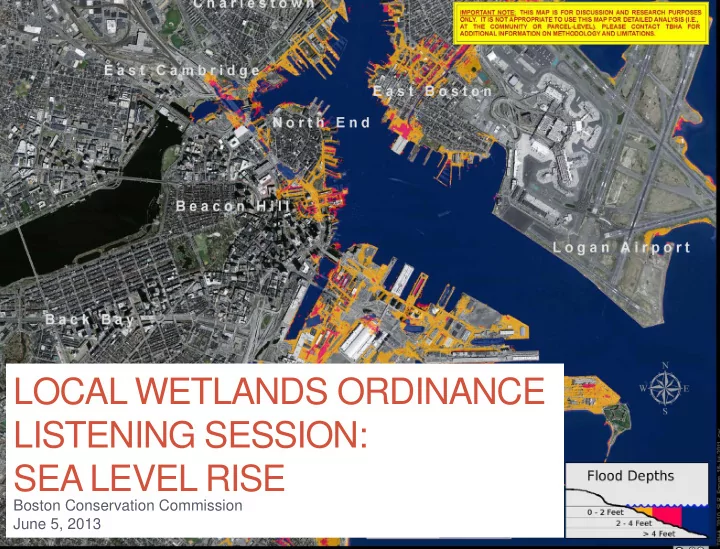
LOCAL WETLANDS ORDINANCE LISTENING SESSION: SEA LEVEL RISE Boston - - PowerPoint PPT Presentation

local wetlands ordinance listening session sea level rise
SMART_READER_LITE
LIVE PREVIEW

LOCAL WETLANDS ORDINANCE LISTENING SESSION: SEA LEVEL RISE Boston - - PowerPoint PPT Presentation

LOCAL WETLANDS ORDINANCE LISTENING SESSION: SEA LEVEL RISE Boston Conservation Commission June 5, 2013 Why do we need a Local Wetlands Ordinance? Protect more resource areas Protect existing resource areas to a greater degree

slide-1
SLIDE 1

LOCAL WETLANDS ORDINANCE LISTENING SESSION: SEA LEVEL RISE

Boston Conservation Commission June 5, 2013

slide-2
SLIDE 2

Why do we need a Local Wetlands Ordinance?

  • Protect more resource areas
  • Protect existing resource areas to a greater degree
  • Consider how future conditions will affect resource areas
slide-3
SLIDE 3

Why do we need a Local Wetlands Ordinance?

  • More than half of the 351 cities and towns in MA already

have a LWO.

  • Of the 78

municipalities in the Coastal Zone, Boston is 1 of only 6 that does not already have a LWO.

slide-4
SLIDE 4

What is happening?

  • Between the last ice age and a few decades ago, the rate of

sea level rise (SLR) had been on average 10” per century.

  • The rate of SLR has been increasing, and is expected to

increase globally between 0.2 and 2.0 meters (8” – 80”) per century.

NOAA 2012 report “Global Sea Level Rise Scenarios for the United States National Climate Assessment”

slide-5
SLIDE 5

How do we know what to plan for?

  • We should act on the best scientific consensus about sea

level rise, as it exists today, knowing that forecasts will shift as each decade validates or causes modifications to

  • ur projections.

Ranges of Projected Sea Level Rise by 2100

NOAA (2012)

slide-6
SLIDE 6

How do we know what to plan for?

  • In Boston, SLR may reach 4.5 - 7 feet by 2100,

and continue to rise for several hundred more years.

In about 80-90 years...

slide-7
SLIDE 7

How will this impact Boston?

  • Daily tidal inundation of low lying areas

High Tide at Long Wharf November 2011

slide-8
SLIDE 8

How will this impact Boston?

  • Significant coastal flooding of inland areas with storm

events and associated storm surge

UMass Harborwalk & Fort Point Channel during Superstorm Sandy, October 2012

slide-9
SLIDE 9

How will this impact Boston?

  • Significant Erosion

Columbia Point Shoreline Erosion Coastal Beach Erosion at Day Boulevard

slide-10
SLIDE 10

How will this impact Boston?

Developing tidal marsh at Bayswater Street Urban Wild

  • Landward migration of wetland resource areas

Wood Island Bay Marsh

slide-11
SLIDE 11

How will this impact Boston?

  • Permanent loss of land
slide-12
SLIDE 12

Planning ahead…

  • Technology will allow us to more and more accurately

predict the areas at risk of flooding and storm surge resulting from SLR years before they are actually impacted.

  • This means we have some time to plan, prepare and adapt.
  • We do not need to panic, but we do need to act now.
slide-13
SLIDE 13

How can we protect resources as sea level rises?

  • Delineate

future “Land Subject to Coastal Storm Flowage” instead of relying solely

  • n maps of

past storms.

FEMA Special Flood Hazard Zone, aka LSCSF

Current FEMA Floodplain Potential future storm flooding with SLR

slide-14
SLIDE 14

How can we protect resources as sea level rises?

  • Create Performance Standards for Projects in LSCSF
  • Require buildings & structures to demonstrate an ability to function

in an environment with higher sea levels without causing damage to wetland resource areas

Flood vents allow water to flow through buildings, reducing waterborne debris. Sanitary sewer backflow devices prevents contaminated water from flowing back into basements, protecting water quality. The Spaulding Rehab Hospital was built high above the floodplain with the mechanical suite on the roof. This reduces pollution and contamination caused by storm surges.

slide-15
SLIDE 15

Next Steps

  • Additional Listening Sessions:
  • June 19th
  • July 10th
  • Steering Committee will submit Guiding Principles for the

Local Wetlands Ordinance to the Conservation Commission

  • The Commission will endorse them and submit them to

Mayor Menino

  • The Mayor will direct staff to draft the ordinance
  • The Mayor will submit the ordinance to City Council
  • City Council will hold a public hearing
slide-16
SLIDE 16

Questions & Concerns…

http://www.cityofboston.gov/environment/Conservation/wetlands.asp stephanie.kruel@cityofboston.gov