Process What are Functions and Values? Prior Public Listening - - PowerPoint PPT Presentation

process what are functions and values
SMART_READER_LITE
LIVE PREVIEW

Process What are Functions and Values? Prior Public Listening - - PowerPoint PPT Presentation

Local Wetland Ordinance Listening Session 6/19/2013 LOCAL WETLANDS ORDINANCE LISTENING SESSION: What is a Local Wetlands Ordinance & PROTECTING ADDITIONAL WETLAND RESOURCE AREAS AND FUNCTIONS AND VALUES Why Does Boston Need One? Boston


slide-1
SLIDE 1

Local Wetland Ordinance Listening Session 6/19/2013 1

LOCAL WETLANDS ORDINANCE LISTENING SESSION: PROTECTING ADDITIONAL WETLAND RESOURCE AREAS AND FUNCTIONS AND VALUES

Boston Conservation Commission June 19, 2013

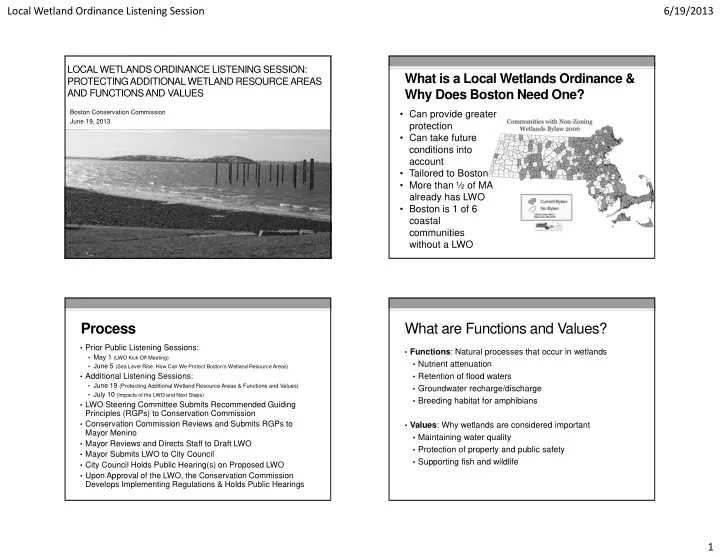
What is a Local Wetlands Ordinance & Why Does Boston Need One?

  • Can provide greater

protection

  • Can take future

conditions into account

  • Tailored to Boston
  • More than ½ of MA

already has LWO

  • Boston is 1 of 6

coastal communities without a LWO

Process

  • Prior Public Listening Sessions:
  • May 1 (LWO Kick Off Meeting)
  • June 5 (Sea Level Rise: How Can We Protect Boston’s Wetland Resource Areas)
  • Additional Listening Sessions:
  • June 19 (Protecting Additional Wetland Resource Areas & Functions and Values)
  • July 10 (Impacts of the LWO and Next Steps)
  • LWO Steering Committee Submits Recommended Guiding

Principles (RGPs) to Conservation Commission

  • Conservation Commission Reviews and Submits RGPs to

Mayor Menino

  • Mayor Reviews and Directs Staff to Draft LWO
  • Mayor Submits LWO to City Council
  • City Council Holds Public Hearing(s) on Proposed LWO
  • Upon Approval of the LWO, the Conservation Commission

Develops Implementing Regulations & Holds Public Hearings

What are Functions and Values?

  • Functions: Natural processes that occur in wetlands
  • Nutrient attenuation
  • Retention of flood waters
  • Groundwater recharge/discharge
  • Breeding habitat for amphibians
  • Values: Why wetlands are considered important
  • Maintaining water quality
  • Protection of property and public safety
  • Supporting fish and wildlife
slide-2
SLIDE 2

Local Wetland Ordinance Listening Session 6/19/2013 2 Protection of property Flood control Water storage Water retention Depression wetland Located within a floodplain

Values Functions Characteristics of Wetland Resource Areas

How are Wetland Functions and Values Protected/Regulated?

The value of wetlands is recognized in federal, state, and local wetland legislation that was enacted to protect these resources

  • Clean Water Act

(public interest review)

  • Wetlands Protection Act

(protected interests)

  • Wetlands Ordinances

(additional protected interests)

What Functions & Values (or Interests) are Currently Protected by the Wetlands Protection Act?

  • Flood control
  • Storm damage prevention
  • Pollution prevention
  • Public and private water supply
  • Groundwater supply
  • Land containing shellfish
  • Fisheries
  • Wildlife habitat

Functions and Values Not Regulated Under the Wetlands Protection Act

  • Climate Change

and Sea Level Rise

slide-3
SLIDE 3

Local Wetland Ordinance Listening Session 6/19/2013 3

Functions and Values Not Regulated Under the Wetlands Protection Act

  • Climate Change

and Sea Level Rise

  • Recreation

Functions and Values Not Regulated Under the Wetlands Protection Act

  • Climate Change

and Sea Level Rise

  • Recreation
  • Aesthetics

Functions and Values Not Regulated Under the Wetlands Protection Act

  • Climate

Change and Sea Level Rise

  • Recreation
  • Aesthetics
  • Historical

Values

Functions and Values Not Regulated Under the Wetlands Protection Act

  • Climate Change and

Sea Level Rise

  • Recreation
  • Aesthetics
  • Historical Values
  • Plant Species
slide-4
SLIDE 4

Local Wetland Ordinance Listening Session 6/19/2013 4

What are Wetland Resource Areas?

  • Wetland Resource Areas (or Areas Subject to Protection)

are Identified in the WPA Regulations.

  • Examples include BVW, Salt Marsh, 100 year Floodplain, Riverfront

Area, Coastal Beach, Coastal Bank, etc.

  • With few exceptions, activities proposed in Wetland

Resource Area or within the 100 foot Buffer Zone Require Review and Approval by the Conservation Commission.

What Resource Areas are Currently Protected by the Act?

  • Coastal Resource Areas
  • Land Under the Ocean
  • Designated Port Areas
  • Coastal Beaches (including tidal flats)
  • Coastal Dunes
  • Barrier Beaches
  • Coastal Banks
  • Rocky Intertidal Shores
  • Salt Marshes & Ponds
  • Land Containing Shellfish
  • Anadromous/Catadromous Fish Runs
  • Land Subject to Coastal Storm Flowage (100 year floodplain) or

Tidal Action

What Resource Areas are Currently Protected by the Act?

  • Inland Resource Areas
  • Banks (of jurisdictional ponds and streams)
  • Bordering Vegetated Wetlands (freshwater wetlands)
  • Land Under Waterbodies and Waterways (of jurisdictional ponds

and streams)

  • Bordering Land Subject to Flooding (100 year floodplain)
  • Isolated Land Subject to Flooding
  • Riverfront Area (25 feet in Boston)

Resource Areas that Are Not Protected by the Act

  • Vernal Pools: Temporary

bodies of fresh water that provide habitat for vertebrates & invertebrates.

slide-5
SLIDE 5

Local Wetland Ordinance Listening Session 6/19/2013 5

Resource Areas that are Not Protected by the Act

  • Vernal Pools
  • Isolated

Vegetated Wetlands

Resource Areas that are Not Protected by the Act

  • Vernal Pools
  • Isolated

Vegetated Wetlands

  • Certain

Intermittent Streams

Buffer Zones

  • Area of land extending 100 feet horizontally outward from the

boundary of certain wetlands resource areas.

  • Not all resource areas have buffer zones (e.g., LSCSF, LSTA,

LUW, LSF, Riverfront Area)

  • The Buffer Zone is not in itself a resource area. Rather it

represents the extent of the Commission’s jurisdiction where work is regulated.

  • Under the Act the Commission imposes conditions to protect the

functions and values (interests) of the adjacent resource areas.

  • Why do Buffer Zones need protection?
  • Maximize groundwater recharge; moderate flooding;

slow runoff; enhance infiltration; trap pollutants; stabilize soil; reduce bank erosion.

slide-6
SLIDE 6

Local Wetland Ordinance Listening Session 6/19/2013 6

Buffer Zones

  • LWO can establish “Regulatory

Buffer Zones” to allow adoption

  • f performance standards.
  • Tailored to urban environment.

Questions & Concerns…

http://www.cityofboston.gov/environment/Conservation/wetlands.asp stephanie.kruel@cityofboston.gov