Computational Concepts Toolbox Data type: values, literals, Higher - - PowerPoint PPT Presentation

computational concepts toolbox
SMART_READER_LITE
LIVE PREVIEW

Computational Concepts Toolbox Data type: values, literals, Higher - - PowerPoint PPT Presentation

Computational Concepts Toolbox Data type: values, literals, Higher Order Functions operations, Functions as Values Expressions, Call Functions with functions as Abstract Data Types argument expression Assignment of


slide-1
SLIDE 1

Abstract Data Types

David E. Culler CS8 – Computational Structures in Data Science http://inst.eecs.berkeley.edu/~cs88 Lecture 7 March 7, 2016

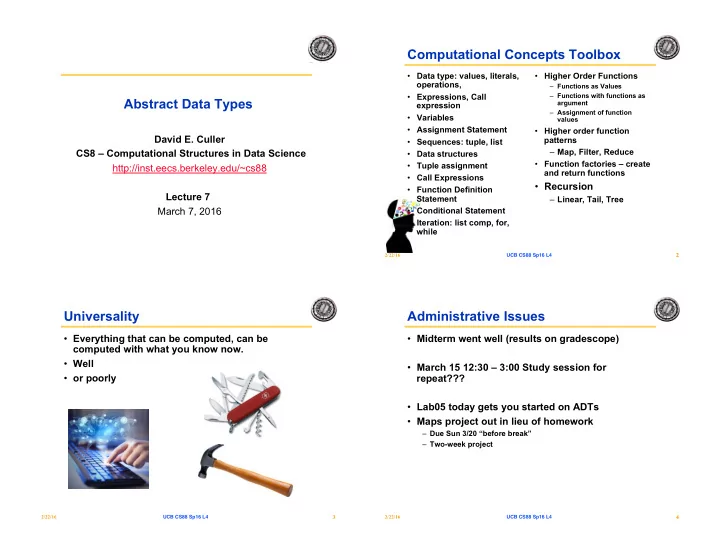
Computational Concepts Toolbox

  • Data type: values, literals,
  • perations,
  • Expressions, Call

expression

  • Variables
  • Assignment Statement
  • Sequences: tuple, list
  • Data structures
  • Tuple assignment
  • Call Expressions
  • Function Definition

Statement

  • Conditional Statement
  • Iteration: list comp, for,

while

  • Higher Order Functions

– Functions as Values – Functions with functions as argument – Assignment of function values

  • Higher order function

patterns – Map, Filter, Reduce

  • Function factories – create

and return functions

  • Recursion

– Linear, Tail, Tree

2/22/16 UCB CS88 Sp16 L4

2

Universality

  • Everything that can be computed, can be

computed with what you know now.

  • Well
  • or poorly

2/22/16 UCB CS88 Sp16 L4

3

Administrative Issues

  • Midterm went well (results on gradescope)
  • March 15 12:30 – 3:00 Study session for

repeat???

  • Lab05 today gets you started on ADTs
  • Maps project out in lieu of homework

– Due Sun 3/20 “before break” – Two-week project

2/22/16 UCB CS88 Sp16 L4

4

slide-2
SLIDE 2

C.O.R.E concepts

2/22/16 UCB CS88 Sp16 L4

5

Compute Operations Representation Evaluation

Perform useful computations treating objects abstractly as whole values and operating on them. Provide operations on the abstract components that allow ease of use – independent of concrete representation. Constructors and selectors that provide an abstract interface to a concrete representation Execution on a computing machine

Abstract Data Type Abstraction Barrier

Creating an Abtract Data Type

  • Operations

– Express the behavior of objects, invariants, etc – Implemented (abstractly) in terms of Constructors and Selectors for the object

  • Representation

– Constructors & Selectors – Implement the structure of the object

  • An abstraction barrier violation occurs when a

part of the program that can use the higher level functions uses lower level ones instead

– At either layer of abstraction

  • Abstraction barriers make programs easier to get

right, maintain, and modify

– Few changes when representation changes

2/22/16 UCB CS88 Sp16 L4

6

Examples You have seen

  • Lists

– Constructors: » list( … ) » [ <exps>,… ] » [<exp> for <var> in <list> [ if <exp> ] ] – Selectors: <list> [ <index or slice> ] – Operations: in, not in, +, *, len, min, max » Mutable ones too (but not yet)

  • Tuples

– Constructors: » tuple( … ) » ( <exps>,… ) – Selectors: <tuple> [ <index or slice> ] – Operations: in, not in, +, *, len, min, max

2/22/16 UCB CS88 Sp16 L4

7

Examples You have seen

  • Lists
  • Tuples
  • Strings

– Constructors: » str( … ) » “<chars>”, ‘<chars>’ – Selectors: <str> [ <index or slice> ] – Operations: in, not in, +, *, len, min, max

  • Range

– Constructors: » range(<end>), range(<start>,<end>), range(<start>,<end>,<step>) – Selectors: <range> [ <index or slice> ] – Operations: in, not in, len, min, max

2/22/16 UCB CS88 Sp16 L4

8

slide-3
SLIDE 3

Example ADT: lookup table (lut)

  • Unordered collection of unique key => value

bindings

– “lookup, i.e., get, the value associated with a key”

  • Where does this occur?

– Phonebook – Facebook friends – Movie listings – Restaurant ratings – Roster – …

2/22/16 UCB CS88 Sp16 L4

9

lut representation lut operations application

lut ADT

  • Constructors

– lut() - Return an empty lut – lut_add(lut, key, value) - Return a lut with new key => value binding – lut_del(lut, key) - Return a lut without a binding for key

  • Selectors

– lut_get(lut, key) - Return value in lut bound to key or None if none exists. – lut_keys(lut) - Return a list of keys for bindings in lut – lut_values(lut) - Return a list of values for bindings in lut – lut_items(lut) - Return a list of (key, value) for bindings in lut

  • Operations

2/22/16 UCB CS88 Sp16 L4

10

http://cs88-website.github.io/assets/slides/adt/lut.py

lut ADT

  • Constructors

– lut(), lut_add(lut, key, value), lut_del(lut, key)

  • Selectors

– lut_get(lut, key), lut_keys(lut), lut_values(lut), lut_items(lut)

  • Operations

– lut_with_bindings(bindings) - Return a lut of bindings – lut_len(lut) - Return the number of bindings in lut. – lut_print(lut) - Print a representation of bindings in lut. – lut_map_values(lut, fun) – lut_sorted(lut, fun) – lut_update(lut, key, value) – lut_fuzzy_get(lut, fuzz_key, dist_fun) » Return (key, value) for the key closest to fuzz_key under dist_fun.

2/22/16 UCB CS88 Sp16 L4

11

The Layered Design Process

  • Build the application based entirely on the ADT

interface

– Operations, Constructors and Selectors

  • Build the operations entirely in ADT

Constructors and Selectors

– Not the implementation of the representation

  • Build the constructors and selectors on some

concrete representation

2/22/16 UCB CS88 Sp16 L4

12

slide-4
SLIDE 4

An lut application (lut_app.py)

2/22/16 UCB CS88 Sp16 L4

13

from lut import * phone_book_data = [ ("Christine Strauch", "510-842-9235"), ("Frances Catal Buloan", "932-567-3241"), ("Jack Chow", "617-547-0923"), ("Joy De Rosario", "310-912-6483"), ("Casey Casem", "415-432-9292"), ("Lydia Lu", "707-341-1254")] phone_book = lut_with_bindings(phone_book_data) lut_print(phone_book) print("Jack Chows's Number: ", lut_get(phone_book, "Jack Chow")) print("Area codes") area_codes = lut_map_values(phone_book, lambda x:x[0:3]) lut_print(area_codes)

Apps (cont)

2/22/16 UCB CS88 Sp16 L4

14

New_book = lut_update(phone_book, "Jack Chow", "805-962-0936") lut_sorted(new_phone_book, lambda k,v:v) http://cs88-website.github.io/assets/slides/adt/lut_app.py

Apps (cont)

2/22/16 UCB CS88 Sp16 L4

15

def name_dist(name1, name2): count = max(len(name1),len(name2)) – min(len(name1),len(name2)) for i in range(min(len(name1), len(name2))): if (name1[i] != name2[i]): count += 1 return count lut_fuzzy_get(phone_book, "Jack", name_dist))

Friends App

2/22/16 UCB CS88 Sp16 L4

16

friend_data = [ ("Christine Strauch", "Jack Chow"), ("Christine Strauch", "Lydia Lu"), ("Jack Chow", "Christine Strauch"), ("Casey Casem", "Christine Strauch"), ("Casey Casem", "Jack Chow"), ("Casey Casem", "Frances Catal Buloan"), ("Casey Casem", "Joy De Rosario"), ("Casey Casem", "Casey Casem"), ("Frances Catal Buloan", "Jack Chow"), ("Jack Chow", "Frances Catal Buloan"), ("Joy De Rosario", "Lydia Lu"), ("Joy De Lydia", "Jack Chow") ]

slide-5
SLIDE 5

More Friends

2/22/16 UCB CS88 Sp16 L4

17

def make_friends(friends): friend_lut = lut() for (der, dee) in friends:

  • ld_friends = lut_get(friend_lut, der)

new_fr = old_friends + [dee] if old_friends is not None else [dee] friend_lut = lut_update(friend_lut, der, new_fr) return friend_lut

Above Abstraction Barrier – lut.py

2/22/16 UCB CS88 Sp16 L4

18

def lut_with_bindings(bindings): """Construct lookup table with (key,val) bindings.""” new_lut = lut() for k,v in bindings: new_lut = lut_add(new_lut, k, v) return new_lut

Aside: lambda

  • Function expression

– “anonymous” function creation – Expression, not a statement, no return or any other statement

2/22/16 UCB CS88 Sp16 L4

19

lambda <arg or arg_tuple> : <expression using args>

inc = lambda v : v + 1 def inc(v): return v + 1

Lambda Examples

2/22/16 UCB CS88 Sp16 L4

20

>>> msort([1,2,3,4,5], lambda x: x) [1, 2, 3, 4, 5] >>> msort([1,2,3,4,5], lambda x: -x) [5, 4, 3, 2, 1] >>> msort([(2, "hi"), (1, "how"), (5, "goes"), (7, "I")], lambda x:x[0]) [(1, 'how'), (2, 'hi'), (5, 'goes'), (7, 'I')] >>> msort([(2, "hi"), (1, "how"), (5, "goes"), (7, "I")], lambda x:x[1]) [(7, 'I'), (5, 'goes'), (2, 'hi'), (1, 'how')] >>> msort([(2,"hi"),(1,"how"),(5,"goes"),(7,"I")], lambda x: len(x[1])) [(7, 'I'), (2, 'hi'), (1, 'how'), (5, 'goes')] http://cs88-website.github.io/assets/slides/adt/mersort.py

slide-6
SLIDE 6

Lambdas

2/22/16 UCB CS88 Sp16 L4

21

>>> def inc_maker(i): ... return lambda x:x+i ... >>> inc_maker(3) <function inc_maker.<locals>.<lambda> at 0x10073c510> >>> inc_maker(3)(4) 7 >>> map(lambda x:x*x, [1,2,3,4]) <map object at 0x1020950b8> >>> list(map(lambda x:x*x, [1,2,3,4])) [1, 4, 9, 16] >>>

Above Abstraction Barrier – lut.py

2/22/16 UCB CS88 Sp16 L4

22

def lut_with_bindings(bindings): def lut_sorted(lut, fun): """Return a list of (k,v) for bindings in lut sorted by <= over fun(k, v).""” return msort(lut_items(lut), lambda b: fun(b[0],b[1]))

Above Abstraction Barrier – lut.py

2/22/16 UCB CS88 Sp16 L4

23

def lut_with_bindings(bindings): def lut_sorted(lut, fun): def lut_print(lut): """Print a representaion of bindings in lut."”” for k,v in lut_sorted(lut, lambda k,v:k): print(k,"=>",v)

Above Abstraction Barrier – lut.py

2/22/16 UCB CS88 Sp16 L4

24

def lut_with_bindings(bindings): def lut_sorted(lut, fun): def lut_print(lut): def lut_map_values(lut_to_map, fun): """Return lut of bindings (k, fun(v)) for k => v bindings in lut_to_map.""" return lut_with_bindings([(k,fun(v)) for k,v in lut_items(lut_to_map)])

slide-7
SLIDE 7

Above Abstraction Barrier – lut.py

2/22/16 UCB CS88 Sp16 L4

25

def lut_with_bindings(bindings): def lut_sorted(lut, fun): def lut_print(lut): def lut_map_values(lut_to_map, fun): def lut_update(lut, key, value): """Return a new lut with new or updated key=>value binding.""” if lut_get(lut, key) is None: return lut_add(lut, key, value) else: return lut_add(lut_del(lut, key), key, value)

Beneath the Abstraction Barrier

  • How to represent a lookup table?

2/22/16 UCB CS88 Sp16 L4

26

Representation: list of tuples

2/22/16 UCB CS88 Sp16 L4

27

# Constructors def lut(): """Construct a lookup table."”” return [] def lut_add(lut, key, value): """Return a new lut with (key,value) binding added.""" assert key not in lut_keys(lut), "Duplicate key” return [(key, value)] + lut def lut_del(lut, key): """Return a new lut with (key, *) binding removed.""" assert key in lut_keys(lut), ”Missing key” return [(k, v) for k,v in lut if k != key] http://cs88-website.github.io/assets/slides/adt/lut_tuples.py

Repr: list of tuples (lut_tuples.py)

2/22/16 UCB CS88 Sp16 L4

28

# Constructors def lut(): return [] def lut_add(lut, key, value): def lut_del(lut, key): # Selectors def lut_get(lut, key): for k,val in lut: if k == key: return val return None def lut_keys(lut): """Return a list of keys in lookup table lut.""" return map(lambda x:x[0], lut) def lut_values(lut): def lut_items(lut):

slide-8
SLIDE 8

Repr: tuple of lists – lut_lists.py

2/22/16 UCB CS88 Sp16 L4

29

# Constructors def lut(): """Construct a lookup table.""" return ([], []) def lut_add(lut, key, value): """Return a new lut with (key,value) binding added.""" assert key not in lut_keys(lut), "Duplicate key" return ([key] + lut_keys(lut), [value] + lut_values(lut)) def lut_del(lut, key): """Return a new lut with (key, *) binding removed.""" assert key in lut_keys(lut), ”Missing key" keys, values = lut key_index = keys.index(key) return (keys[0:key_index] + keys[key_index+1:], values[0:key_index] + values[key_index+1:]) http://cs88-website.github.io/assets/slides/adt/lut_lists.py

Repr: list of tuples (lut_lists.py)

2/22/16 UCB CS88 Sp16 L4

30

# Constructors def lut(): return ([], []) def lut_add(lut, key, value): def lut_del(lut, key): # Selectors def lut_get(lut, key): for k,val in zip(lut[0],lut[1]): if k == key: return val return None def lut_keys(lut): """Return a list of keys in lookup table lut.""" return lut[0]

Repr: list of tuples (lut_lists.py)

2/22/16 UCB CS88 Sp16 L4

31

# Constructors def lut(): return ([], []) def lut_add(lut, key, value): def lut_del(lut, key): # Selectors def lut_get(lut, key): def lut_keys(lut): def lut_values(lut): """Return a list of values in lookup table lut.""" return lut[1] def lut_items(lut): """Return a list of (key,value) items in lut.""" return list(zip(lut[0],lut[1]))

Dictionaries

  • Lists, Tuples, Strings, Range
  • Dictionaries

– Constructors: » dict( <list of 2-tuples> ) » dict( <key>=<val>, ...) # like kwargs » { <key exp>:<val exp>, … } » { <key>:<val> for <iteration expression> }

>>> {x:y for x,y in zip(["a","b"],[1,2])} {'a': 1, 'b': 2}

– Selectors: <dict> [ <key> ] » <dict>.keys(), .items(), .values() » <dict>.get(key [, default] ) – Operations: » Key in, not in, len, min, max » <dict>[ <key> ] = <val>

2/22/16 UCB CS88 Sp16 L4

32

slide-9
SLIDE 9

Dictionary Example

2/22/16 UCB CS88 Sp16 L4

33

Repr: dictionary – lut_dict.py

2/22/16 UCB CS88 Sp16 L4

34

# Constructors def lut(): """Construct a lookup table."”” return {} def lut_add(lut, key, value): """Return a new lut with (key,value) binding added.""" assert key not in lut_keys(lut), "Duplicate key" new_lut = lut.copy() new_lut[key] = value return new_lut def lut_del(lut, key): """Return a new lut with (key, *) binding removed.""" assert key in lut_keys(lut), ”Missing key" new_lut = lut.copy() del new_lut[key] return new_lut http://cs88-website.github.io/assets/slides/adt/lut_dict.py

Repr: dictionary

2/22/16 UCB CS88 Sp16 L4

35

# Constructors def lut(): return {} def lut_add(lut, key, value): def lut_del(lut, key): # Selectors def lut_get(lut, key): """Return the value bound to key in lut or None.""" return lut.get(key, None) # see lut[key] def lut_keys(lut): """Return a list of keys in lookup table lut.""" return list(lut.keys()) def lut_values(lut): """Return a list of values in lookup table lut.""" return list(lut.values()) def lut_items(lut): """Return a list of (key,value) items in lut.""" return list(lut.items())

In Lab

  • Dictionaries
  • Lambdas
  • Abstract Data Types
  • Go build things…

2/22/16 UCB CS88 Sp16 L4

36