Functions Declarations vs Definitions Inline Functions Class - - PDF document

functions
SMART_READER_LITE
LIVE PREVIEW

Functions Declarations vs Definitions Inline Functions Class - - PDF document

2/21/2017 Functions in C++ Functions Declarations vs Definitions Inline Functions Class Member functions Overloaded Functions For : COP 3330. Pointers to functions Object oriented Programming (Using C++) Recursive


slide-1
SLIDE 1

2/21/2017 1

Functions

For : COP 3330. Object oriented Programming (Using C++)

http://www.compgeom.com/~piyush/teach/3330 Piyush Kumar

Functions in C++

 Declarations vs Definitions  Inline Functions  Class Member functions  Overloaded Functions  Pointers to functions  Recursive functions

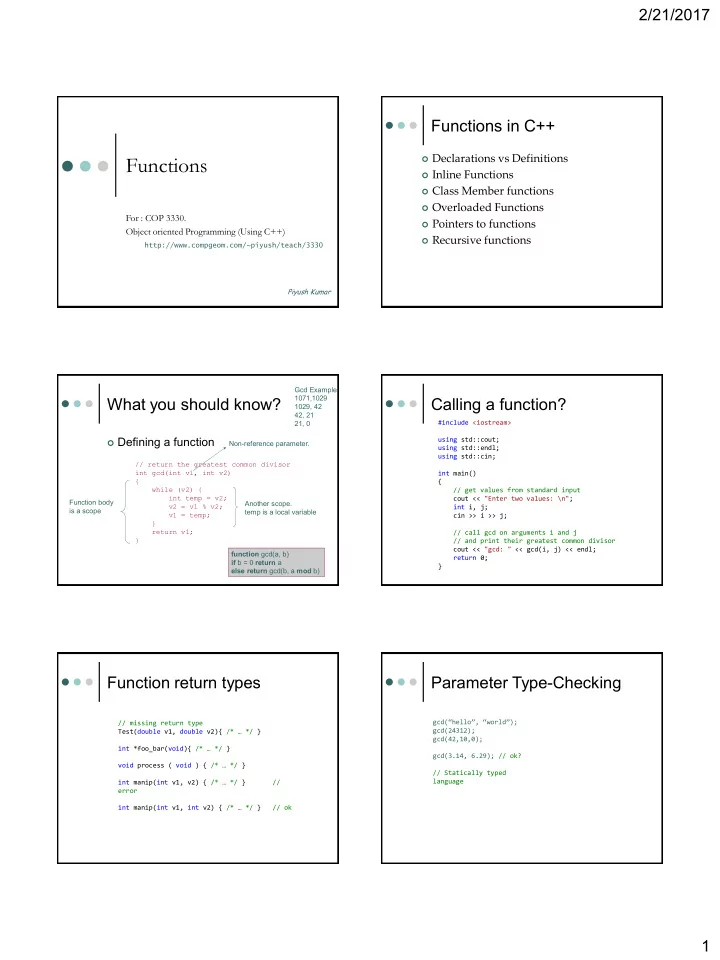
What you should know?

 Defining a function

// return the greatest common divisor int gcd(int v1, int v2) { while (v2) { int temp = v2; v2 = v1 % v2; v1 = temp; } return v1; } function gcd(a, b) if b = 0 return a else return gcd(b, a mod b) Gcd Example 1071,1029 1029, 42 42, 21 21, 0 Function body is a scope Another scope. temp is a local variable Non-reference parameter.

Calling a function?

#include <iostream> using std::cout; using std::endl; using std::cin; int main() { // get values from standard input cout << "Enter two values: \n"; int i, j; cin >> i >> j; // call gcd on arguments i and j // and print their greatest common divisor cout << "gcd: " << gcd(i, j) << endl; return 0; }

Function return types

// missing return type Test(double v1, double v2){ /* … */ } int *foo_bar(void){ /* … */ } void process ( void ) { /* … */ } int manip(int v1, v2) { /* … */ } // error int manip(int v1, int v2) { /* … */ } // ok

Parameter Type-Checking

gcd(“hello”, “world”); gcd(24312); gcd(42,10,0); gcd(3.14, 6.29); // ok? // Statically typed language

slide-2
SLIDE 2

2/21/2017 2 Pointer Parameters

#include <iostream> #include <vector> using std::vector; using std::endl; using std::cout; void reset(int *ip) { *ip = 0; // changes the value of the object to which ip points ip = 0; // changes only the local value of ip; the argument is unchanged } int main() { int i = 42; int *p = &i; cout << "i: " << *p << '\n'; // prints i: 42 reset(p); // changes *p but not p cout << "i: " << *p << endl; // ok: prints i: 0 return 0; }

Const parameters

 Fcn(const int i) {}…  Fcn can read but not write to i.

Reference Parameters

// vec is potentially large, so copying vec might be expensive // use a const reference to avoid the copy void print(const vector<int> &vec) { for (vector<int>::const_iterator it = vec.begin(); it != vec.end(); ++it) { if (it != vec.begin()) cout << " "; cout << *it; } cout << endl; } int main() { vector<int> vec(42); print(vec.begin(), vec.end()); // Defined on next slide print(vec); } Can be used to return information

Passing Iterators

// pass iterators to the first and one past the last element to print void print(vector<int>::const_iterator beg, vector<int>::const_iterator end) { while (beg != end) { cout << *beg++; if (beg != end) cout << " "; // no space after last element } cout << endl; }

Const references

// When you don’t what the function to modify the value associated with // the reference bool isShorter(const string &s1, const string &s2){ return s1.size() < s2.size(); }

Passing reference to a pointer

// swap values of two pointers to int void ptrswap(int *&v1, int *&v2) { int *tmp = v2; v2 = v1; v1 = tmp; } // v1 and v2 are the pointers passed to ptrswap themselves, // just renamed // The following link is out of the reach of this course: // Reading C/C++ declarations: http://www.unixwiz.net/techtips/reading-cdecl.html

slide-3
SLIDE 3

2/21/2017 3 Array parameters

 void printvalues(const int ia[10]);  Parameter treated as “const int *”

No return values?

 void swap (int &v1, int &v2);

Returning from main

#include <cstdlib> int main() { bool some_failure = false; if (some_failure) return EXIT_FAILURE; else return EXIT_SUCCESS; } // Typical use: exit(EXIT_FAILURE)

Returning a reference

#include <string> #include <iostream> using std::string; using std::cout; using std::endl; //inline version: find longer of two strings inline const string & shorterString(const string &s1, const string &s2) { return s1.size() < s2.size() ? s1 : s2; } int main() { string s1("successes"), s2("failure"); cout << shorterString(s1, s2) << endl; return 0; }

Tip 1: Never return a reference to a local object. Tip 2: Never return a pointer to a local object. Put these in header files.

Recursion

 Recursion is the process a procedure

goes through when one of the steps of the procedure involves rerunning the entire same procedure.

 Fibonacci number sequence:  F(n) = F(n − 1) + F(n − 2).

Recursion

function factorial(n) { if (n <= 1) return 1; else return n * factorial(n-1); }

slide-4
SLIDE 4

2/21/2017 4 Recursion Recursion

template <typename T> void recSort(T begin, T end){ int len = distance(begin,end); if( len <= 1) return; for(int i = 1; i < len; ++i) if(*(begin+i) < *(begin)) swap( *(begin+i) , *(begin) ); recSort(begin+1,end); } int main() { vector<int> vs; int N = 10; for(int i = 0; i < N; ++i) vs.push_back(rand()); recSort(vs.begin(), vs.end()); for(int i = 0; i < N; ++i) cout << vs[i] << endl; return 0; }

Recursion

template <typename T> void recSort(T begin, T end){ int len = distance(begin,end); if( len <= 1) return; for(int i = 1; i < len; ++i) if(*(begin+i) < *(begin)) swap( *(begin+i) , *(begin) ); recSort(begin+1,end); }

void recSort(vector<int>::iterator begin, vector<int>::iterator end){ int len = distance(begin,end); if( len <= 1) return; for(int i = 1; i < len; ++i) if(*(begin+i) < *(begin)) swap( *(begin+i) , *(begin) ); recSort(begin+1,end); } Generates Can you see the recursion in a Sudoku solver?

Recursion

 Another example.

void printNum(int n) { if (n >= 10) printNum(n/10); print(n%10); } Another version. void printNumB(int n, int b) { if (n >= b) printNumB(n/b); print(n%b); }

Recursion

Eight Queens problem:

Brute force solution: 64^8 = 2^48 = 281,474,976,710,656 possible blind placements of eight queens,

 The eight queens puzzle is based on the problem of

putting eight chess queens on an 8×8 chessboard such that none of them is able to capture any other using the standard chess queen's moves.

Recursion

 Invariants:  no two pieces can share the same row  any solution for n queens on an n×m

board must contain a solution for n−1 queens on an (n−1)×m board

 proceeding in this way will always

keep the queens in order, and generate each solution only once.

slide-5
SLIDE 5

2/21/2017 5 Backtracking

 A strategy for guessing at a solution

and backing up when an impasse is reached

 Recursion and Backtracking can be

used together to solve our problem (and many other problems)

Eight Queens

 An observation that eliminates many

arrangements from consideration

 No queen can reside in a row or a

column that contains another queen

  • Now: only 40,320 (8!) arrangements of

queens to be checked for attacks along diagonals

Eight Queens

 A recursive algorithm that places a queen in

a column

 Base case

  • If there are no more columns to consider
  • You are finished

 Recursive step

  • If you successfully place a queen in the current

column

  • Consider the next column
  • If you cannot place a queen in the current column
  • You need to backtrack

The Eight Queens Problem

Figure 5.1 a) Five queens that cannot attack each other, but that can attack all of column 6; b) backtracking to column 5 to try another square for the queen; c) backtracking to column 4 to try another square for the queen and then considering column 5 again

Backtracking Animation Default Arguments

int ff(int i = 0); screen = screenInit( string::size_type height = 24, string::size_type width = 80, char background = ‘ ‘ ); string screen = screenInit(); string screen = screenInit(66); string screen = screenInit(66,256); string screen = screenInit(66,256,’#’); string screen = screenInit(,,’?’); // error string screen = screenInit(’?’); // calls (‘?’,80,’ ‘); You can also call functions to initialize default

  • Arguments. These functions are called when the function is called.
slide-6
SLIDE 6

2/21/2017 6 Function overloading

 Functions having same name but

different parameter types.

 Record lookup(const Account&);  Record lookup(const Phone&);  Record lookup(const Name&);  Record lookup(const SS&);