Iterators and Generators Sequences: tuple, list return functions - - PDF document

iterators and generators
SMART_READER_LITE
LIVE PREVIEW

Iterators and Generators Sequences: tuple, list return functions - - PDF document

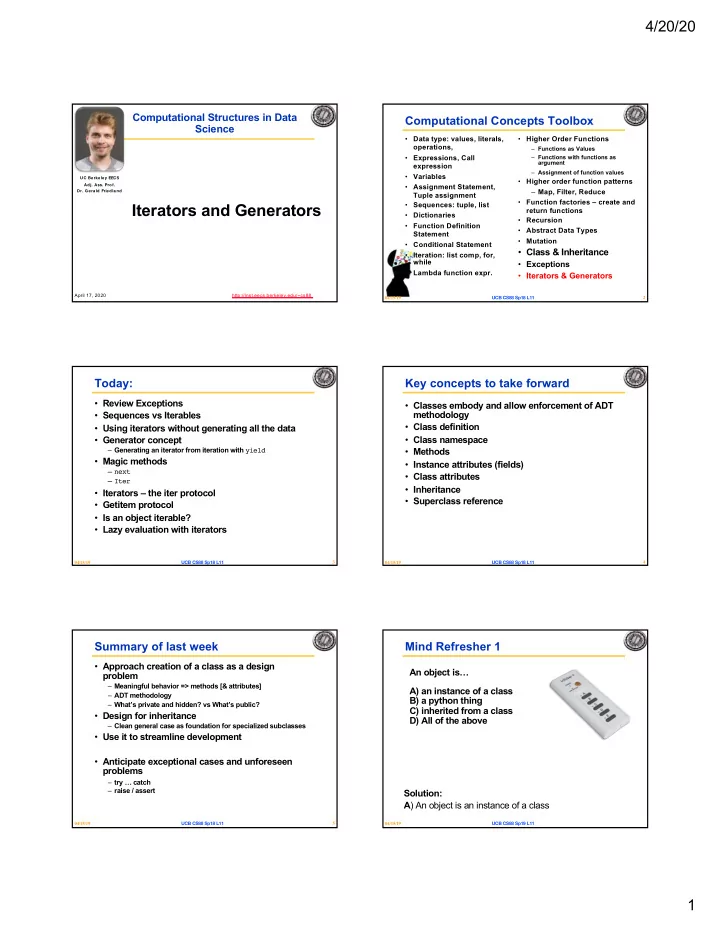
4/20/20 Computational Structures in Data Computational Concepts Toolbox Science Data type: values, literals, Higher Order Functions operations, Functions as Values Expressions, Call Functions with functions as argument


slide-1
SLIDE 1

4/20/20 1

Computational Structures in Data Science

Iterators and Generators

U C Berkeley EECS

  • Adj. Ass. Prof.
  • Dr. Gera ld Friedla nd

http://inst.eecs.berkeley.edu/~cs88 April 17, 2020

Computational Concepts Toolbox

  • Data type: values, literals,
  • perations,
  • Expressions, Call

expression

  • Variables
  • Assignment Statement,

Tuple assignment

  • Sequences: tuple, list
  • Dictionaries
  • Function Definition

Statement

  • Conditional Statement
  • Iteration: list comp, for,

while

  • Lambda function expr.
  • Higher Order Functions

– Functions as Values – Functions with functions as argument – Assignment of function values

  • Higher order function patterns

– Map, Filter, Reduce

  • Function factories – create and

return functions

  • Recursion
  • Abstract Data Types
  • Mutation
  • Class & Inheritance
  • Exceptions
  • Iterators & Generators

04/15/19 UCB CS88 Sp18 L11 2

Today:

  • Review Exceptions
  • Sequences vs Iterables
  • Using iterators without generating all the data
  • Generator concept

– Generating an iterator from iteration with yield

  • Magic methods

– next – Iter

  • Iterators – the iter protocol
  • Getitem protocol
  • Is an object iterable?
  • Lazy evaluation with iterators

3 04/15/19 UCB CS88 Sp18 L11

Key concepts to take forward

  • Classes embody and allow enforcement of ADT

methodology

  • Class definition
  • Class namespace
  • Methods
  • Instance attributes (fields)
  • Class attributes
  • Inheritance
  • Superclass reference

4 04/15/19 UCB CS88 Sp18 L11

Summary of last week

  • Approach creation of a class as a design

problem

– Meaningful behavior => methods [& attributes] – ADT methodology – What’s private and hidden? vs What’s public?

  • Design for inheritance

– Clean general case as foundation for specialized subclasses

  • Use it to streamline development
  • Anticipate exceptional cases and unforeseen

problems

– try … catch – raise / assert

5 04/15/19 UCB CS88 Sp18 L11

Mind Refresher 1

An object is… A) an instance of a class B) a python thing C) inherited from a class D) All of the above Solution: A) An object is an instance of a class

04/15/19 UCB CS88 Sp19 L11

slide-2
SLIDE 2

4/20/20 2

Mind Refresher 2

A setter method… A) constructs an object B) changes the internal state of an object or class C) is required by Python to access variables D) All of the above Solution: B) Changes the internal state of an object or class by allowing access to a private variable.

04/15/19 UCB CS88 Sp19 L11

Exception (read 3.3)

  • Mechanism in a programming language to

declare and respond to “exceptional conditions”

– enable non-local cntinuations of control

  • Often used to handle error conditions

– Unhandled exceptions will cause python to halt and print a stack trace – You already saw a non-error exception – end of iterator

  • Exceptions can be handled by the program

instead

– assert, try, except, raise statements

  • Exceptions are objects!

– They have classes with constructors

8 04/15/19 UCB CS88 Sp18 L11

Handling Errors – try / except

  • Wrap your code in try – except statements
  • Execution rule

– <try suite> is executed first – If during this an exception is raised and not handled otherwise – And if the exception inherits from <exception class> – Then <except suite> is executed with <name> bound to the exception

  • Control jumps to the except suite of the most

recent try that handles the exception

9

try: <try suite> except <exception class> as <name>: <except suite> ... # continue here if <try suite> succeeds w/o exception

04/15/19 UCB CS88 Sp18 L11

Types of exceptions

  • TypeError -- A function was passed the wrong

number/type of argument

  • NameError -- A name wasn't found
  • KeyError -- A key wasn't found in a dictionary
  • RuntimeError -- Catch-all for troubles during

interpretation

  • . . .

10 04/15/19 UCB CS88 Sp18 L11

Demo

11 04/15/19 UCB CS88 Sp18 L11

Exceptions are Classes

12

class NoiseyException(Exception): def __init__(self, stuff): print("Bad stuff happened", stuff) try: return fun(x) except: raise NoiseyException((fun, x))

04/15/19 UCB CS88 Sp18 L11

slide-3
SLIDE 3

4/20/20 3

Mind Refresher 3

Exceptions… A) allow to handle errors non-locally B) are objects C) cannot happen within a catch block D) B, C E) A, B Solution: A, B) Exceptions are objects, passed through the callstack and they can occur any time.

04/15/19 UCB CS88 Sp19 L11

Iterable - an object you can iterate over

  • iterable: An object capable of yielding its members
  • ne at a time.
  • iterator: An object representing a stream of data.
  • We have worked with many iterables as if they were

sequences

14 04/15/19 UCB CS88 Sp18 L11

Functions that return iterables

  • map
  • range
  • zip
  • These objects are not sequences.
  • If we want to see all of the elements at once, we

need to explicitly call list() or tuple() on them

15 04/15/19 UCB CS88 Sp18 L11

Generators: turning iteration into an iterable

  • Generator functions use iteration (for loops, while

loops) and the yield keyword

  • Generator functions have no return statement, but

they don’t return None

  • They implicitly return a generator object
  • Generator objects are just iterators

16

def squares(n): for i in range(n): yield (i*i)

04/15/19 UCB CS88 Sp18 L11

Nest iteration

17

def all_pairs(x): for item1 in x: for item2 in x: yield(item1, item2)

04/15/19 UCB CS88 Sp18 L11

Iterables

18 04/15/19 UCB CS88 Sp18 L11

Demo

slide-4
SLIDE 4

4/20/20 4

Next element in generator iterable

  • Iterables work because they have some "magic

methods" on them. We saw magic methods when we learned about classes,

  • e.g., __init__, __repr__ and __str__.
  • The first one we see for iterables is __next__
  • iter( ) – transforms a sequence into an iterator

19 04/15/19 UCB CS88 Sp18 L11

Iterators – iter protocol

  • In order to be iterable, a class must implement

the iter protocol

  • The iterator objects themselves are required to

support the following two methods, which together form the iterator protocol:

– __iter__() : Return the iterator object itself. This is required to allow both containers and iterators to be used with the for and in statements. – This method returns an iterator object, Iterator can be self – __next__() : Return the next item from the container. If there are no further items, raise the StopIteration exception.

  • Classes get to define how they are iterated over by

defining these methods

20 04/15/19 UCB CS88 Sp18 L11

Getitem protocol

  • Another way an object can behave like a sequence

is indexing: Using square brackets “[ ]” to access specific items in an object.

  • Defined by special method: __getitem__(self, i)

– Method returns the item at a given index

21 04/15/19 UCB CS88 Sp18 L11

Determining if an object is iterable

  • from collections.abc import Iterable
  • isinstance([1,2,3], Iterable)
  • This is more general than checking for any list of

particular type, e.g., list, tuple, string...

22 04/15/19 UCB CS88 Sp18 L11