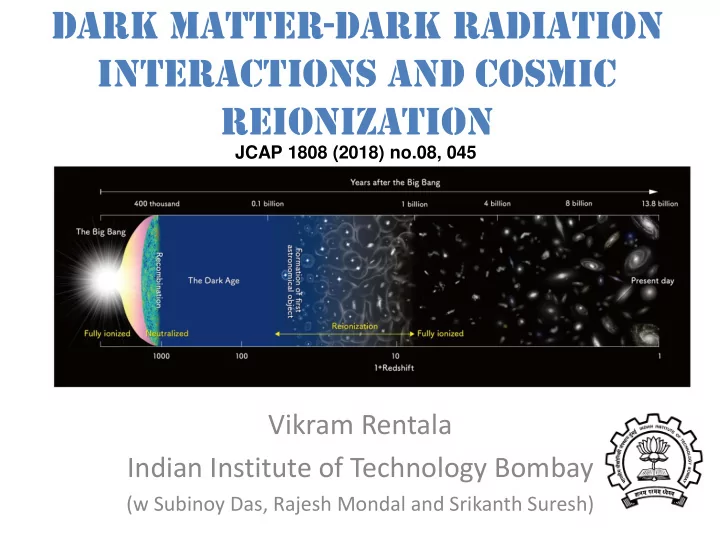
SLIDE 1 Dark matter-DARK RadiAtion interactions and cosmic reionization
Vikram Rentala Indian Institute of Technology Bombay
(w Subinoy Das, Rajesh Mondal and Srikanth Suresh)
JCAP 1808 (2018) no.08, 045
SLIDE 2 Observational constraints on reionization
- Quasar absorption spectra traces neutral hydrogen
SLIDE 3 Observational constraints on reionization
SLIDE 4 Observational constraints on reionization
SLIDE 5 When does reionization happen?
Seiler, Jacob et al. astro-ph/1902.01611
SLIDE 6 Can we constrain dark matter particle physics models with these
SLIDE 7 Outline
- Self-interacting dark matter
- ETHOS framework
- Structure formation
- Constraints from Cosmic Reionization
- Future observables
- Conclusions
SLIDE 8
Astrophysical and cosmological evidence for dark matter
SLIDE 9 Problems with the standard LCDM
Small scales
- Missing satellite problem (Klypin et al, Moore et al, 1999)
- Too big to fail problem (Boylan-Kolchin et al, 2011)
- Core cusp problem (Oh et al, 2010)
Baryonic feedback or dark matter self interactions?
(Bullock et al 2000, Benson et al 2002, Governato et al 2010)
Large scales
- Hubble tension (Zhang et al, 2017)
- σ8 tension (Battye et al 2014)
- Effective number of neutrinos (Mangano et al 2005, Lesgourges et al
2016)
SLIDE 10 Self-interacting dark matter
c c c c
Spergel, Steinhardt PRL, 1999 Harvey et al, Science, 2015
SLIDE 11 Dark matter and dark radiation
Visible Hidden Mediator Light particles are generic:
Goldstone bosons, chiral fermions, gauge bosons
CMB:
Mass/Energy
SLIDE 12
Evolution of cosmological perturbations Metric
Photons Electrons Protons Dark Matter Neutrinos
SLIDE 13
Evolution of cosmological perturbations Metric
Photons Electrons Protons Dark Matter Dark Radiation Neutrinos
?
SLIDE 14 Wh What at is the is the impact impact of D
ark Matter Matter-Dar Dark k Radiatio Radiation n inte interactions ractions on reio
nization? tion?
- Impact on structure formation
- Impact on reionization
SLIDE 15
Impact on structure formation
SLIDE 16 ETHOS framework
(Cyr-Racine et al 2016)
Particle physics -> Cosmology Basic idea: Map all the particle physics parameters to coefficients of a red-shift series expansion of the collision term
SLIDE 17 ETHOS model 1
(Cyr-Racine et al, Binder et al 2016) Dark matter particle Dark radiation Mediator
SLIDE 18 Decoupling of DM and DR
- Comoving Hubble scale
- Scattering length
Early times Late times DM and DR are tightly coupled (dark acoustic oscillations) DM and DR are decoupled (DM free streams) * We will assume that this transition takes place in the radiation dominated universe
SLIDE 19
Decoupling of dark matter and dark radiation
SLIDE 20
Jeans scale (pre-decoupling)
SLIDE 21
Jeans scale (post-decoupling)
SLIDE 22
Evolution of Jeans scale in ETHOS 1
SLIDE 23
Evolution of Jeans scale in ETHOS 1
SLIDE 24
Evolution of Jeans scale in WDM models
SLIDE 25
Evolution of Jeans scale in WDM models
SLIDE 26
Linear Power Spectrum (z=124)
SLIDE 27
Non-Linear power spectrum (z=8)
from N-body simulation Lyman-alpha constraints rule out mx < 3.5 keV
SLIDE 28
Halo mass distribution (z=8)
from Halo finding algorithm
SLIDE 29
Halo mass distribution (z=8)
from Halo finding algorithm
SLIDE 30
Impact on reionization
SLIDE 31 From structure to reionization
Halos in ΛCDM
SLIDE 32 From structure to reionization
Halos in ΛCDM
SLIDE 33 From structure to reionization
With suppressed small scale structure we need higher values of Nion in order to achieve reionization!
Halos in self-interacting DM model
SLIDE 34
What value of Niondo we need for successful reionization?
SLIDE 35
HI brightness temperature (z = 8)
Nion Nion 100 321 721 23 23 57 225 861
SLIDE 36
Can we estimate Nion?
can be safely assumed
Depends on metallicity, IMF, SF efficiency, escape fraction
Large systematic uncertainties! However,
SLIDE 37 Our Results
- Constraint on a4 from demanding consistency
with global history of reionization
SLIDE 38 Future: HI brightness power spectrum
Future 21 cm surveys could measure this difference
GMRT, LOFAR, MWA, PAPER, SKA, HERA …
SLIDE 39 Other future observations
How can we reduce systematic uncertainties on Nion?
- Direct observations of early galaxies that reionized
the universe (using near IR observations)
- Pop III stars (JWST)
- Improved galaxy formation simulations matched to
data
SLIDE 40 Conclusions
- Dark Matter - Dark radiation interactions can
lead to suppression of the small scale matter power spectrum
- Global history of reionization can set strong
constraints on DM-DR interactions
- Need to have a realistic understanding of the
astrophysical uncertainties
- 21 cm surveys could potentially detect the
impact of DM-DR interactions on cosmological perturbations
SLIDE 41
QUESTIONS, COMMENTS, SUGGESTIONS?
SLIDE 42
Backup Slides
SLIDE 43
Robustness check
SLIDE 44 Global history of reionization
EDGES, SARAS, DARE … Pritchard (2011)
SLIDE 45 Abundance Matching
The Current Status of Galaxy Formation - Silk, Joe et al. arXiv:1207.3080