Introduction to astroparticle observables and cosmic ray physics - - PowerPoint PPT Presentation

introduction to astroparticle observables and cosmic ray
SMART_READER_LITE
LIVE PREVIEW

Introduction to astroparticle observables and cosmic ray physics - - PowerPoint PPT Presentation

Introduction to astroparticle observables and cosmic ray physics Cosmic rays basics, discovery Particle astrophysics: experimental settings and messengers Fundamental questions: anti-matter, dark matter, cosmic ray origins


slide-1
SLIDE 1
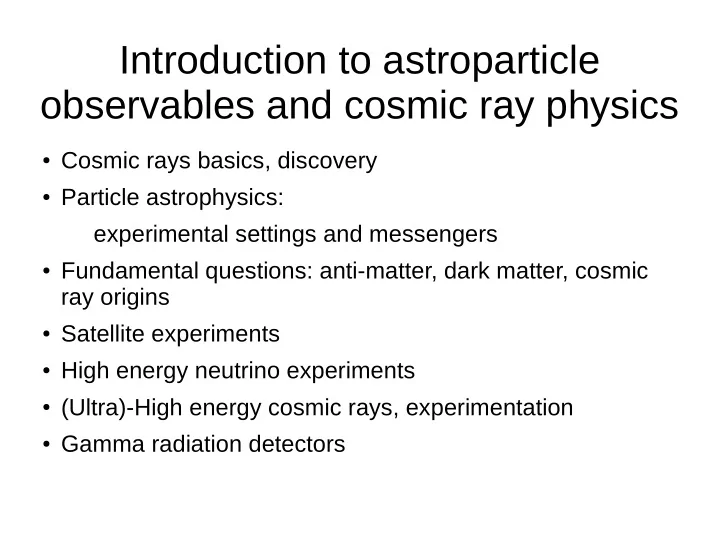
  • Cosmic rays basics, discovery
  • Particle astrophysics:

experimental settings and messengers

  • Fundamental questions: anti-matter, dark matter, cosmic

ray origins

  • Satellite experiments
  • High energy neutrino experiments
  • (Ultra)-High energy cosmic rays, experimentation
  • Gamma radiation detectors

Introduction to astroparticle

  • bservables and cosmic ray physics
slide-2
SLIDE 2

Experimental settings overview

  • Relevance of atmospheric effects
slide-3
SLIDE 3
slide-4
SLIDE 4

Antimatter: antiprotons

  • BESS (balloon), AMS

(satellite)

  • Matter / antimatter

asymmetry, is there antimatter region of the universe

  • A single anti-carbon nucleus

proves the existence of an anti-matter world

slide-5
SLIDE 5

Can anti-protons come from DM (WIMP-s, neutralino?)

  • Anti-proton production consistent with CR and

interstellar material interaction

slide-6
SLIDE 6

Antimatter:Positrons (various sources,

shorter lifetime, more effects from solar magnetic field)

  • Max/min sunspot, sensitive to DM
slide-7
SLIDE 7

AMS (see talk by G. Pásztor)

  • Experiment at the ISS
  • Full “Particle Physics” toolkit: tracking, PID
slide-8
SLIDE 8

BESS: balloon experiment

  • Long term flights (months), 38km (1% pressure!)
slide-9
SLIDE 9

BESS flight system: cost efficiency

  • The balloon is also an engineering marvel
slide-10
SLIDE 10

Sources of (high energy) cosmic rays

  • Is it uniform? How modified during travel (GZK-like,

intergalactic material?) What is the composition?

  • Galactic magnetic field: minimal above 10^20eV
  • Active Galactic Nuclei (massive BH)
  • Magnetars (fast spinning high magnetic field)
  • Gamma Ray Burst - correlated
slide-11
SLIDE 11

Cosmic rays

  • Falling as 1/E^3
  • 25 orders in flux
  • Structures

Knee, Ankle

slide-12
SLIDE 12

Acceleration scheme: “Hillas plot”

  • E approximately:

Z B R

  • Sources up to

few EeV

slide-13
SLIDE 13

UHECR: the very tail of CR

  • Dedicated Extended Air Shower (EAS) detectors
slide-14
SLIDE 14

Greisen-Zatsepin-Kuzmin cutoff

  • UHECR interaction with CMBR
  • Propagation distance 100Mly
  • Mechanism: p+gamma →

Delta → p+pi0

  • For high energy nuclei,

dissociation! So even faster decay

  • Length scale (time scale):

100My

slide-15
SLIDE 15

EAS: Pierre Auger Observatory

slide-16
SLIDE 16

Detection techniques at PAO

  • Fluorescence in atmosphere (N2, at clear night)
  • Scintillator tanks (high area, all time)
slide-17
SLIDE 17

Fluorescence: precision measurement, like calorimetry

  • 3D imaging of the shower, lateral and longitudinal

profile to be compared to simulations

  • Direct comparison to ground arrays
slide-18
SLIDE 18

Ground array

  • It is large. 1.5km spacing: 5 – 10 towers hit at a time
  • Arrival time comparision gives angular information

(typical 1 degree at 10EeV)

slide-19
SLIDE 19

Air shower, complicated development

  • Electrons and muons (10 EeV proton)

(Sergio Sciutto for AIRES, UChicago)

slide-20
SLIDE 20

Typical event with both observation techniques

  • Energy and direction
  • Precision comparison
  • f the two

measurements

  • Shower profile (nearly

reaching surface)

slide-21
SLIDE 21

Neutrinos: a truly penetrating messenger

(See also talk of Emma Kun)

  • (25 orders of magnitude in relevant energy)
  • High and very high E neutrinos: special “particle

physics” detectors. Note: xsect goes with E !

  • One of the most relevant sources:

p + gamma → pi+ + neutron → neutrino

  • On Earth: also Atmospheric
  • Example cosmic neutrino detector: ICECUBE
slide-22
SLIDE 22

Neutrino sources

  • Low energy: solar; Medium energy:

Atmospheric; High energy: interaction with UHECR (J. Becker)

slide-23
SLIDE 23

IceCube Detector at Antarctica

  • A truly big array of down-looking photo-

multipliers

slide-24
SLIDE 24

Upward-going neutrinos!

  • Interaction in Earth crust with high xsection!

few 1000km interaction length

  • Ensuring appearance inside detector volume
slide-25
SLIDE 25

Gamma rays: very special direct sources (see talk by Zsolt Bagoly)

  • Active Galactic Nuclei
  • Neutron stars and (ms) pulsars
  • Gamma Ray Bursts (short time)
slide-26
SLIDE 26

Gamma rays: FERMI satellite

  • Soruces: decays, cosmic ray interactions
  • One most relevant source: p + gamma → pi0 +

proton → gamma; also inverse Compton

slide-27
SLIDE 27

Fermi LAT instrument: tracking combined with calorimetry

  • Very good angular (direction) resolution (first e+e- pair)
  • Extremely low background, rejection of charged and out-of-

sight gamma signals

slide-28
SLIDE 28

Conclusions

  • Particle-astrophysics: very interesting and

scientifically decisive astro-messengers to be studied

  • Astro-particlephysics: high energy instrumentation

in astro-settings

  • Multi-messengers with very different observables

and detector systems

  • Large collaborations (satellite, UHECR, gamma,

neutrinos)

slide-29
SLIDE 29

Sources

  • Open promotional online materials
  • Large collaboration press releases and public

images

  • ICRC proceedings
  • Credited sources: Anni Adams,