
SLIDE 1
Slide 1 / 67
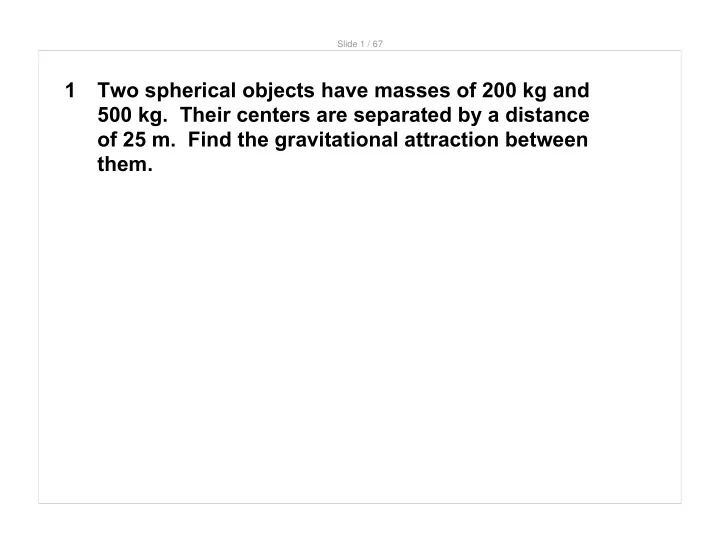
1 Two spherical objects have masses of 200 kg and 500 kg. Their centers are separated by a distance
- f 25 m. Find the gravitational attraction between
1 Two spherical objects have masses of 200 kg and 500 kg. Their - - PowerPoint PPT Presentation
Slide 1 / 67 1 Two spherical objects have masses of 200 kg and 500 kg. Their centers are separated by a distance of 25 m. Find the gravitational attraction between them. Slide 2 / 67 2 Two spherical objects have masses of 1.5 x 10 5 kg and
Slide 1 / 67
Slide 2 / 67
Slide 3 / 67
Slide 4 / 67
Slide 5 / 67
A What is the size of the force acting on the smaller object? B What is the size of the force acting on the larger object? C What is the acceleration of the smaller object when it is released? D What is the acceleration of the larger object when it is released?
Slide 6 / 67
Slide 7 / 67
Slide 8 / 67
Slide 9 / 67
Slide 10 / 67
A What is the size of the force acting on the smaller object? B What is the size of the force acting on the larger object? C What is the acceleration of the smaller object when it is released? D What is the acceleration of the larger object when it is released?
Slide 11 / 67
Slide 12 / 67
Slide 13 / 67
Slide 14 / 67
Slide 15 / 67
A What is the size of the force acting on the smaller object? B What is the size of the force acting on the larger object? C What is the acceleration of the smaller object when it is released? D What is the acceleration of the larger object when it is released?
Slide 16 / 67
Slide 17 / 67
Slide 18 / 67
Slide 19 / 67
Slide 20 / 67
Slide 21 / 67
Slide 22 / 67
Slide 23 / 67
Slide 24 / 67
Slide 25 / 67
Slide 26 / 67
Slide 27 / 67
Slide 28 / 67
Slide 29 / 67
Slide 30 / 67
Slide 31 / 67
Slide 32 / 67
Slide 33 / 67
Slide 34 / 67
Slide 35 / 67
Slide 36 / 67
Slide 37 / 67
Slide 38 / 67
Slide 39 / 67
Slide 40 / 67
Slide 41 / 67
8 m and an orbital
Slide 42 / 67
Slide 43 / 67
Calculate the magnitude and state the direction.
to the space rock. Indicate that force on the diagram above.
accelerate if released. Label that vector “a”.
diagram above a possible direction of its velocity. Label that vector “v”.
rock is located 2.5x10 7 m from the center of the earth. The mass of the earth is 6.0x10 24 kg.
Slide 44 / 67
Calculate the magnitude and state the direction.
Slide 45 / 67
to the space rock. Indicate that force on the diagram above.
Slide 46 / 67
accelerate if released. Label that vector “a”.
Slide 47 / 67
Slide 48 / 67
diagram above a possible direction of its velocity. Label that vector “v”.
Slide 49 / 67
Slide 50 / 67
Slide 51 / 67
the magnitude and state the direction.
to the spacecraft. Indicate that force on the diagram above.
accelerate if released. Label that vector “a”.
diagram above a possible direction of its velocity. Label that vector “v”.
spacecraft is located 9.2x10 6 m from the center of the
Slide 52 / 67
the magnitude and state the direction.
Slide 53 / 67
to the spacecraft. Indicate that force on the diagram above.
Slide 54 / 67
accelerate if released. Label that vector “a”.
Slide 55 / 67
Slide 56 / 67
diagram above a possible direction of its velocity. Label that vector “v”.
Slide 57 / 67
Slide 58 / 67
Slide 59 / 67
Calculate the magnitude and state the direction.
due to the asteroid. Indicate that force on the diagram above.
accelerate if released. Label that vector “a”.
diagram above a possible direction of its velocity. Label that vector “v”.
asteroid is located 6.8x10 6 m from the center of the
Slide 60 / 67
Calculate the magnitude and state the direction.
Slide 61 / 67
due to the asteroid. Indicate that force on the diagram above.
Slide 62 / 67
accelerate if released. Label that vector “a”.
Slide 63 / 67
Slide 64 / 67
diagram above a possible direction of its velocity. Label that vector “v”.
Slide 65 / 67
Slide 66 / 67
Slide 67 / 67