Cosmic Particles Galactic particle accelerators Stefan Funk My - - PowerPoint PPT Presentation

cosmic particles
SMART_READER_LITE
LIVE PREVIEW

Cosmic Particles Galactic particle accelerators Stefan Funk My - - PowerPoint PPT Presentation

Cosmic Particles Galactic particle accelerators Stefan Funk My personal motivation Cosmic particle acceleration and Dark Matter searches Electrons and positrons Electrons and Positrons The highest-cited Fermi-LAT science paper H.E.S.S.


slide-1
SLIDE 1

Cosmic Particles

Galactic particle accelerators

Stefan Funk
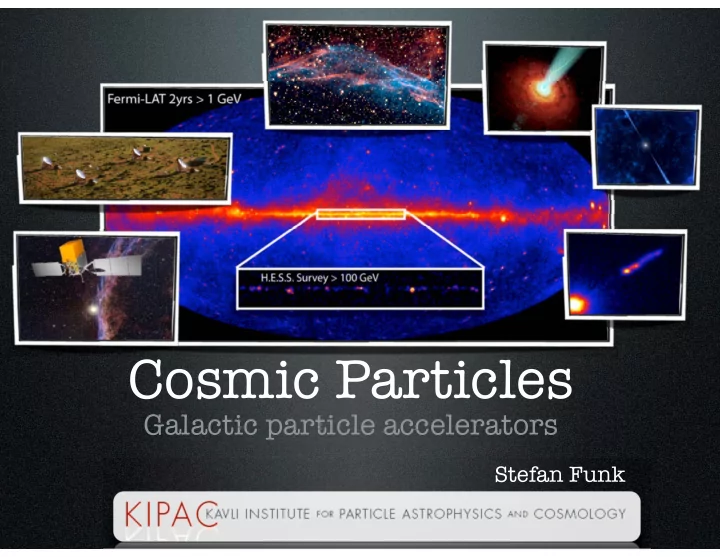
slide-2
SLIDE 2

My personal motivation

  • Cosmic particle acceleration and

Dark Matter searches

slide-3
SLIDE 3

Electrons and positrons

slide-4
SLIDE 4

Electrons and Positrons

slide-5
SLIDE 5
  • Possibility to detect DM signatures both

in gamma-rays and in charged particles

H.E.S.S. Fermi-LAT

Secondary Production

The highest-cited Fermi-LAT science paper

slide-6
SLIDE 6

Separate positrons

Adriani et al. 2009

Model for secondaries

slide-7
SLIDE 7

Separating Positrons with Fermi-LAT

7 Fermi LAT Collaboration, Ackermann et al. 2011, PRL 108, 011103

slide-8
SLIDE 8

Fermi LAT Collaboration, Ackermann et al. 2011, PRL 108, 011103

32-40 GeV e+ 32-40 GeV e- 63-80 GeV e+e- 63-80 GeV e+ 63-80 GeV e- 32-40 GeV e+e-

Separating Positrons with Fermi-LAT

slide-9
SLIDE 9

9 Fermi LAT Collaboration, Ackermann et al. 2011, PRL 108, 011103

Separating Positrons with Fermi-LAT

slide-10
SLIDE 10

Possible sources

  • Dark Matter,

Pulsars, SNRs, ...

Pulsar Wind Nebulae WIMPs

E.g. Grasso et al., 2011 E.g. Blasi 2009

Supernova remnants

E.g. Yüksel et al., 2009

slide-11
SLIDE 11

e+ e- + e+ γ

Lepto-Philic models

  • Mostly ruled out by now ...

Meade et al. 2010

DM→e+e- DM→μ+μ- DM→τ+τ-

slide-12
SLIDE 12

Pulsar Wind Nebulae

slide-13
SLIDE 13
slide-14
SLIDE 14
slide-15
SLIDE 15
slide-16
SLIDE 16

Crab Nebula Chandra X-ray

  • F. D. Seward, W. H. Tucker, R. A. Fesen

Pulsed emission from pulsar magnetosphere Steady emission from extended electron nebula

slide-17
SLIDE 17

The Crab Nebula

  • Measure falling tail of synchrotron and rising tail of IC emission
  • Emission not resolved by Fermi - need instruments such as

Chandra, Hubble, ...

Chandra X-rays Fermi-LAT γ-rays

0.1° 15°

slide-18
SLIDE 18

The Crab Nebula

  • Measure falling tail of synchrotron and rising tail of IC emission
  • Emission not resolved by Fermi - need instruments such as

Chandra, Hubble, ...

Chandra X-rays Fermi-LAT γ-rays

0.1° 15°

slide-19
SLIDE 19

Fermi LAT, R. Buehler

slide-20
SLIDE 20

Synchrotron part light-curve

  • Three major flares since start of the mission (one

additional observed by AGILE)

  • During April flare: Crab Nebula brightest source on

the GeV gamma-ray sky (!)

slide-21
SLIDE 21

Fermi LAT, R. Buehler

slide-22
SLIDE 22

Fermi LAT, R. Buehler

slide-23
SLIDE 23

Fermi LAT, R. Buehler

similar flares predicted in 100 TeV range might be detectable with HAWC or CTA

slide-24
SLIDE 24
slide-25
SLIDE 25

Escape from Vela X

  • Vela SNR
  • Very nearby

(290 pc) supernova explosion 10,000 years ago

Optical

slide-26
SLIDE 26

Escape from Vela X

  • Vela SNR
  • Very nearby

(290 pc) supernova explosion 10,000 years ago

Optical

slide-27
SLIDE 27

Radio contours HESS colour scale

(HESS Coll. 2012)

Escape from Vela X

  • Vela SNR
  • Very nearby

(290 pc) supernova explosion 10,000 years ago

Optical

slide-28
SLIDE 28
  • Model which

matches the GeV-TeV gamma-ray spectrum

  • Predicts

contribution to local CR electron spectrum

Escape from Vela X

slide-29
SLIDE 29
  • Model which matches the

GeV-TeV gamma-ray spectrum

  • Predicts contribution

to local CR electron spectrum

  • CTA will
  • A) beautifully measure

gamma-ray emission, morphology, spectrum

  • B) measure the

electrons lost from Vela X arriving at the Earth (diffuse)

Escape from Vela X

CTA 1 year sensitivity (prelim.) Dan Parsons

slide-30
SLIDE 30

Supernova remnants

slide-31
SLIDE 31

Supernova remnants

Cas A W51C W44 IC 443

slide-32
SLIDE 32

The General Idea

Molecular Cloud Molecular Cloud Evolved massive star (about to die?)

slide-33
SLIDE 33

The General Idea

Molecular Cloud Molecular Cloud Evolved massive star (about to die?) gamma-rays

SNR shock

slide-34
SLIDE 34

The π0-decay bump

  • Neutral pion-decay: in the

rest-frame of the pion, the two γ rays have 67.5 MeV each (i.e. a line)

  • Transforming into the lab-

frame smears the line but keeps it symmetric about 67.5 MeV (in dN/dE)

  • Transforming to E2 dN/dE

destroys symmetry and generates the “bump”

Stecker, 1971 67.5 MeV dN/dE Dermer, 1986

slide-35
SLIDE 35
  • The only smoking gun feature beyond neutrinos

Proton (momentum) powerlaw index Gamma Flux

The π0-decay bump

slide-36
SLIDE 36

Earlier observations

  • Seen with EGRET in the

Galactic diffuse

  • AGILE detection of drop in γ-ray

emission in W44

  • Earlier Fermi-LAT analyses

started at 200 MeV (rapidly changing effective area)

Giuliani et al., 2011

IC 443 W44

slide-37
SLIDE 37

The best candidates

  • IC 443 and W44 are the two brightest

SNRs in the Fermi-LAT range

IC 443 W44

slide-38
SLIDE 38

Clear detection of pion-bump

  • Clear indication of a low-energy “turnover”

Preliminary

IC 443 W44

Envelope of 8 Galprop diffuse models

slide-39
SLIDE 39

Clear detection of pion-bump

  • Turnover matches what is expected from pion-decay
  • Best-fit Bremsstrahlung model shows less steep

decline

IC 443 W44

Bremsstrahlung π0-decay

slide-40
SLIDE 40

Ruling out leptonic scenarios

  • Inverse Compton scenario: energetically completely disfavored (need

factor 100 higher radiation fields). Also shape not consistent with IC

  • Bremsstrahlung (solid): adjust B-field, total number of electrons and

density to match observed emission. Spectra < 200 MeV inconsistent.

  • Mixed model: Ratio electrons/protons: Kep= 0.01 (dN/dp @ p=1GeVc-1)

IC 443 W44

Bremsstrahlung π0-decay Mixed

slide-41
SLIDE 41

Resulting Proton spectrum

  • s1 = 2.36±0.05, s2 = 3.1±0.1 (3.5±0.1) pbr =239±74 (22±8) GeV c-1 (for IC 443)
  • Below the break: proton spectrum softer than electron spectrum (s1,e = 1.72)
  • Reason for high-energy break not fully understood
  • CR efficiency 1-4%. Strongly depends on assumed density

Preliminary

slide-42
SLIDE 42

Summary

  • Whatever your interest in the high-energy sky,

you have to understand particle acceleration - this is the prevalent signal

  • Foreground for Dark Matter studies
  • Can study the acceleration of Cosmic ray

(protons and electrons) in astrophysical sources

  • VERITAS, CTA, IceCube, and HAWC are expected

to make significant progress on these issues in the next decade.