Liquid metal vapour shielding in linear plasma devices T.W. Morgan 1 - - PowerPoint PPT Presentation

โ–ถ
liquid metal vapour shielding in linear plasma devices
SMART_READER_LITE
LIVE PREVIEW

Liquid metal vapour shielding in linear plasma devices T.W. Morgan 1 - - PowerPoint PPT Presentation

Liquid metal vapour shielding in linear plasma devices T.W. Morgan 1 , G.G. van Eden 1 , P. Rindt 2 , V. Kvon 1 , D. U. B. Aussems 1 , M. A. van den Berg 1 , K. Bystrov 1 , N.J. Lopes Cardozo 2 and M. C. M. van de Sanden 1 1 Dutch Institute for


slide-1
SLIDE 1

IAEA VS Meeting | 19-20th March 2018 | T.W. Morgan 1/28 LM VS in linear plasma devices

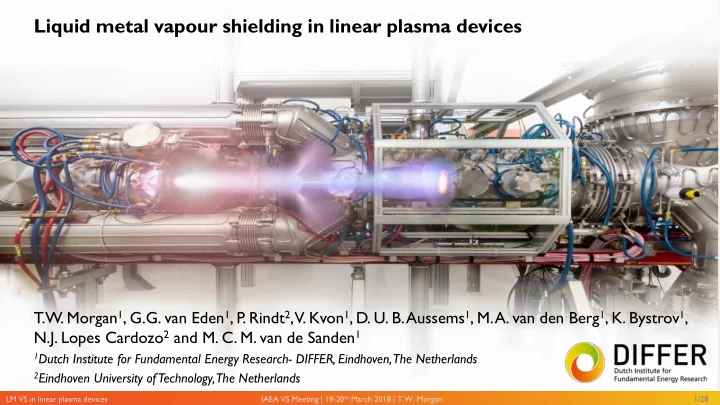
Liquid metal vapour shielding in linear plasma devices

T.W. Morgan1, G.G. van Eden1, P. Rindt2, V. Kvon1, D. U. B. Aussems1, M. A. van den Berg1, K. Bystrov1, N.J. Lopes Cardozo2 and M. C. M. van de Sanden1

1Dutch Institute for Fundamental Energy Research- DIFFER, Eindhoven, The Netherlands 2Eindhoven University of Technology, The Netherlands

slide-2
SLIDE 2

IAEA VS Meeting | 19-20th March 2018 | T.W. Morgan 2/28 LM VS in linear plasma devices

Going from ITER to DEMO involves large jumps in several parameters

  • Timescales/fluence much larger
  • Neutron loading much higher
  • Narrow path to avoid excessive

exhaust power

Property ITER DEMO1 Pulse length ~400 s ~7200 s Duty cycle <2% 60-70% Neutron load 0.05 dpa/yr 1-9 dpa/yr Exhaust power 150 MW 500 MW Divertor area ~4 m2 ~6 m2 Radiated power 80% 97%

Courtesy G. Matthews

slide-3
SLIDE 3

IAEA VS Meeting | 19-20th March 2018 | T.W. Morgan 3/28 LM VS in linear plasma devices

Limiting factors for W in DEMO

High heat/particles

Erosion For 5 mm W lifetime ~2 years1

Thermal shock/fatigue

Cracking (small ELM-like loading)2 Progressive deterioration3

Big ELMs/VDEs/disruptions

Melting- irreversible damage Runaway failure?

Neutrons

Transmutation, H+He creation, defects Smaller operational temperature window Increased brittleness

1Maissonier NF 2007 2Linke NF 2011 3Loewenhoff FED 2012

slide-4
SLIDE 4

IAEA VS Meeting | 19-20th March 2018 | T.W. Morgan 4/28 LM VS in linear plasma devices

Capillary porous structures (CPSs) create conduction based stabilized PFCs

Evtikhin 1999

  • Replace solid surface with liquid
  • MHD forces (jxB) destabilize liquids in

tokamaks (droplets)

  • Use surface tension/capillary refilling
  • Replace top region with this combined

material

W monoblock Coolant pipe Coolant Thin CPS layer Capillary supply to surface LM reservoir

slide-5
SLIDE 5

IAEA VS Meeting | 19-20th March 2018 | T.W. Morgan 5/28 LM VS in linear plasma devices

Benefits of liquid metals for DEMO

Sputtering

Self replenishment Higher heat fluxes (see later)

Thermal shock/fatigue

No cracking Lowered stresses substrate ELMs possible(?)

Big ELMs/VDEs/disruptions

Already molten Vapour protection

Neutrons

Only influences substrate Separation of PSI from neutron issue

slide-6
SLIDE 6

IAEA VS Meeting | 19-20th March 2018 | T.W. Morgan 6/28 LM VS in linear plasma devices

Material options of Li, Sn both have strengths and weaknesses

Lithium Tin/Ga Low Z Higher Z High vapour pressure Lower vapour pressure High T retention Lower T retention

Allain and Taylor PoP (2012) Wesson, Tokamaks (2004) Choices once cost, availability, activation etc. taken into account

slide-7
SLIDE 7

IAEA VS Meeting | 19-20th March 2018 | T.W. Morgan 7/28 LM VS in linear plasma devices

Magnum-PSI/Pilot-PSI utility for LM study due to DEMO relevant heat/particle loading

slide-8
SLIDE 8

IAEA VS Meeting | 19-20th March 2018 | T.W. Morgan 8/28 LM VS in linear plasma devices

Linear devices have good flexibility and diagnostic access for basic physics and test module studies

Plasma source Superconducting magnetic field coil Diagnostic ports through coil Rotatable/tiltable target holder Plasma beam Skimmer plates (differentially pumped chambers) Water cooled vacuum vessel

slide-9
SLIDE 9

IAEA VS Meeting | 19-20th March 2018 | T.W. Morgan 9/28 LM VS in linear plasma devices

Linear devices have good flexibility and diagnostic access for basic and test module studies

slide-10
SLIDE 10

IAEA VS Meeting | 19-20th March 2018 | T.W. Morgan 10/28 LM VS in linear plasma devices

Vapour shielding: additional loss channels for heat flux (impurity stimulated โ€œdetachmentโ€)

๐‘Ÿ๐‘ž๐‘š๐‘๐‘ก๐‘›๐‘ = ๐‘Ÿ๐‘‘๐‘๐‘œ๐‘’ + ๐‘Ÿ๐‘“๐‘ค๐‘๐‘ž + ๐‘Ÿ๐‘ ๐‘๐‘’ + ๐‘Ÿ๐‘›๐‘๐‘ก๐‘ก ๐‘Ÿ๐‘ž๐‘š๐‘๐‘ก๐‘›๐‘ = ๐‘Ÿ๐‘‘๐‘๐‘œ๐‘’ Solid metal: Liquid metal:

slide-11
SLIDE 11

IAEA VS Meeting | 19-20th March 2018 | T.W. Morgan 11/28 LM VS in linear plasma devices

Experiment compared performance of Sn CPS with solid Mo reference targets

n.b. Deliberately poorly cooled to reach VS temperature regime

Ion species T

e

(eV) ne (1020 m-3) Qref (MW m-2) H or He 0.4-3.1 0.6-7.0 0.47-22

slide-12
SLIDE 12

IAEA VS Meeting | 19-20th March 2018 | T.W. Morgan 12/28 LM VS in linear plasma devices

Vapour interaction with plasma decouples input power from surface temperature

van Eden PRL 2016

Poorly cooled Sn samples exposed to power load series in pilot-PSI

Temperature rise cut off Temperature locked through shot

Tsurf at target centre

slide-13
SLIDE 13

IAEA VS Meeting | 19-20th March 2018 | T.W. Morgan 13/28 LM VS in linear plasma devices

T emperature locking when vapour pressure and plasma pressure ~ matches

Plasma pressure vs vapour pressure Equilibrium Tsurf at target centre

slide-14
SLIDE 14

IAEA VS Meeting | 19-20th March 2018 | T.W. Morgan 14/28 LM VS in linear plasma devices

Overall reduction in power to cooling water of ~one third

Evaporation alone cannot explain energy loss: relatively high re-deposition rate means most energy returns to surface

slide-15
SLIDE 15

IAEA VS Meeting | 19-20th March 2018 | T.W. Morgan 15/28 LM VS in linear plasma devices

Strong recombination occurs due to lowered T

e

Te Sn shots vs Mo shots Atomic/Molecular processes

slide-16
SLIDE 16

IAEA VS Meeting | 19-20th March 2018 | T.W. Morgan 16/28 LM VS in linear plasma devices

Oscillatory self-regulatory behaviour is observed: dynamical equilibrium

REPEAT

slide-17
SLIDE 17

IAEA VS Meeting | 19-20th March 2018 | T.W. Morgan 17/28 LM VS in linear plasma devices

Shielding behaviour is oscillatory in nature

Tsurf centre and edge

  • Vapour cloud size and emission

correlated to surface temperature

  • ๐‘’๐‘›๐‘”๐‘ž โˆ

1 ๐œ๐‘œ๐‘“ ๏ƒ  dmfp โ†‘;

T

e and/or ne โ†“

slide-18
SLIDE 18

IAEA VS Meeting | 19-20th March 2018 | T.W. Morgan 18/28 LM VS in linear plasma devices

Oscillations in floating target potential indication of T

e variations

slide-19
SLIDE 19

IAEA VS Meeting | 19-20th March 2018 | T.W. Morgan 19/28 LM VS in linear plasma devices

Oscillation in continuum emission โ€“ a sign of ne variation

  • Continuum emission increasing

throughout cycle. ne increases by factor 4

  • Increased mean free path of Sn neutrals

thus explained by reduced collision rate due to lower T

e

  • Plasma pressure still ~conserved. (โˆ

neTe)

slide-20
SLIDE 20

IAEA VS Meeting | 19-20th March 2018 | T.W. Morgan 20/28 LM VS in linear plasma devices

Cyclical equilibrium leads to dynamic locking of temperature at pressure balance point

  • Detachment timescale: ฯ„ie=ฯ„ei= ฯ„e mHe

/2me โ‰ˆ 0.2 ยตs (at 0.8 eV and ne =1020 m-3)

  • Vapour extinction timescale: ฯ„v =

dax/ (2 ๐‘™๐ถ ๐‘ˆ๐‘ก๐‘ฃ๐‘ ๐‘”)/๐‘› โ‰ˆ 16 ยตs

  • Cooling timescale: Tsurf = (T0 - Tcool)

๐‘“โˆ’๐‘ข/ฯ„๐‘‘ โ†’ ฯ„c โ‰ˆ 250 ยตs

  • Oscillation freq. (~10 Hz) set by

thermal equilibrium timescale

slide-21
SLIDE 21

IAEA VS Meeting | 19-20th March 2018 | T.W. Morgan 21/28 LM VS in linear plasma devices

Increased (visual) emission near Li CPS target compared to solid reference

Applied conditions: 150 A, 14 slm He, 0.8 T ๏ƒ  11.4 MW m-2

Li CPS Mo reference:

slide-22
SLIDE 22

IAEA VS Meeting | 19-20th March 2018 | T.W. Morgan 22/28 LM VS in linear plasma devices

T echnological challenge- performance on long timescales via surface replenishment

Component similar to and designed to test design for NSTX-U

Rindt FED 2016

slide-23
SLIDE 23

IAEA VS Meeting | 19-20th March 2018 | T.W. Morgan 23/28 LM VS in linear plasma devices

Similar vapour shielding effect observed for Li as for Sn

  • scillations

Temperature cut off

Heat flux (MW m-2) Time (s) 8

  • High heat load can be sustained (8 MW m-2

peak heat load)

  • Sn vapour limit is ~1700 ยฐC (Pvap~3Pplasma)
  • Prediction for Li is therefore ~700-900 ยฐC
  • Prediction well matched by observation
  • Similar oscillatory behaviour as for Sn
slide-24
SLIDE 24

IAEA VS Meeting | 19-20th March 2018 | T.W. Morgan 24/28 LM VS in linear plasma devices

Analytical description of VS mechanism

๐‘น๐’’๐’Ž๐’ƒ๐’•๐’๐’ƒ = ๐‘๐๐ฉ๐จ๐ž(๐‘ˆ๐‘ก๐‘ฃ๐‘ ๐‘”) + ๐šซ

๐Œ๐ฃ๐ฎ๐ข๐ฃ๐ฏ๐ง ๐Œ๐ฉ๐ญ๐ญ ๐‘ˆ๐‘ก๐‘ฃ๐‘ ๐‘”, ๐‘† โˆ™ ๐›co๐ฉ๐ฆ Heat conducted through target. ๐›๐๐ฉ๐ฉ๐ฆ =? Net lithium loss rate. Power dissipated by lost Li. Limited by available supply

slide-25
SLIDE 25

IAEA VS Meeting | 19-20th March 2018 | T.W. Morgan 25/28 LM VS in linear plasma devices

Lithium energy dissipation through ionization and radiation

Calculated from collisional radiative modeling in: Goldston et al., Nuclear Materials and Energy, 2017.

Dissipated energy per particle

๐‘๐’…๐’‘๐’‘๐’Ž [๐’‡๐‘พ] ๐‘ผ๐’‡ [๐’‡๐‘พ]

slide-26
SLIDE 26

IAEA VS Meeting | 19-20th March 2018 | T.W. Morgan 26/28 LM VS in linear plasma devices

A temperature plateau occurs when dissipation via Li becomes dominant.

deposited power surface temperature

~10 MW/m2 ~800 oC

Li dissipated regime

conductive regime

Tungsten substrate melting, 3422 oC

slide-27
SLIDE 27

IAEA VS Meeting | 19-20th March 2018 | T.W. Morgan 27/28 LM VS in linear plasma devices

FEM shows good agreement with experiment

Time [s] Temperature [oC] bare molybdenum lithium Temperature plateau when Li dissipation becomes significant.

slide-28
SLIDE 28

IAEA VS Meeting | 19-20th March 2018 | T.W. Morgan 28/28 LM VS in linear plasma devices

Benefit for DEMO of vapour shielding

  • Decouples incoming heat load from surface

temperature and reduces cooling requirements

  • Maximum impurity influx ~fixed
  • For Sn adds protection for off-normal events:

adds robustness and is more forgiving

  • For Li constant operation could be possible
slide-29
SLIDE 29

IAEA VS Meeting | 19-20th March 2018 | T.W. Morgan 29/28 LM VS in linear plasma devices

Requirements for atomic physics modelling of VS

  • cross sections for electron impact ionization

and excitation for Sn (~0 - 5+)

  • Improved low charge state modelling?
  • cross sections for CX between Sn0 or Li0 and

H+ or He+

  • cross sections for momentum exchange

between neutrals and ions (e.g. Sn0 and H+)

  • Lz curves for Sn
slide-30
SLIDE 30

IAEA VS Meeting | 19-20th March 2018 | T.W. Morgan 30/28 LM VS in linear plasma devices

EXTRA SLIDES

slide-31
SLIDE 31

IAEA VS Meeting | 19-20th March 2018 | T.W. Morgan 31/28 LM VS in linear plasma devices

  • PFC design for DEMO unresolved issue
  • LM-based PFC is a promising solution
  • Can tolerate same/higher heat load than W-only PFC
  • Possible to operate at high power handling while staying

below core impurity limits

  • VS and replenishment means more robust and forgiving

against off-normal events

  • Physics rich and can be counter-intuitive
  • VS, enhanced redeposition, radiative interactionsโ€ฆ
  • Further engineering and physics required to reach

maturity Conclusions

slide-32
SLIDE 32

IAEA VS Meeting | 19-20th March 2018 | T.W. Morgan 32/28 LM VS in linear plasma devices

The heat exhaust challenge

B

Divertor

10MW.m-2 steady-state 1024 m-2s-1 (105A.m-2) Heat Particles

Low temperature (~10,000 ยฐC) High density (1/10,000 of an atmosphere)

  • A. Kukushkin, POP/DPWI

Temperature Density

slide-33
SLIDE 33

IAEA VS Meeting | 19-20th March 2018 | T.W. Morgan 33/28 LM VS in linear plasma devices

Power handling limit set by tolerable impurity concentration in core

ฮ“๐‘—๐‘›๐‘ž ๐‘œ๐‘“๐‘ข = ๐‘”๐‘Š ๐‘œ๐‘“ ๐ต๐‘’๐‘—๐‘ค๐œ๐‘ž

ฮ“๐‘—๐‘›๐‘ž ๐‘œ๐‘“๐‘ข ฮ“๐‘—๐‘œ ? Redeposited fraction

Li Sn Wesson, Tokamaks (2004)

? Fraction going to core

slide-34
SLIDE 34

IAEA VS Meeting | 19-20th March 2018 | T.W. Morgan 34/28 LM VS in linear plasma devices

Experiments carried out in Magnum-PSI to study re-deposition rate directly

Measure mass loss (mass balance)

Sample Flux (x1023m-2s-1) Cu1 0.3 Cu2 1.0 Cu3 5.7 Cu4 8.5

Measure mass gain (QMB) Ar+

  • 50

V Tsurf<200 ยฐC 45ยฐ

slide-35
SLIDE 35

IAEA VS Meeting | 19-20th March 2018 | T.W. Morgan 35/28 LM VS in linear plasma devices

Mass loss rate goes down as a function of flux

slide-36
SLIDE 36

IAEA VS Meeting | 19-20th March 2018 | T.W. Morgan 36/28 LM VS in linear plasma devices

Re-deposition rate strongly increases with flux, approaches 99.9%

1 โˆ’ ๐‘† = ฮ“0 ฮ“0 + ฮ“ ฮ“0 = 1.4 ยฑ 0.3 ร— 1021 m-2 s-1 โˆ†๐‘›loss

e

= เถฑ

๐‘ max

2๐œŒ๐‘  ๐‘(๐นion, ๐‘—, ๐‘จ) โˆ— ๐‘z โˆ— ฮ“i ๐‘  ๐‘ข d๐‘ 

slide-37
SLIDE 37

IAEA VS Meeting | 19-20th March 2018 | T.W. Morgan 37/28 LM VS in linear plasma devices

Mechanisms for strong redeposition

  • Ionization rates negligible at these

temperatures (<2 eV)

  • Ion-neutral friction (and potentially

CX) dominant with ฮปmfp of a few mm (high ne >1020 m-3)

  • Particles promptly entrained in

magnetized plasma and redirected to surface

  • Such high density/flux plasma

expected in DEMO divertor at strikepoints

+ + + + + + + +

slide-38
SLIDE 38

IAEA VS Meeting | 19-20th March 2018 | T.W. Morgan 38/28 LM VS in linear plasma devices

Influences maximum evaporation rate and therefore upper limit of temperature window

Li Sn

*Interaction of Li and D increases surface binding energy and can increase operational temperature further (Abrams NF 2015)

Increase upper limit Li to ~700 ยฐ C* Increase upper limit Sn to ~1250 ยฐC

slide-39
SLIDE 39

IAEA VS Meeting | 19-20th March 2018 | T.W. Morgan 39/28 LM VS in linear plasma devices

What is the power handling capability of liquid metals?

  • 1. Overall temperature window
  • 2. Power handling limits

3. Vapour shielding

  • Sn
  • Li
slide-40
SLIDE 40

IAEA VS Meeting | 19-20th March 2018 | T.W. Morgan 40/28 LM VS in linear plasma devices

Finite element modelling can give estimate for power handling capability LMs

  • Studies in Pilot-PSI demonstrated how to treat

CPS as mixed material thermally1

  • Modify existing DEMO designs2 and use 3D FE

modelling to determine max power load

  • Determined from temperature limits of each

component

1Morgan NME (2017) 2Li-Puma FED (2013)

Material Limit Tmax W Recrystallization 1250 ยฐC Sn Evaporation (90% Redeposition) 1000 ยฐC Cu/CuCrZr Softening 300 ยฐC EUROFER Softening 700 ยฐC

slide-41
SLIDE 41

IAEA VS Meeting | 19-20th March 2018 | T.W. Morgan 41/28 LM VS in linear plasma devices

Different designs modelled to scope possibilities and limitations

3.5 mm W 1 mm Cu 1 mm CuCrZr 200 ยฐC water 1 mm CPS 2.5 mm W 1 mm Cu 1 mm CuCrZr 200 ยฐC water 0.5 mm CPS 1 mm W 1 mm Cu 1 mm CuCrZr 200 ยฐC water 1.1 mm CPS 0.42 mm EUROFER 325 ยฐC water

20 20 21

DEMO Original

21

CPS added

16 16

Shrunken

9 9

All CPS + EUROFER

slide-42
SLIDE 42

IAEA VS Meeting | 19-20th March 2018 | T.W. Morgan 42/28 LM VS in linear plasma devices

Results show comparable/improved performance with additional advantages possible

qmax~18 MW m-2 Lim: CuCrZr qmax~15 MW m-2 Lim: Sn qmax~20 MW m-2 Lim: CuCrZr qmax~15 MW m-2 Lim: Sn

  • Minimum

modification

  • Increased

power handling

  • Eliminate

CuCrZr

  • No interlayer
  • Low stresses

20 21

DEMO Original

21

CPS added

16 16

Shrunken

9 9

All CPS + EUROFER

slide-43
SLIDE 43

IAEA VS Meeting | 19-20th March 2018 | T.W. Morgan 43/28 LM VS in linear plasma devices

What is the power handling capability of liquid metals?

  • 1. Overall temperature window
  • 2. Power handling limits
  • 3. Vapour shielding
  • Sn
  • Li