Recent Trends and Critical Issues for Assessment of Vapour Intrusion Pathway
- Dr. Ian Hers
Golder Associates Ltd.
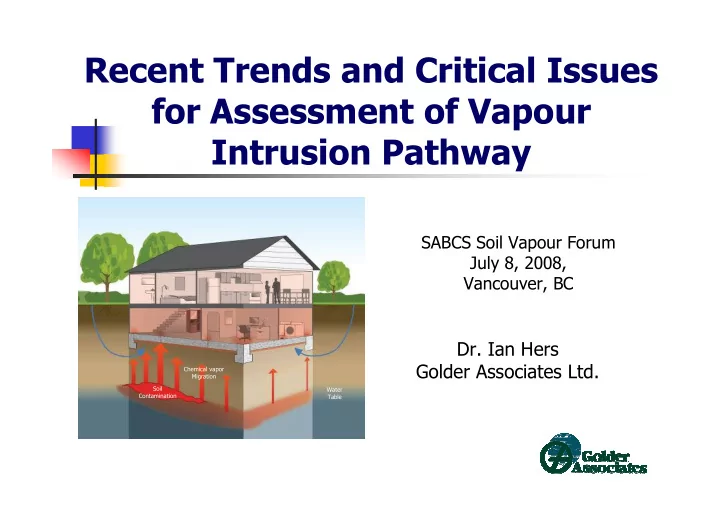
Soil Contamination Water Table Chemical vapor Migration
SABCS Soil Vapour Forum July 8, 2008, Vancouver, BC
Recent Trends and Critical Issues for Assessment of Vapour - - PowerPoint PPT Presentation
Recent Trends and Critical Issues for Assessment of Vapour Intrusion Pathway SABCS Soil Vapour Forum July 8, 2008, Vancouver, BC Dr. Ian Hers Golder Associates Ltd. Chemical vapor Migration Soil Water Contamination Table Assessment
Golder Associates Ltd.
Soil Contamination Water Table Chemical vapor Migration
SABCS Soil Vapour Forum July 8, 2008, Vancouver, BC
GOLDER ASSOCIATES
GOLDER ASSOCIATES
NAPL Source Fresh-water lens (non- contaminated groundwater)
Capillary Transition Zone
GOLDER ASSOCIATES
Vapor intrusion (VI) is a potential exposure pathway at
Perception and potential for breathing “toxic” vapours
Increasing number of sites with demonstrated VI
VI has caught the attention of regulators, lawyers and
GOLDER ASSOCIATES
Johnson & Ettinger Model (1991) [The beginning of the end…] Johnson & Ettinger Model (1991) [The beginning of the end…] Early Guidance (1990’s)
(MA 1992, ASTM E-1739 1995, CCME 2000 [Limited knowledge of pathway…]
Early Guidance (1990’s)
(MA 1992, ASTM E-1739 1995, CCME 2000 [Limited knowledge of pathway…]
Experience (~ 2000 on)
(“Colorado” Sites, Endicott, NY)
[We need to take this pathway seriously …]
Experience (~ 2000 on)
(“Colorado” Sites, Endicott, NY)
[We need to take this pathway seriously …]
Recent Guidance (2005 on)
(USEPA 2002, Health Canada 2004, CA 2005, NJ 2005, ITRC 2007, ASTM 2008?)
[Hmmm…Lot of different approaches]
Recent Guidance (2005 on)
(USEPA 2002, Health Canada 2004, CA 2005, NJ 2005, ITRC 2007, ASTM 2008?)
[Hmmm…Lot of different approaches]
Early IAQ Concerns (1970’s & early 1980’s) (VOCs as Carcinogens) Early IAQ Concerns (1970’s & early 1980’s) (VOCs as Carcinogens) Early Experience (1980’s)
(Love Canal, 1985; Hillside MA School 1989)
Early Experience (1980’s)
(Love Canal, 1985; Hillside MA School 1989)
GOLDER ASSOCIATES
Many chlorinated solvent sites with significant VI
Large degree spatial variability in groundwater
Significant VI impacts for range of building types
USEPA VI database has contributed significant
GOLDER ASSOCIATES
(proposed alpha)
1.E-07 1.E-06 1.E-05 1.E-04 1.E-03 1.E-02 3 6 9 12 15
Depth to Vapor Source below Foundation (m) Alpha
Alliant - 11 DCE - C Bay Area 1 - TCE - L Bay Area 2 - TCE - L CDOT - TCE, 111 TCA, 11 DCE - SI Davis - TCE, cis-12-DCE - S Eau Claire - TCE - S Hamilton Sunstrand - 11 DCE - S&G Hopewell Precision - TCE - S&G LAFB - TCE & 11DCE - LS Lockwood - TCE & PCE - L MADEP 1 TCE - S MADEP 2 TCE - S Mountain View TCE - LS Redfields 11 DCE - S to SI Twins Inn TCE,cis-DCE,11 DCE - S Uncasville PCE - S Harcros-Tri State PCE - S Site 1 TCE - S&G Endicott TCE S&G Wall Township PCE - S Sand (Coarse-grained) Loamy Sand Sandy Loam Loam (Fine-grained)
Light Blue = Sand & gravel = 1.5E-4 Red = Loam = 3.8E-5 Dark Blue = Sand = 7.7E-5 Green = Clay a = 7.1E-6 Orange = Loamy Sand = 1.6E-5 Median alphas provided
GOLDER ASSOCIATES
0% 10% 20% 30% 40% 50% 60% 70% 80% 90% 100% 1.0E-06 1.0E-05 1.0E-04 1.0E-03
Attenuation Factor Cumulative Percent Singe Point Alphas Average Alpha Geomean Alpha
1.E-07 1.E-06 1.E-05 1.E-04 1.E-03 Mar-97 Jul-98 Dec-99 Apr-01 Sep-02 Jan-04 May-05 Oct-06
Sample Date Attenuation Factor
H1 H2 H3 H4 H5
GOLDER ASSOCIATES
Groundwater Alpha - Residential & Commercial - All Data
1.E-07 1.E-06 1.E-05 1.E-04 1.E-03 1.E-02 1.E-01 1.E+00 1.E+00 1.E+01 1.E+02 1.E+03 1.E+04 1.E+05 1.E+06 1.E+07
Predicted vapor conc. from groundwater (ug/m3) Groundwater-Air Alpha
TCE PCE 1,1-DCE 1,1,1-TCA Benzene Ethylbenzene Toluene Xylenes 100 ug/m3 10 ug/m3 1 ug/m3
Normalized Groundwater Alpha - Residential & Commercial - All Data
1.E-07 1.E-06 1.E-05 1.E-04 1.E-03 1.E-02 1.E-01 1.E+00 1.E+00 1.E+01 1.E+02 1.E+03 1.E+04 1.E+05 1.E+06 1.E+07 1.E+08
Predicted Vapor Conc. from Groundwater/ 90th Background (ug/m3) Groundwwater-air AF
TCE PCE 1,1-DCE 1,1,1-TCA Benzene Ethylbenzene Toluene Xylenes
Filter all other chemicals Filter TCE
GOLDER ASSOCIATES
1.E-06 1.E-05 1.E-04 1.E-03 1.E-02 1.E-01 1.E+00 2 4 6 8 10
Distance building to vapour measurement (m) Soil Vapour Alpha
Soil vapour chlorinated solvent Soil vapour PHC Subslab vapour Sand (coarse-grained) Loamy Sand Sandy Loam Loam (fine-grained)
Subslab Data (417 points, filtered from 1549)
Most of this data couldn't be distinguished from background
Chlorinated solvents
BTEX (support lower alpha factor)
GOLDER ASSOCIATES
Soil Vapor Alpha - Residential- Chlorinated Solvent - Filtered
1.E-06 1.E-05 1.E-04 1.E-03 1.E-02 1.E-01
1.E+02 1.E+03 1.E+04 1.E+05 1.E+06 Measured vapor conc. (ug/m3)
Alpha
Jackson PCE - LS MADEP1 TCE - S Mountainview TCE - LS Uncasville PCE - S Harcros-Tri States PCE - S Grants PCE and TCE - S Site 1 TCE - S&G Raymark 11 DCE - S&G Endicott TCE - S&G
GOLDER ASSOCIATES
PCE in groundwater
Dry cleaners source of two large PCE
plumes (1.5 by 2 miles!), sand, depth to groundwater = 20’
Dry cleaners decommissioned prior to 1991 PCE detected in private wells 1997 Indoor air testing began 2001 Max indoor PCE concentration!: Residential
~ 2000 ug/m3, Commercial ~ 1500 ug/m3
GOLDER ASSOCIATES
LEGEND PCE concentration indoor air (ug/m3)
Max indoor PCE
concentration!: Residential houses ~ 2000 ug/m3, Commercial (1 building) ~ 1500 ug/m3
GOLDER ASSOCIATES
GOLDER ASSOCIATES
GOLDER ASSOCIATES
Intrusive, cost, temporal variability moderate to high, background issues Most direct indication (only for existing building) Air Intrusive, cost, small scale spatial variability can be high Closer to receptor, avoids lateral variability Subslab vapour Spatial variability moderate to high, temporal variability moderate, method issues Avoids partitioning, more direct indication exposure, may integrate sources External soil vapour Partitioning uncertain, not representative if unsaturated zone source Data may be available, low cost, moderate temporal variability Ground water Partitioning highly uncertain, high spatial variability Data may be available, low cost, low temporal variability Soil Con’s Pro’s Media
GOLDER ASSOCIATES
Golder Associates Ian Hers, 2004
GOLDER ASSOCIATES
1.E-02 1.E-01 1.E+00 1.E+01 1.E+02 1.E+03 1.E+04 1.E+05 1.E+06 1.E+07 1.E-02 1.E+00 1.E+02 1.E+04 1.E+06
Predicted F1 in Soil Vapour (mg/m 3) Measured F1 in Soil Vapour (mg/m3)
Difference depth soil gas & soil > 0.5 m Vm/Vp 50th = 2.1E-5, 90th = 3.6E-3 Difference depth soil gas & soil < 0.5 m Vm/Vp 50th = 9.3E-5, 90th = 7.4E-3 1:1 1:10 1:100
Approximate relationship between measured & predicted vapor
Key points:
GOLDER ASSOCIATES
More direct indication of potential exposure, can
Significant challenge is observed spatial and temporal
Capping effect of building
“Rain shadow” and drier soils below building “Oxygen limitations” leading to reduced biodegradation
Barometric pumping Influence of building (subslab fill, utilities, advection)
Deeper near source data least affected by variability
Poor sampling methods also a problem
GOLDER ASSOCIATES
Bill Wertz, NYDEC
Bill Wertz, NYDEC Courtesy Justin Deming, Bill Wertz, NYSDEC, EPA/AEHS Workshop March 2008
GOLDER ASSOCIATES
Bill Wertz, NYDEC
GOLDER ASSOCIATES
Y
2 4 6 8
0.0 0.1 0.2 0.3 0.4 0.5
0.22 . 2 6 . 3 0.34 0.3810 20 30 4
5 10
0.5 0.5 1.5 1.5 2.5 2.5 3.5 3.5 4.5 4.5 5.5 5.5 6.5 6.510 20 30 4
5 10
Depth (m)
Steady State ~ 3 yr Initial Condition
2 4 6 8
Ksat = 1.39E-04cm/sec FC = 0.235 Res.Sat=0.15
GOLDER ASSOCIATES
Courtesy Todd McAlary, AEHS/EPA Mar 08 Workshop
GOLDER ASSOCIATES
H-009 Sub-Slab Trends TCE 50 100 150 200 250 300
O N D J F M A M J J A S O N
ug/m3
Subslab A Subslab B Subslab C
GOLDER ASSOCIATES
Blayne Hartman, H&P Geochemistry
GOLDER ASSOCIATES
2 4 6 8 10 12 14 16 18 1.E+00 1.E+02 1.E+04 1.E+06
Benzene Vapor Concentration (mg/m3) Depth below ground (ft)
Below Building #1 Below Building #2 Below Building #3 Below Building #4 Adjacent Building #1 Adjacent Building #2
Building foundation depth
Subslab Beside
Paul Johnson, ASU, Paul Lundegard, Unocal and Paul Dahlen, Golder O2
10 8 6 4 2
Depth (ft)
5 10 15 20
Ci (%)
CH4 slab
GOLDER ASSOCIATES
Golder Associates Ian Hers, 2004
Diffusion most important, wind induced O2 recharge also important. Rainfall can affect recharge
Paul Johnson, ASU, Paul Lundegard, Unocal and Paul Dahlen, Golder
GOLDER ASSOCIATES
Golder Associates Ian Hers, 2004
GOLDER ASSOCIATES
Golder Associates Ian Hers, 2004
GOLDER ASSOCIATES
Golder Associates Ian Hers, 2004
GOLDER ASSOCIATES
Health Canada – tiered approach based on soil,
Alberta and Ontario – Tier 1 soil and
Draft USEPA 2002 OSWR VI Guidance – current
ITRC VI Guidance (2007) – multiple lines of
ASTM E2600 – Phase 1 screeening approach and
GOLDER ASSOCIATES
Preliminary Screening for
Secondary Screening using
Attenuation factor (AF) “alpha” curve approach for soil type and depth
Adjustments for:
Aerobic biodegradation (10X) Mass flux for groundwater Source depletion for soil Building properties
Tier 3 process? (not defined)
Vapour Intrusion Factors
1.E-05 1.E-04 1.E-03 1.E-02 10 20 30 Depth to Contamination (m) Vapor Attenuation Ratio Sand Loam
GOLDER ASSOCIATES
Media Contamination Criteria Bioattenuation Adjustment Factors (BAF) Groundwater Dissolved - Low Benzene < 0.1 mg/L F1 < 5 mg/L F2 < 1 mg/L 100X for Ds > 1 m Dissolved – High Benzene < 1 mg/L F1 < 15 mg/L F2 < 5 mg/L 10X for Ds > 1 m 100X for Ds > 3 m NAPL 10X for Ds > 5 m Soil Vapour Dissolved Cg < 1 mg/L 10X for Ds > 1 m 100X for Ds > 1 m, Dp < 1 m Transition dissolved & NAPL Cg > 1 mg/L Cg < 50 mg/L 10X for Ds > 2 m NAPL Cg > 50 mg/L 10X for Ds > 5 m Soil All 20X for Ds > 1 m
Note: BAFs may only be applied when there is no significant capping effect. Cg = BTEX + F1 + F2 + CH4 Ds = Separation distance between contamination source and building Dp = Distance from contamination to soil gas probe
GOLDER ASSOCIATES
Need better screening approach to categorize
No brainer – there is a problem Likely a problem – lets not think to much about it Grey zone – more assessment needed Not a problem – let’s move on (biodegradation critical
One size does not fit all, more flexibility needed in
GOLDER ASSOCIATES
Need to get a better handle on soil vapour spatial
Sampling and analysis tools and practice needs to
Updated surrogate approach for TPH Greater standardization for mitigation design Use of more sophisticated models
GOLDER ASSOCIATES
Often will not be able to see above the noise! (especially if some bioattenuation)
1.E-07 1.E-06 1.E-05 1.E-04 1.E-03 1.E-02 1.E-01 1.E+00 1.E+01 1.E+03 1.E+05 1.E+07 1.E+09 Source Vapor Concentration/Background Air Conc
Vapor-derived ("inherent")
High Source Strength Low Source Strength Empirical alpha Benzene Site Data
background / Cvapour source + inherent
ACC = 1.5 ug/m3 0.001
GOLDER ASSOCIATES
3-D Numerical Model (this is a slice through the house) Abreu & Johnson, ES&T, 2005
Building Vapors
What if you sample out here?
Oxygen
Slightly lower gasoline concentrations
GOLDER ASSOCIATES
Kwadahcha 1 2 3 4 5 6 7 8 500 1000 1500
TVOC Vapor Conc. (mg/m3)
Depth below ground (m) 5 10 15 20 O2 and CO2 (%)
TVOC O2 CO2
Kwadahcha 1 2 3 4 5 6 7 8
5 10 15 20
Vapor Conc. (mg/m3) Depth below ground (m) 5 10 15 20 O2 and CO2 (%)
Decane O2 CO2
Diesel NAPL above water table, sand and gravel,
Health Canada protocol requires minimum depth ½
PHC, O2, CO2, CH4 profiles helpful to evaluate biodegradation!
GOLDER ASSOCIATES
GOLDER ASSOCIATES
Golder Associates Ian Hers, 2004
Cs = 400 mg/m3 Cs = 1600 mg/m3
%
%
GOLDER ASSOCIATES
Similar or higher level of care than groundwater Preference small diameter probes Carefully seal boreholes Leak tracer tests to test seals and
GOLDER ASSOCIATES
Low flow (100-200 ml/min) and low vacuum (< 5
Vacuum chamber (lung box) sampling warranted in
Analytical methods
QC samples (equip-
GOLDER ASSOCIATES
GOLDER ASSOCIATES
Courtesy Todd McAlary, AEHS/EPA Mar 08 Workshop